
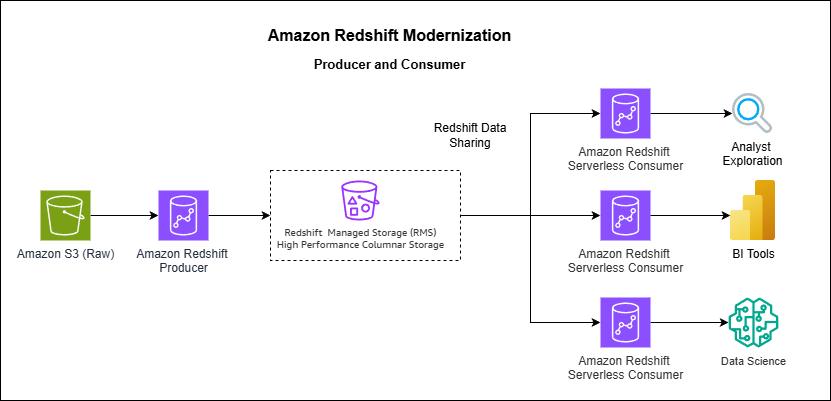
Organizations often create a second data pipeline simply because another team needs the same warehouse data.
The producer exports or copies tables.
The consumer loads them.
Both teams then maintain schedules, storage, reconciliation and support.
Amazon Redshift data sharing offers another option.
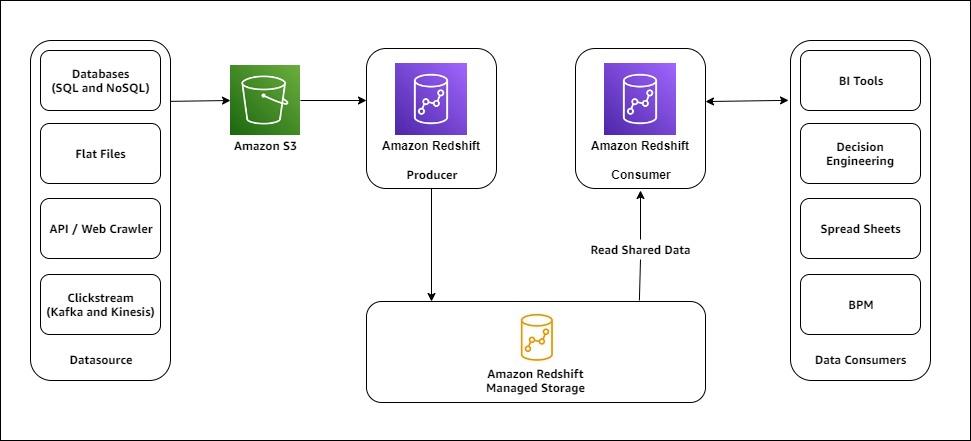
It allows Redshift producers to share live data with other Redshift consumers without manually copying or moving the underlying dataset for standard sharing scenarios.
This can simplify multi-team analytics significantly.
But data sharing is not a universal replacement for replication.
What Amazon Redshift Data Sharing Does
AWS describes Redshift data sharing as live access across Redshift data warehouses without manually copying or moving data.
Standard datashares can operate across provisioned clusters, Serverless workgroups, Availability Zones, AWS accounts and supported AWS Regions.
Providers can share objects at granular levels such as:
- Databases.
- Schemas.
- Tables.
- Views.
- Materialized views.
- SQL UDFs.
Consumers query shared data through their own Redshift compute.
Actiknow’s business intelligence and data engineering services include Redshift warehouse design, governed reporting and data integration. The right sharing pattern should minimize unnecessary pipelines while preserving clear ownership and security.
Data sharing separates data ownership from consumer compute.
A central producer can maintain trusted warehouse tables.
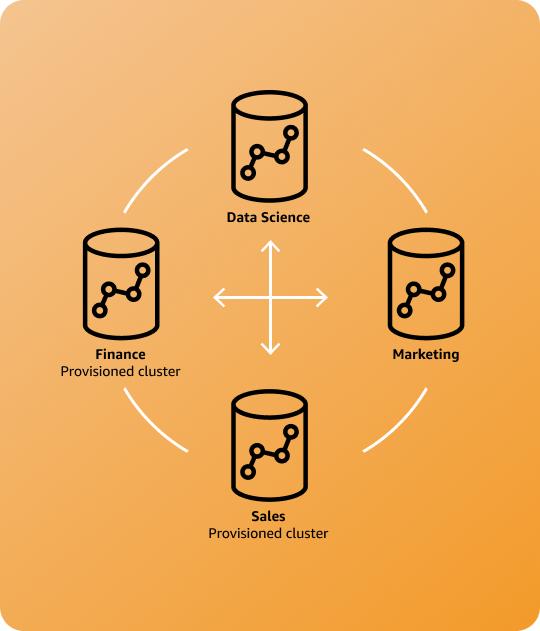
Different consumer teams can query them using separate Redshift compute.
For example:
- Central data engineering warehouse.
- Finance analytics workgroup.
- Marketing analytics workgroup.
- Data science cluster.
- Development environment.
Each consumer can have workload isolation without requiring a duplicate data-delivery pipeline.
This is especially useful when one workload should not compete with another.
Avoid Copy Pipelines When the Consumer Needs the Same Live Data
Suppose a finance team needs access to a curated sales fact table.
A traditional pattern might be:
Producer table → unload/export → transfer → consumer load → reconciliation
With Redshift data sharing, the consumer can query the shared object.
This removes several failure points.
- No export schedule.
- No duplicate load.
- No copy reconciliation.
- No separate storage lifecycle for the duplicate.
- No delay waiting for the next copy.
That is the ideal use case.
Consumers See Current Producer Data
AWS positions data sharing as live access.
When producer data changes, consumers can query the updated shared data without waiting for a separate ETL copy.
This can improve consistency across teams.
Finance and sales can reference the same curated data product instead of maintaining slightly different replicas.
However, the data is only as fresh as the producer’s upstream pipeline.
Sharing does not fix stale ingestion.
Workload Isolation Is a Major Benefit
Data sharing is not only about moving fewer bytes.
It can separate compute workloads.
A central ETL warehouse can maintain data while BI consumers query from other clusters or Serverless workgroups.
This protects transformation workloads from dashboard concurrency.
It can also support chargeback because consumer compute is separated.
For larger organizations, this is often as valuable as eliminating copies.
Cross-Account Sharing Supports Organizational Boundaries
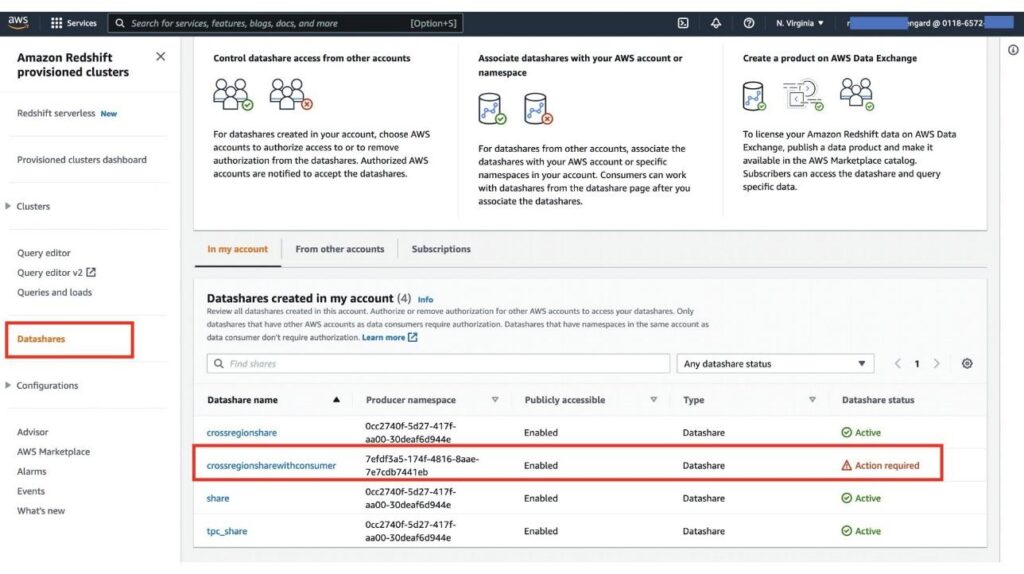
Redshift can share data across AWS accounts.
This can support:
- Business units with separate AWS accounts.
- Subsidiaries.
- Partner environments.
- Central data platforms.
- Acquisitions operating separate infrastructure.
Cross-account architecture needs explicit governance.
Define who is allowed to create, authorize and consume shares.
Cross-Region Sharing Is Supported in Eligible Regions
AWS supports cross-region data sharing in specified Regions.
Check the current regional support matrix before designing the solution.
Cross-region sharing can introduce data-transfer cost and regulatory considerations.
Review:
- Data residency.
- Transfer pricing.
- Latency.
- Security policy.
- Contract requirements.
Do not assume a same-region design behaves identically across geography.
A common mistake is to share broad schemas because it is easy.
Instead, define a sharing layer.
Expose:
- Approved dimensions.
- Approved facts.
- Stable views.
- Documented metrics.
- Consumer-safe columns.
Keep internal staging, audit and sensitive operational structures private.
The shared objects should behave like a data product.
Use Views to Stabilize the Contract
Internal warehouse tables evolve.
Consumers should not break every time a staging implementation changes.
A view can provide a stable interface.
For example:
- Internal table names can change.
- Transformation logic can evolve.
- The consumer still queries analytics.sales_orders_v1.
Version important contracts.
Document breaking changes.
Data sharing removes copying, not schema governance.
Security Must Be Explicit
For each share, define:
- Producer owner.
- Consumer.
- Objects.
- Purpose.
- Sensitive-data classification.
- Region.
- Retention expectations.
- Access duration.
- Approval.
- Offboarding.
- Audit owner.
Do not let datashares become permanent invisible connections.
Apply Least Privilege
Share only the objects required.
Avoid exposing an entire database when a consumer needs two views.
Review sensitive columns.
Use appropriate Redshift and AWS governance controls.
If the consumer should not see row-level detail, publish an aggregate.
Data sharing is not a reason to weaken the warehouse security model.
Read and Write Sharing Need Different Risk Reviews
Redshift data sharing has evolved beyond simple read-only patterns, with supported write capabilities in current configurations and regions.
Treat writable sharing as a different governance decision.
Read access primarily creates confidentiality and query-risk concerns.
Write access can affect integrity.
Before enabling writes, define:
- Who can modify data.
- Which objects.
- Transaction expectations.
- Audit.
- Recovery.
- Conflict ownership.
Most analytics sharing use cases should begin with the minimum required capability.
Track:
- Who consumes the share.
- Which objects are queried.
- Query frequency.
- Consumer performance.
- Cross-region transfer.
- Schema changes.
- Support incidents.
- Unused shares.
A share that has not been used for six months may no longer be needed.
Periodic access review reduces unnecessary exposure.
Consumer Compute Still Needs Sizing
Data sharing removes data-copy infrastructure.
It does not remove compute.
The consumer needs sufficient Redshift capacity for its queries.
A poorly sized consumer warehouse can still deliver slow dashboards.
Separate responsibilities:
- Producer owns data quality and freshness.
- Consumer owns its query workload and compute.
Document the boundary.
Data Sharing Can Simplify Development Environments
AWS explicitly lists sharing between development, test and production environments as a use case.
A development environment can access approved production-like data without maintaining a full copy.
However, security and privacy may require masking or filtered views.
Do not expose production PII to development merely because sharing makes it easy.
Use Data Sharing for Centralized ETL With Distributed Analytics
A strong enterprise pattern is:
- Central ingestion and transformation.
- Curated warehouse layer.
- Datashares.
- Independent consumer compute.
This provides one transformation truth with workload isolation.
It can reduce duplicated ETL logic across departments.
The central team still needs service-level commitments because many consumers now depend on its data products.
When Conventional Replication Still Makes Sense
Use a copy or replication pipeline when:
- The consumer is not using Redshift.
- The consumer needs independent historical snapshots.
- Data must remain available if the producer is unavailable.
- The consumer requires physical ownership.
- Data must be transformed substantially for the destination.
- Contractual rules require delivery artifacts.
- Offline processing is needed.
- A separate region requires an architecture better served by replication.
Data sharing is strongest when the consumer naturally wants to query the producer’s current Redshift data.
Data Sharing Is Not an API
Do not use warehouse sharing for transactional application integration.
If an application needs:
- Record creation.
- Commands.
- Request validation.
- Operational workflows.
- Low-latency service calls.
- Public developer access.
an API is usually the appropriate boundary.
Redshift data sharing is an analytics access pattern.
Data Sharing Is Not a Data Contract by Itself
The platform can expose a table instantly.
That does not tell the consumer:
- What a metric means.
- When it updates.
- Which rows are complete.
- How history changes.
- Who owns errors.
- Whether a column will be removed.
Create documentation.
At minimum include:
- Object definition.
- Business grain.
- Primary keys.
- Freshness.
- Data-quality rules.
- Owner.
- Change policy.
- Known limitations.
Build a Consumer Onboarding Process
For each new consumer:
- Confirm the use case.
- Classify the data.
- Select approved objects.
- Define region/account architecture.
- Establish access.
- Test permissions.
- Validate performance.
- Document the contract.
- Configure monitoring.
- Define support and offboarding.
This prevents ad hoc shares from becoming unmanaged dependencies.
Plan Schema Evolution
Additive changes are usually easier for consumers.
Breaking changes need coordination.
Use versioned views where necessary.
For example:
- sales_orders_v1
- sales_orders_v2
Give consumers a migration window.
Do not silently redefine business metrics in a shared object.
Cost Should Include the Pipeline You Avoid
When comparing data sharing with replication, include:
- Export compute.
- Transfer.
- Storage.
- Consumer load compute.
- Orchestration.
- Monitoring.
- Reconciliation.
- Support.
- Latency.
Engineering maintenance.
The value of sharing is often operational simplification rather than a single AWS line-item reduction.
A Practical Decision Framework
1. Use Redshift data sharing when:
- Producer and consumer use Redshift.
- Consumers need current analytical data.
- Independent compute is valuable.
- Copy pipelines would duplicate the same dataset.
- Central governance is desired.
- The shared schema can be stable.
2. Use replication when:
- Physical independence is required.
- The consumer uses another platform.
- Historical delivery snapshots are required.
- Transformation at destination is substantial.
- Availability must be decoupled from producer state.
3. Use files or APIs when:
- The consumer contract is not warehouse-native.
A Production Checklist
Before enabling a datashare, confirm:
- Producer and consumer owners are named.
- Objects are curated.
- Sensitive fields are reviewed.
- Cross-account permissions are documented.
- Regional support is confirmed.
- Data residency is approved.
- Consumer compute is sized.
- Freshness expectations are documented.
- Schema-change policy exists.
- Usage monitoring is enabled.
- Offboarding is documented.
- Cross-region cost is understood.
- Write access, if any, has a separate integrity review.

Frequently Asked Questions
Does Redshift data sharing copy data?
AWS describes standard data sharing as live access without manually copying or moving the underlying data between Redshift producer and consumer environments.
Yes. Standard datashares support sharing between provisioned Redshift and Serverless workgroups in supported configurations.
Yes. Cross-account sharing is supported with appropriate authorization.
Yes, in supported AWS Regions. Check the current regional support matrix and evaluate transfer cost and residency.
Does the consumer need compute?
Yes. Consumers query shared data using their own Redshift compute resources.
Usually not by default. Curated views or approved analytical objects create a safer and more stable consumer contract.
Does data sharing replace ETL?
It can eliminate ETL whose only purpose is copying the same curated Redshift data to another Redshift environment. It does not replace upstream ingestion and transformation.
Conclusion
Amazon Redshift data sharing can eliminate an entire class of unnecessary copy pipelines.
When multiple Redshift consumers need the same current analytical data, sharing provides a cleaner model: central data ownership with independent compute.
That can improve freshness, reduce duplicated engineering and isolate workloads.
But the architecture still needs governance.
Curate what is shared. Define ownership. Protect sensitive data. Plan schema changes. Monitor consumers. Understand cross-region implications.
Use replication only when the consumer genuinely needs a separate physical copy.
If you are designing a multi-team Redshift environment or maintaining duplicate warehouse pipelines, Actiknow can help evaluate where data sharing can simplify the architecture while preserving governance and BI performance. Discuss your Redshift data architecture with Actiknow.