
“Zero-ETL” sounds like the end of data engineering.
It is not.
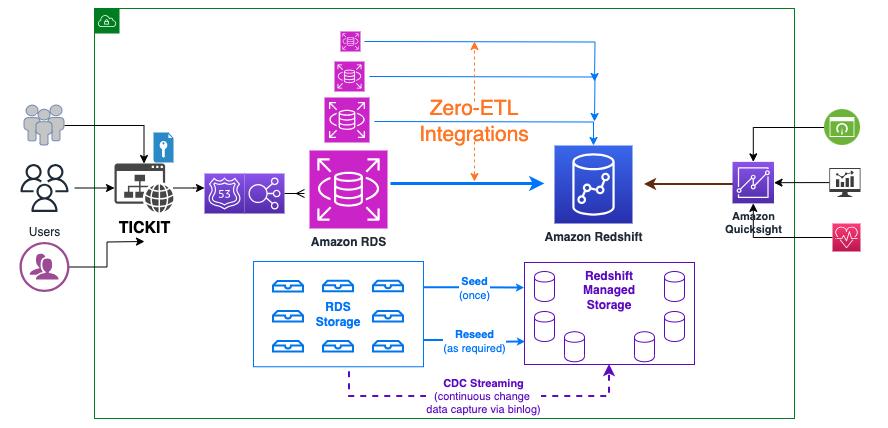
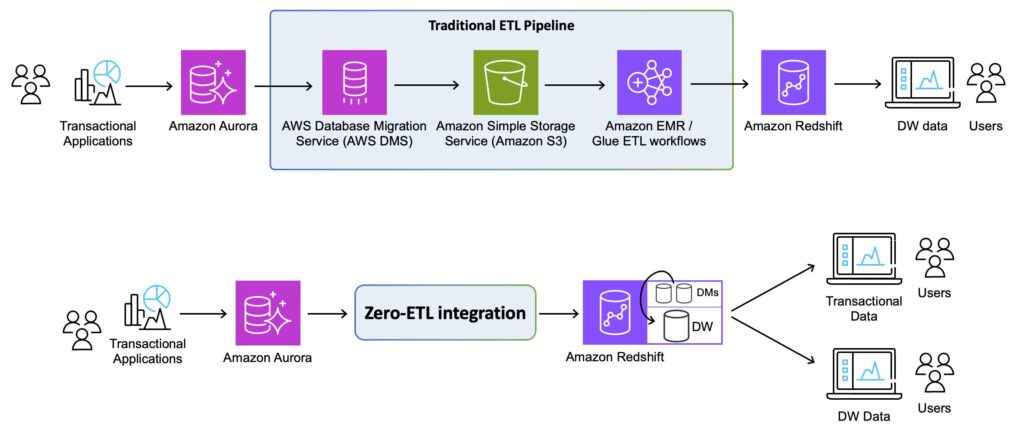
Amazon Redshift zero-ETL integrations can remove a substantial amount of custom engineering required to replicate operational data into Redshift.
AWS manages the initial load and ongoing synchronization for supported sources.
That can eliminate connector infrastructure, CDC plumbing and much of the operational work around replication.
But the data arriving in Redshift is still operational source data.
It usually needs modeling, validation, governance and semantic definition before it becomes reliable executive reporting.
What Redshift Zero-ETL Does
AWS describes zero-ETL integration as a fully managed way to make transactional and operational data available in Amazon Redshift.
Current supported source categories include AWS operational databases, self-managed databases and selected enterprise applications, with exact support varying by source and Region.
The integration performs an initial load and then continuously replicates changes.
AWS monitors integration health and can recover from some issues automatically.
This replaces a meaningful part of traditional ingestion engineering.
Actiknow’s business intelligence and data engineering services include Redshift ingestion, warehouse modeling and BI delivery. Zero-ETL is most useful when it simplifies the ingestion layer without confusing replication with analytics readiness.
What It Can Replace: Custom CDC Infrastructure
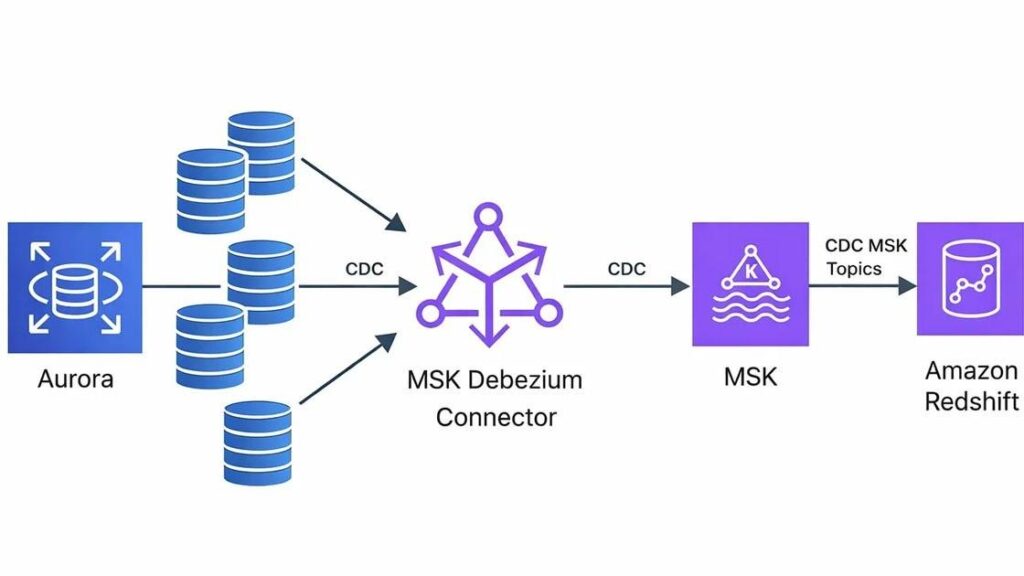
Traditionally, replicating a transactional database into a warehouse may require:
- CDC configuration.
- Connector services.
- Offset management.
- Extraction code.
- Landing tables.
- Retry logic.
- Schema handling.
- Monitoring.
- Operational recovery.
For supported zero-ETL sources, AWS manages much of this replication machinery.
That can reduce:
- Custom code.
- Third-party connector administration.
- Pipeline infrastructure.
- On-call burden.
- Time to make operational data available for analytics.
What It Can Replace: Scheduled Full Extracts
Some organizations still copy entire operational tables nightly because incremental replication is difficult.
This creates:
- Long batch windows.
- High source load.
- Stale dashboards.
- Complex delete handling.
- Repeated scanning.
Zero-ETL can replace many of these bulk extraction patterns with managed ongoing replication.
That is a substantial architectural improvement.
What It Can Replace: Some Connector Licensing
If an existing third-party connector exists only to replicate a supported source into Redshift, zero-ETL may remove that specific dependency.
But compare carefully.
Third-party platforms may provide:
- More connectors.
- Transformation.
- Schema normalization.
- Historical re-sync tools.
- Cross-destination routing.
- Rich observability.
- Support.
Do not cancel a connector platform before confirming what other workloads depend on it.
What It Does Not Replace: Business Transformations
Replicated source tables are not automatically analytics models.
Operational systems are designed for transactions.
BI needs stable business definitions.
You may still need:
- Fact tables.
- Dimensions.
- Aggregations.
- Deduplication.
- Business-status logic.
- Fiscal calendars.
- Currency conversion.
- Metric definitions.
- Historical modeling.
Zero-ETL removes movement, not meaning.
What It Does Not Replace: Data Quality
A managed replication pipeline can faithfully copy bad source data.
Examples:
- Duplicate customers.
- Missing categories.
- Invalid dates.
- Unexpected nulls.
- Incorrect statuses.
- Broken source relationships.
Data quality still requires:
- Rules.
- Tests.
- Exceptions.
- Ownership.
- Reconciliation.
- Remediation.
“Pipeline healthy” does not mean “data correct.”
What It Does Not Replace: Reconciliation
Before business teams trust the warehouse, validate it against source systems.
Compare:
- Row counts.
- Financial totals.
- Distinct business keys.
- Deletes.
- Updates.
- Late-arriving transactions.
- Date boundaries.
- Null rates.
- Key dimensions.
Reconciliation is particularly important during initial implementation and major source changes.
Managed replication should make the process easier, not eliminate it.

What It Does Not Replace: Semantic Modeling
Executives should not query raw replicated CRM or ERP tables directly.
They need metrics such as:
- Revenue.
- Active customer.
- Pipeline.
- Gross margin.
- Renewal.
- Inventory.
- Utilization.
Those definitions belong in a governed semantic or warehouse layer.
Zero-ETL does not decide what “active customer” means.
What It Does Not Replace: Access Governance
Replicated operational data may include:
- PII.
- Financial details.
- Employee data.
- Internal notes.
- Security attributes.
The warehouse needs:
- Roles.
- Least privilege.
- Sensitive-data classification.
- Masking where required.
- Row or object controls.
- Audit.
- Retention.
Replication can actually increase governance risk if raw operational data becomes broadly accessible in analytics.
What It Does Not Replace: Data Contracts
Source systems change.
Applications add columns.
Enums evolve.
Tables are renamed.
Business processes change.
Zero-ETL can manage supported replication mechanics, but downstream consumers still need change management.
Document:
- Critical source objects.
- Expected schema.
- Business grain.
- Owners.
- Breaking-change process.
- Downstream impact.
A managed connector does not remove organizational dependencies.
What It Does Not Replace: BI Engineering
A dashboard still needs:
- User requirements.
- Metric definitions.
- Semantic model.
- Performance design.
- Security.
- Visual design.
- Testing.
- Refresh/freshness monitoring.
- User acceptance.
Zero-ETL shortens the path from source to warehouse.
It does not build the decision layer.

Near Real Time Is Not the Same as Instant
AWS describes supported zero-ETL integrations as enabling near-real-time analytics.
Do not convert that into a zero-second SLA.
Measure actual latency.
Track:
- Source commit time.
- Replication availability.
- Transformation completion.
- Semantic-model freshness.
- Dashboard availability.
Define the business SLA end to end.
Source Support Must Be Verified
Zero-ETL capabilities are evolving.
AWS currently supports multiple operational databases and enterprise applications, but exact source, engine-version and Region support varies.
Before committing architecture, verify:
- Source type.
- Engine version.
- AWS Region.
- Network requirements.
- Permissions.
- Encryption.
- Target type.
- Limitations.
Do not design from a marketing diagram alone.
Initial Load Still Matters
The integration needs to establish the initial dataset before ongoing changes are useful.
Large sources can require time.
Plan:
- Initial synchronization.
- Validation.
- Cutover.
- Source load.
- Downstream readiness.
- Business acceptance.
Do not expose dashboards simply because the integration status becomes active.
Validate the baseline first.
Monitor the Integration
AWS provides Redshift system views for zero-ETL monitoring and integration events through EventBridge.
Use them.
Monitor:
- Integration status.
- Table state.
- Replication activity.
- Errors.
- Lag.
- Schema issues.
- Unexpected inactivity.
Create alerts with owners.
Managed infrastructure still requires operational accountability.
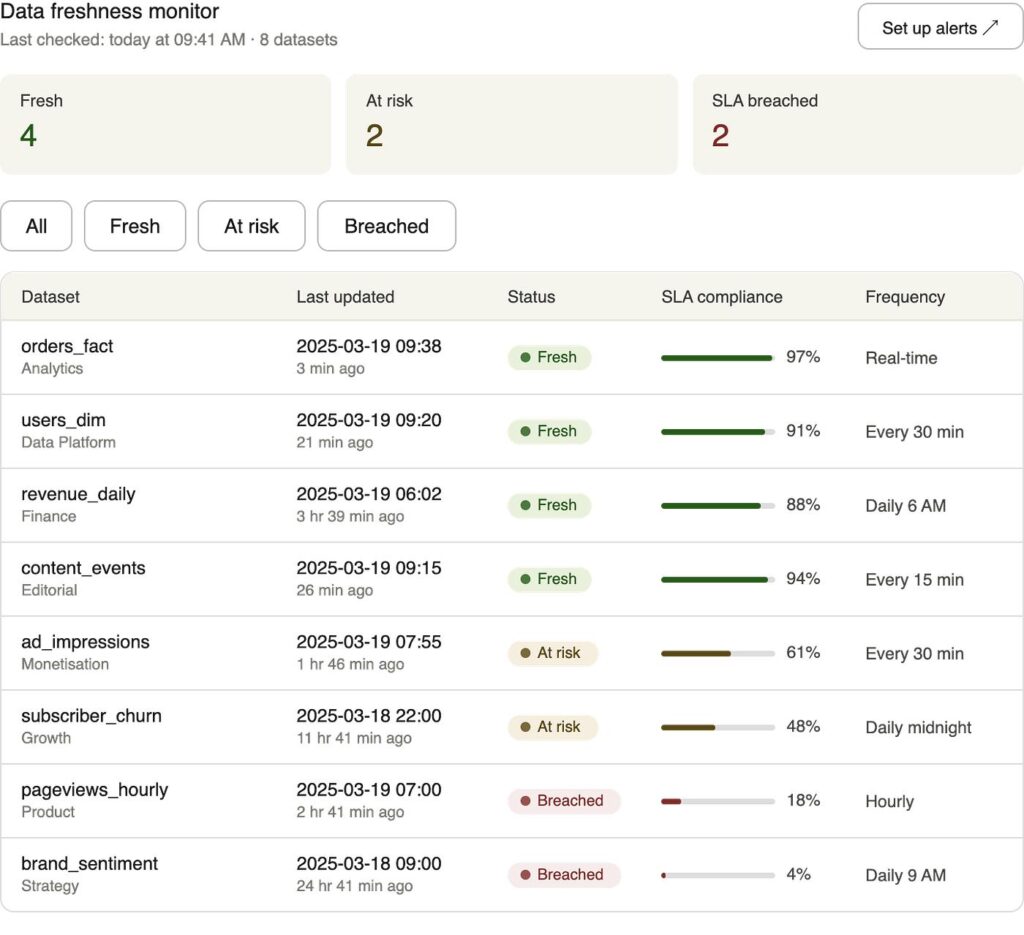
Separate Replication Health From Data Freshness
An integration can be healthy while a downstream model is stale.
Create monitoring across layers:
- Source.
- Zero-ETL replication.
- Warehouse transformation.
- Semantic model.
- Dashboard.
This prevents teams from saying “AWS is green” while users see yesterday’s numbers.
Plan for Schema Evolution
Understand how the selected source integration handles schema changes.
Test:
- New columns.
- Removed columns.
- Type changes.
- New tables.
- Renames.
- Unsupported changes.
Then define how downstream transformations react.
The ingestion layer may adapt while a dbt model or BI semantic model breaks.
Transformation Architecture Still Needs a Choice
Once data lands in Redshift, choose how to transform it.
Options can include:
- SQL transformation jobs.
- dbt.
- Stored procedures.
- Materialized views.
- Scheduled orchestration.
- Other AWS services.
The correct choice depends on complexity, team skills and freshness.
Zero-ETL should simplify one layer, not dictate every downstream tool.
Use a Raw Replicated Layer
A useful pattern is:
Operational source → zero-ETL replicated database → governed transformation layer → BI marts → semantic model
This preserves a clear boundary.
Do not let every dashboard query replicated source tables independently.
A controlled modeling layer protects business definitions from source complexity.
Multiple Sources Increase the Need for Modeling
AWS supports bringing multiple sources into a Redshift warehouse.
That is powerful.
It also means entities must be reconciled.
For example:
- CRM customer.
- Billing customer.
- Product user.
- Support organization.
These may use different identifiers.
Zero-ETL can bring all four datasets together.
It does not resolve identity.
That remains a data-modeling problem.
History Mode Can Be Useful, but It Is Not Universal Business History
AWS provides history-related capabilities for some zero-ETL scenarios.
Evaluate whether the captured history matches the business requirement.
A warehouse may still need explicit slowly changing dimensions or snapshots to answer questions such as:
- Which sales region owned this customer at the time of the transaction?
- What was the product category when the order occurred?
- What was the membership status on that reporting date?
Technical change history and business-effective history are not always the same.
Cost Moves Rather Than Disappears
Zero-ETL can reduce engineering and connector costs.
You may still pay for:
- Source integration capabilities.
- Redshift storage.
- Redshift compute.
- Transformations.
- Monitoring.
- Cross-region transfer where applicable.
- BI.
- Support.
Measure total cost of ownership.
The biggest saving may be fewer pipelines to maintain rather than raw infrastructure cost.
When Zero-ETL Is a Strong Fit
Consider it when:
- The source is supported.
- Redshift is the analytical destination.
- Fresh operational data is valuable.
- Existing replication is complex.`
- Connector maintenance consumes engineering time.`
- The team wants AWS-managed ingestion.
- Downstream modeling already exists or is planned.
When Conventional Pipelines Still Make Sense
Use another ingestion approach when:
- The source is unsupported.
- Complex extraction transformations are required.
- One source must feed many destinations.
- You need a vendor-neutral integration layer.
- Specialized schema normalization is valuable.
- Custom control over CDC is required.
- Regulatory architecture dictates another path.
A Migration Approach
Do not switch ingestion blindly.
- Inventory the existing pipeline.
- Identify transformations currently embedded in ingestion.
- Separate replication logic from business logic.
- Configure zero-ETL for a representative source.
- Run old and new pipelines in parallel.
- Reconcile counts and business totals.
- Measure latency.
- Test schema changes.
- Validate downstream models.
- Cut over.
- Retire old infrastructure only after acceptance.
Frequently Asked Questions
Does Redshift zero-ETL mean no ETL work at all?
No. It can eliminate much of the custom replication pipeline for supported sources, but transformation, data quality, governance and semantic modeling often remain necessary.
Is zero-ETL real time?
AWS describes it as near-real-time for supported scenarios. Measure actual end-to-end latency and define a realistic business freshness SLA.
What sources can replicate to Redshift with zero-ETL?
AWS supports a growing set of databases and enterprise applications. Exact source types, versions and Regions should be verified in current AWS documentation.
Does zero-ETL replace Fivetran or another connector platform?
It may replace a connector for supported source-to-Redshift replication, but connector platforms can provide broader source coverage, multi-destination routing and other operational capabilities.
Do I still need dbt or SQL transformations?
Usually, if the business needs curated analytical models. Zero-ETL replicates source data; it does not automatically create business facts, dimensions and metrics.
How do I monitor zero-ETL?
AWS provides Redshift system views and integration events that can be used to monitor configuration, table state, activity and failures.
Should dashboards query replicated source tables directly?
Usually not for governed executive BI. Create a curated transformation and semantic layer so business definitions remain stable.
Conclusion
Redshift zero-ETL integration can remove a difficult part of data engineering: building and operating replication pipelines.
That is valuable.
But replication is only the first part of an analytics system.
The warehouse still needs quality controls, reconciliation, business modeling, security, monitoring and BI engineering.
Treat zero-ETL as a simpler ingestion layer, not as the elimination of data architecture.
If you are evaluating zero-ETL for Redshift, Actiknow can help compare it with your current ingestion stack, validate replicated data and design the transformation and BI layers that sit above it. Discuss your Redshift data engineering requirements with Actiknow.