
Data mesh is an attractive answer to a familiar problem: a growing business has more data sources, more reporting demands and more disagreements about whose numbers are correct. The central data team is busy, while the people who understand the business processes are not accountable for the analytical data those processes produce.
But the promise of domain ownership can be misunderstood. A company with three analysts and a single warehouse does not become more efficient by creating four miniature data platforms. It may simply add infrastructure, coordination and governance costs.
For COOs, CFOs, CIOs and data leaders, the decision is not about adopting the latest architecture label. It is about deciding which responsibilities should sit with the business, which engineering capabilities should remain shared, and when genuine decentralization becomes worthwhile.
The short answer: borrow the accountability, not necessarily the architecture
For most mid-market companies, a full data mesh is a larger organizational commitment than the current problem requires. The useful part is usually much smaller: give business domains clear responsibility for the meaning and quality of their data, publish important datasets with explicit contracts, and retain a shared platform and common governance.
A full mesh becomes more attractive when several genuinely independent domain teams already build and operate data capabilities, a central data team has become a persistent delivery bottleneck, and the organization can fund platform engineering and federated governance. Without those conditions, decentralization can turn one manageable data backlog into several incompatible pipelines.
The right question is not “Should we implement data mesh?” It is “Which decisions and responsibilities need to move closer to the business, and which should remain shared?”
What data mesh actually means
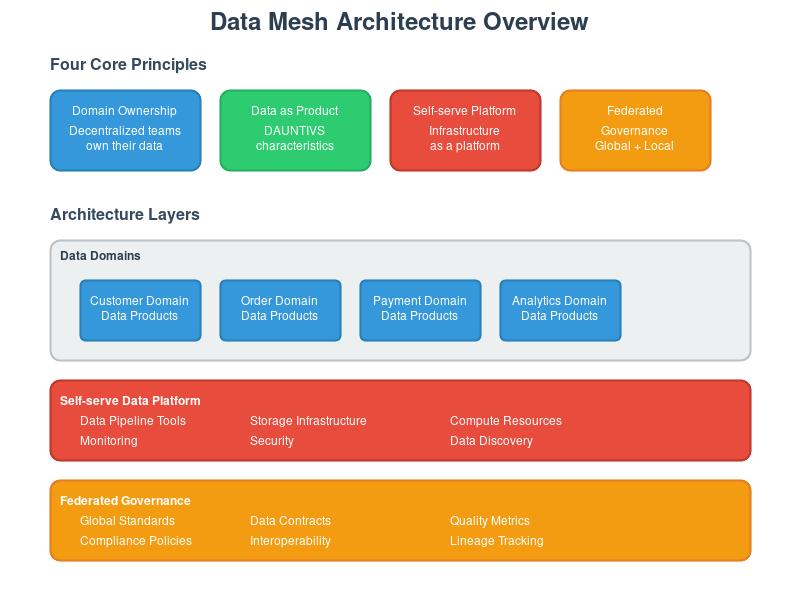
Data mesh is not a new warehouse product, a particular cloud deployment or a synonym for dividing a database into schemas. Zhamak Dehghani’s data mesh principles describe four mutually reinforcing ideas.
- Domain-oriented ownership: teams closest to business capabilities such as orders, billing and fulfillment take responsibility for analytical data in their domain.
- Data as a product: a dataset is published for real consumers, with an owner, clear meaning, documentation, quality expectations, discoverability and a dependable interface.
- Self-service data platform: common infrastructure makes it possible for domain teams to publish and operate data products without reinventing ingestion, security, monitoring and deployment.
- Federated computational governance: domains participate in setting shared rules, while common standards and automated controls keep products secure and interoperable.
The fourth principle matters as much as the first. If finance, sales and operations independently publish three definitions of “active customer,” moving ownership outward has not made the business more data-driven. It has made disagreement harder to resolve.
Why the idea appeals to growing companies
A centralized data team often starts as an efficient arrangement. One small group integrates systems, builds models and serves every dashboard. As the business grows, that team may be asked to reconcile ERP orders, CRM opportunities, service tickets, subscription billing and marketing data while responding to urgent reporting requests.
The business understands its processes better than a generalist data team. Sales knows which opportunity stages count as qualified. Finance knows when a transaction becomes recognized revenue. Operations knows which shipment events indicate an actual delivery. When those definitions live only in tickets and meetings, the central team becomes a translation service.
Domain accountability can reduce ambiguity. It can also shorten the time required to resolve upstream data issues. The danger is assuming that business expertise automatically includes the engineering capacity to own production pipelines.
The three operating models worth comparing
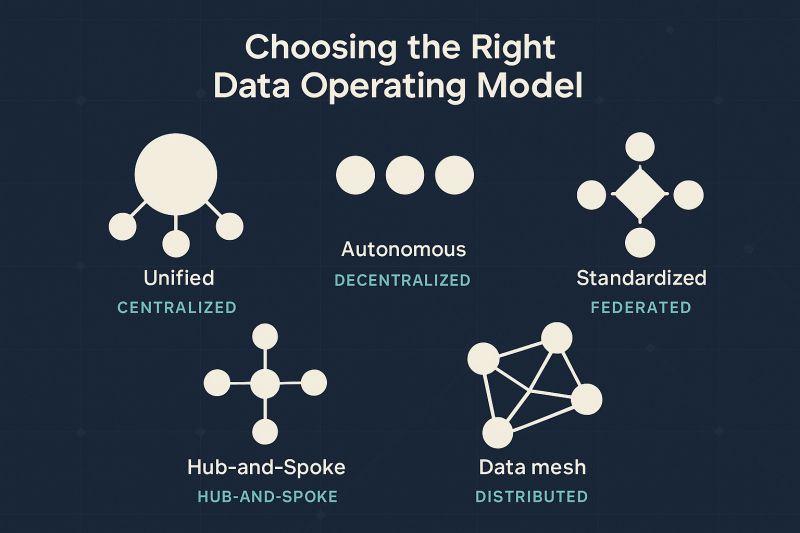
A centralized model places ingestion, transformations, quality monitoring and publication under one data team. Business teams supply requirements and approve definitions. It works well when sources are limited, engineering capacity is scarce and cross-functional reporting dominates.
A federated ownership model keeps shared infrastructure and much of the engineering work centralized but assigns named business owners to critical datasets. Owners approve definitions, set quality priorities, review breaking changes and accept service expectations. This is often the strongest first step for a mid-market organization.
A full data mesh distributes more of the data-product lifecycle to domain-aligned teams. Those teams can build, deploy, operate and evolve their own products using a self-service platform, while cross-domain standards remain enforceable. This offers autonomy but demands additional capabilities, funding and coordination.
These are not maturity badges. A centralized warehouse with strong ownership can outperform a poorly operated mesh. Select the least complex model that reliably meets business needs.
A practical example: the order-to-cash data problem
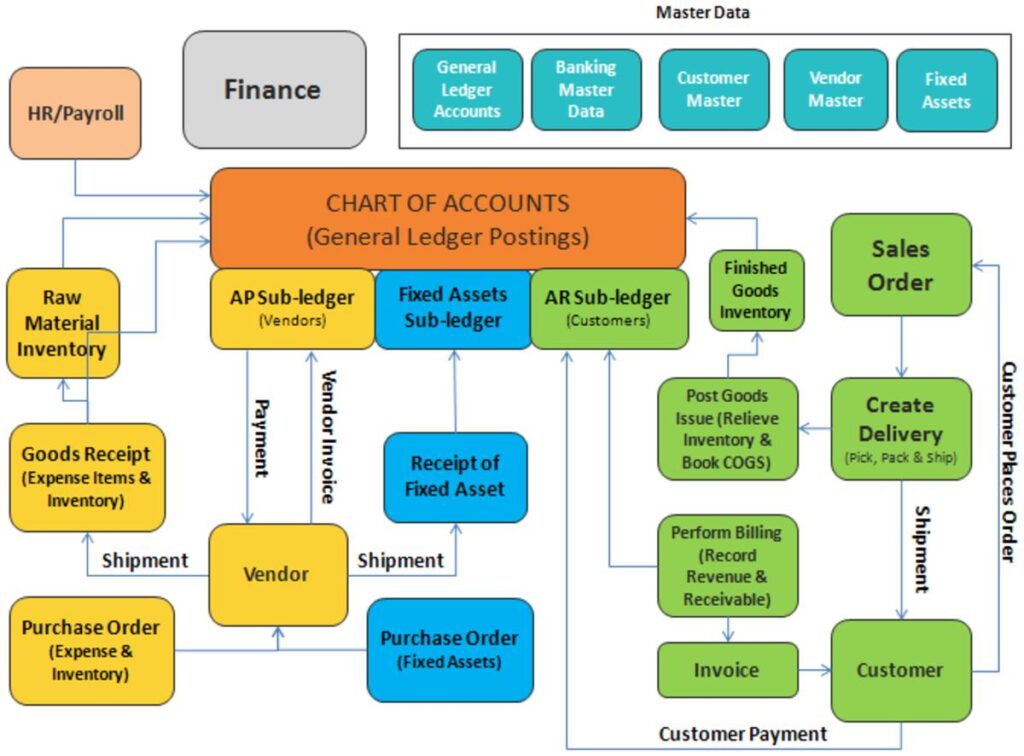
Consider a hypothetical B2B distributor with an ERP, CRM, warehouse management system and finance platform. The COO wants a trusted view of order fulfillment. Sales wants customer revenue by account manager. Finance wants recognized revenue and overdue receivables.
In a weak centralized model, the data team reverse-engineers source tables, builds all three dashboards and repeatedly asks the departments to clarify definitions. The resulting models may be technically sound but fragile when processes change.
In a lightweight federated model, operations owns the meaning of order status and fulfillment milestones; finance owns recognized revenue and invoice states; sales owns opportunity stage definitions. A shared data team still operates pipelines and publishes governed models. Each domain signs off on its contract and owns business-level quality exceptions.
In a full mesh, each domain may publish its own versioned analytical product through shared platform tooling. That is useful only if the domains have the staff and release discipline to support those products.
The example is illustrative, not a client case study. Its lesson is that ownership and reliable interfaces can be introduced without multiplying infrastructure.
What a real data product must contain
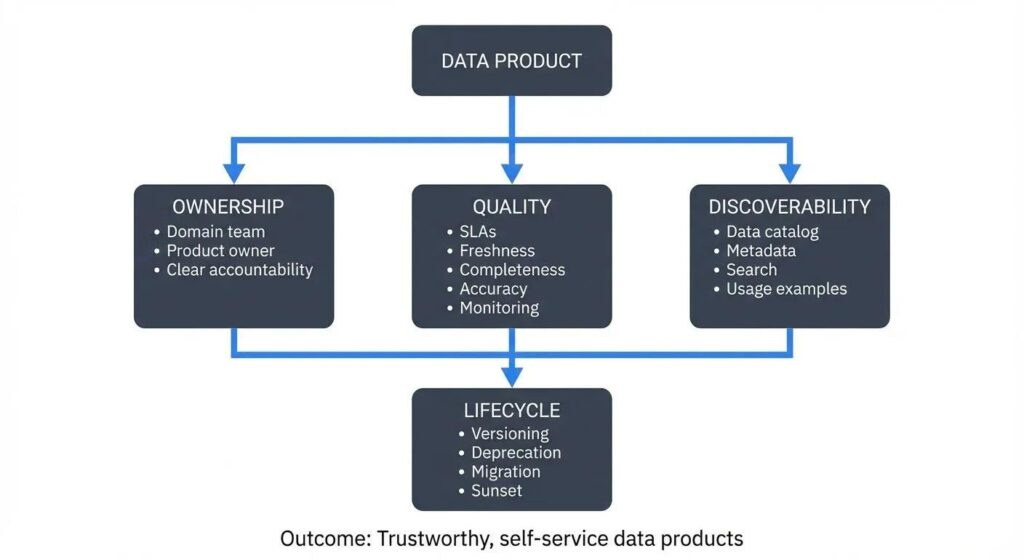
Calling a table a “data product” does not make it one. A useful product should answer what it represents, who can rely on it and what happens when it changes.
For an Orders product, define the grain first: one row per order, order line or fulfillment event. Identify its authoritative source and the rules for cancellations, returns, partial shipments and late updates. Name the business owner and the technical steward. Publish the schema, key fields, expected refresh cadence, quality checks and known limitations.
A practical contract might state: each order_id is unique at the order grain; status must be in an approved set; customer_id must resolve to the governed customer dimension; source-to-publication latency is measured against an agreed target; breaking schema changes require advance notice and a versioning plan.
The product should have consumers and a support path. If nobody knows who depends on it or who fixes it, it is simply a dataset with better marketing.
The difference between business ownership and technical stewardship
Business ownership means accountability for definitions, acceptable quality, access decisions and change priorities. Technical stewardship means responsibility for pipeline implementation, tests, deployment, monitoring and incident response.
One person may hold both roles in a small company, but the responsibilities should remain explicit. A head of operations should not be expected to debug an orchestration failure. Equally, an engineer should not independently decide whether an unshipped order counts as revenue.
Use a simple responsibility matrix. The domain owner approves business semantics. The data team maintains the implementation. Security or governance approves sensitive access rules. Downstream consumers report defects and participate in change review.
An owner without decision rights or time to participate is not a meaningful owner.
Many mid-market businesses already have a workable cloud warehouse, ingestion service, transformation framework and BI layer. There is no requirement to replace that stack to introduce domain responsibility.
A shared warehouse can support domain-oriented schemas, versioned models, automated tests, documentation, lineage, access controls and deployment pipelines. Domain ownership can be reflected in code repositories, approval workflows and operational responsibilities even when compute and storage remain centralized.
Actiknow’s business intelligence and data integration services describe work across solution architecture, source integration, data modeling and dashboards. Those are practical building blocks for improving reliability without committing prematurely to a fully decentralized platform.
Only separate infrastructure when there is a specific requirement such as workload isolation, regulatory boundaries, independent release schedules or sustained team autonomy that justifies the additional operations.
When a full mesh is likely to be unnecessary complexity
Be cautious when the organization has one or two data engineers, business teams have no analytics engineering capacity, most reports reuse the same small set of sources, and the existing warehouse is not the limiting factor.
Other warning signs include inconsistent identifiers across systems, no agreed KPI definitions, unreliable source data, missing access governance and weak incident ownership. A mesh does not repair these foundations automatically. It may expose their weaknesses across more interfaces.
If the main pain is slow dashboard delivery, investigate requirements management, model reuse, source quality and prioritization before redesigning the operating model.
If the main pain is conflicting numbers, define metric ownership and semantic contracts before distributing pipelines.
If the main pain is ingestion reliability, invest in monitoring, reconciliation and recovery before giving each department its own ingestion stack.
When the full model deserves serious consideration
The case strengthens when multiple domains have sustained analytical demand, domain teams can staff engineering and product ownership, and a central team repeatedly blocks independently valuable changes.
Look for concrete evidence: long queues caused by domain-specific changes, repeated source misunderstandings, independent product release cycles, diverse consumption patterns, and strong demand for reusable data interfaces beyond dashboards.
Also test organizational readiness. Can domains accept on-call responsibility? Can the platform team provide self-service deployment and observability? Can governance standards be enforced automatically? Can executives resolve cross-domain definition disputes?
The answer may be yes for a company with several autonomous product lines. It may be no for a similarly sized company with one integrated operating model. Revenue or headcount alone is a poor selection criterion.
A full mesh shifts costs rather than simply eliminating a central bottleneck. Domain teams need engineering time, product ownership, quality monitoring, release management and incident support. A shared platform team must build the paved road that prevents duplicated infrastructure. Governance needs ongoing decision-making.
Estimate total operating cost rather than comparing a central team’s salary against a promised future efficiency gain. Include duplicated transformations, warehouse consumption, catalog administration, security reviews, training, observability and cross-domain coordination.
The return should appear in measurable outcomes: faster delivery of domain changes, fewer definition disputes, reduced incident resolution time, higher reuse and better data-product reliability.
If the organization cannot quantify the problem it is solving, it cannot credibly justify the added organizational structure.
Cross-domain metrics are the hardest test
Domain boundaries are useful, but executives still need enterprise-wide measures. Customer lifetime value may combine CRM, order, support and billing information. Gross margin may combine product, procurement, fulfillment and finance data.
Decide which identifiers and definitions must be shared. For example, customer_id may need a governed mapping across CRM accounts and ERP customers. Revenue recognition belongs to finance, while booked sales may belong to commercial operations. Both metrics can be valid, but they should not share an ambiguous label.
The governance model should specify which domain owns the source fact, who owns the cross-domain metric, and how changes are communicated. Do not create a universal canonical model for everything. Standardize only the boundaries that need to interoperate.
A mesh that cannot produce a trusted company-wide revenue view has not solved the executive reporting problem.
Governance should be executable, not just documented
Policies are easier to follow when the platform checks them. Examples include schema tests, freshness monitoring, required ownership metadata, classification of sensitive fields, role-based access, and automated detection of breaking changes.
A domain can choose how to model its internal operations while still complying with common requirements for identifiers, documentation, access and quality. This balance preserves useful autonomy without sacrificing interoperability.
Start with a small set of mandatory controls. Every published product should have a named owner, a defined grain, access classification, refresh expectation, automated quality checks and a change process.
Governance meetings should handle unresolved decisions and exceptions. Routine compliance should happen in code and deployment workflows where practical.
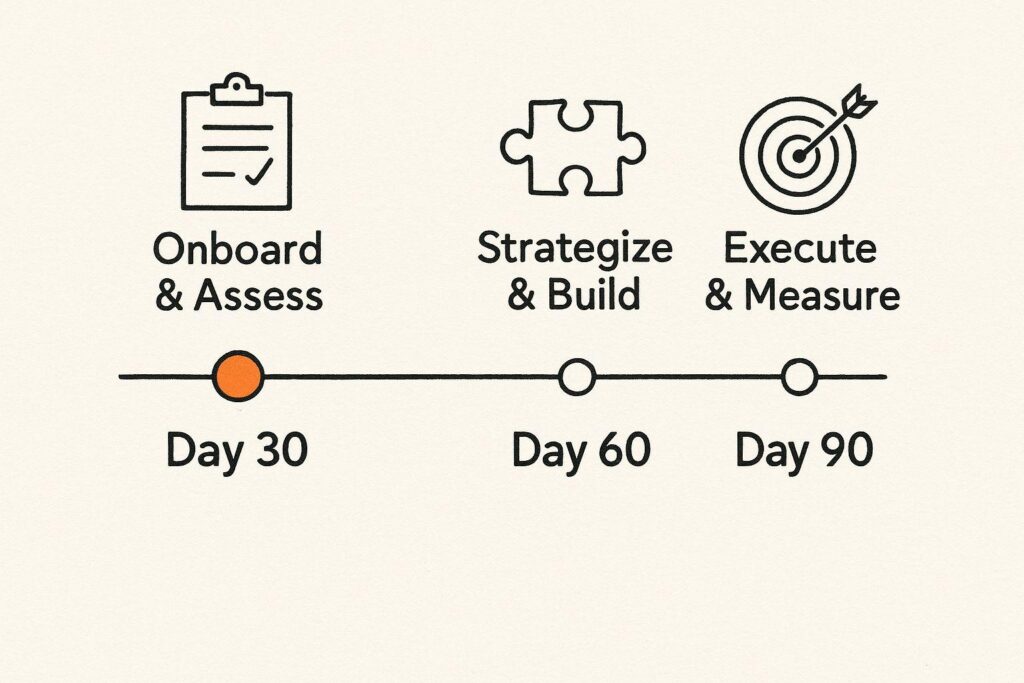
A 90-day pilot without an organizational reorganization
Days 1 to 20: identify one cross-functional pain point. Interview the users who depend on the data. Record baseline lead time, incidents, disputed metrics and manual reconciliation effort. Select one high-value dataset with a clear business owner.
Days 21 to 45: publish a lightweight data contract. Define grain, metrics, freshness, quality tests, access rules and ownership. Map the source-to-consumer lineage. Build the required checks into the existing pipeline and make failures visible.
Days 46 to 70: introduce a controlled change process. Require business approval for semantic changes and technical review for schema or pipeline changes. Add versioning or compatibility checks where consumers depend on a stable interface.
Days 71 to 90: measure whether consumers spend less time reconciling data, whether defects are detected earlier and whether changes move faster. Identify the next two candidate products.
This pilot tests the valuable principles before the company commits to distributed deployment tooling or new teams.
How to judge whether the pilot worked
Measure data-product adoption by actual downstream use, not by the number of registered tables. Track consumer-reported trust, freshness compliance, quality incidents, mean time to resolution and lead time for approved changes.
Also measure the work transferred to domain owners. If business leaders spend more time in governance meetings but consumers still distrust the data, the model is not improving.
Compare the pilot with the previous delivery process. A credible result might be fewer reconciliation steps or faster ownership decisions. Do not attribute every dashboard improvement to the ownership model when pipeline fixes or better definitions contributed.
Define a stop condition. If ownership cannot be staffed or the same conflicts persist after two review cycles, fix those constraints before scaling.
Technology choices should follow responsibility boundaries
The technical implementation can be straightforward. A cloud warehouse or lakehouse can hold raw, standardized and business-ready data. Transformations can be version-controlled. Quality tests can run in CI and scheduled jobs. A catalog can expose definitions, lineage and owners. BI tools can consume governed marts.
For some organizations, a layered raw-to-mart architecture is sufficient. Others need domain-specific publishing interfaces and independent release pipelines. Those are architectural choices, not prerequisites for naming business owners.
Actiknow’s custom solutions practice includes API integrations, database and data lake setup, and automation. Such capabilities are relevant when the data operating model needs reliable connections between operational systems and the analytical platform.
Avoid buying a new catalog, orchestration platform or governance suite merely to label the program “data mesh.” First identify the control or workflow that the current stack cannot support.
An executive decision checklist
Before approving a data-mesh program, ask:
- Which business outcomes are blocked by the current operating model?
- Are the bottlenecks organizational, technical or both?
- Do domain teams have accountable owners and engineering capacity?
- Which datasets have real, identifiable consumers?
- Can a shared platform provide deployment, monitoring and access controls?
- Which definitions and identifiers must be consistent across domains?
- What additional run cost will decentralization create?
- What metrics will show improvement within one quarter?
- Can the same result be achieved with federated ownership on the existing warehouse?
- Who can stop the rollout if the pilot adds complexity without improving outcomes?
If the team cannot answer these questions, the architecture decision is premature.
A sensible recommendation for most mid-market firms
Start with a shared platform, explicit business ownership and a small portfolio of governed data products. Let domains own semantics and quality priorities while the central team supplies engineering capability and cross-domain standards.
Expand autonomy selectively. A domain that repeatedly needs independent releases and can reliably operate its products may earn greater technical control. Another domain with occasional reporting needs may continue using shared engineering.
This approach captures much of the value of data mesh without forcing every department to become a software and data platform team.
The best architecture is not the most decentralized one. It is the one in which responsibility is clear, data is trustworthy and change is economical.
Frequently asked questions
Is data mesh suitable for a mid-sized company?
Sometimes, but a full implementation usually makes sense only when multiple domains have sustained demand and enough technical capacity. A federated ownership model is often a better starting point.
Is data mesh the same as a data lake or warehouse?
No. Data mesh is primarily an operating and architectural model for ownership, products, platform capabilities and governance. It can use a warehouse, lakehouse or other storage technologies.
Can we implement data mesh principles in Snowflake, BigQuery or Databricks?
Yes. Domain ownership, contracts, testing and governance can be applied within existing platforms. A particular product does not automatically create a data mesh.
Do we need a separate data engineering team in every department?
Not to begin. Business owners can own definitions and quality expectations while a shared team implements and operates pipelines. Full decentralization requires stronger domain engineering capacity.
What is the difference between a dataset and a data product?
A data product has an identified consumer, owner, meaning, interface, quality expectations, discoverability and a support/change process. A table without those commitments is just a dataset.
What should we measure first?
Track disputed metrics, data-quality incidents, freshness, change lead time, time to resolve issues and consumer trust. Use those outcomes to evaluate whether the operating model helps.
Does federated governance mean every team chooses its own standards?
No. It means domains participate in governance decisions while common interoperability, privacy, security and quality rules are enforced consistently.
When should we stop a data-mesh rollout?
Pause when domains cannot staff ownership, cross-domain definitions become less consistent, platform overhead grows without better delivery, or pilot outcomes fail to improve.
Conclusion: use the principles to solve a specific problem
Data mesh offers a valuable challenge to the assumption that a central data team should understand and own every business definition. But it also introduces responsibilities that a smaller organization may not be ready to distribute.
For most mid-market leaders, the pragmatic route is to identify critical data products, assign business accountability, strengthen quality contracts and automate governance on the platform already in place. Move toward fuller domain autonomy only when sustained bottlenecks and organizational capacity justify it.
If you are deciding between improving a centralized warehouse and introducing domain-led data products, Actiknow can help assess the integration, modeling and governance requirements. Discuss your data architecture priorities with Actiknow before committing to a larger operating-model change.
Further reading: the original data mesh principles and logical architecture by Zhamak Dehghani.