

Most analytics programs were built to make data easier to collect, join, retain and explore. Privacy requires a more selective approach: collect what is necessary, make sensitive fields harder to access, and remove information when its purpose expires.
That sounds like a conflict until the organization asks a more precise question: which reporting decisions genuinely require a person’s identity?
A revenue dashboard may need customer segments, order values and acquisition channels, but not customer names or email addresses. A retention model may need to connect a customer’s events over time without knowing who that person is. A support operations report may need identifiable records for a small authorized team, while executives only need aggregate trends.
The right design does not eliminate analytical usefulness. It separates identity from measurement, restricts sensitive detail to justified workflows and makes deletion and access controls part of the data architecture. This guide explains how to do that in a modern warehouse and BI environment.
1. Start with the reporting decision, not the source schema
A common mistake is to replicate every available CRM, product and transaction field into the warehouse because storage is inexpensive and someone might need the data later. The warehouse then inherits sensitive fields that no approved report actually uses.
Begin with an inventory of business decisions: customer retention, revenue forecasting, service quality, marketing attribution, fraud monitoring or operational compliance. For each decision, document the metric, required grain, necessary dimensions, retention horizon and users who need access.
A useful design question is: could this report deliver the same decision if names, emails, phone numbers and precise addresses were absent? If yes, those fields should not enter the general-purpose reporting layer. If not, document exactly why identity is required and limit the exception.
This is data minimization in practice. The UK’s Information Commissioner’s Office describes the principle as keeping personal data adequate, relevant and limited to the stated purpose. Other jurisdictions differ, so legal and privacy teams should confirm the applicable obligations.

2. PII is broader than a list of obvious identifiers
PII is a common business term, especially in the United States. Privacy laws may use broader concepts such as personal data or personal information. A name, email address, telephone number, government identifier or exact street address is easy to recognize.
Indirect identifiers are more difficult. Device identifiers, cookie IDs, IP addresses, precise location, employee numbers and combinations of age, postal area and job title can identify or single out individuals in context. A stable customer token can also remain personal data if someone can reconnect it to a person.
Classification should therefore cover direct identifiers, linkable pseudonyms, sensitive attributes and quasi-identifiers. Do not label a dataset “anonymous” simply because it has no name column.
Consider the information available to an analyst through other tables, exports and external datasets. Identifiability is a property of the data and the access context, not just the column label.
3. Define four access tiers
A practical architecture separates data into four tiers rather than asking one dataset to satisfy every use case.
Tier A, identity-restricted: original names, contact details, precise addresses and other sensitive source fields. Only authorized operational, privacy or support processes should use them.
Tier B, pseudonymized event-level: a stable surrogate customer key, timestamps, product activity and transaction measures. This supports cohort analysis, funnels and longitudinal modeling without exposing identity to most analysts.
Tier C, governed analytical marts: curated facts and dimensions containing only the fields needed for specific reporting products, with role-based or attribute-based controls.
Tier D, aggregate outputs: business-level trends with appropriately designed group sizes, suppression or privacy controls where needed.
These are design tiers, not a claim that every Tier D dataset is legally anonymous. Small groups and unusual combinations can still reveal individuals. The tier model helps teams match access to purpose.
4. Keep the identity map separate from the analytical model
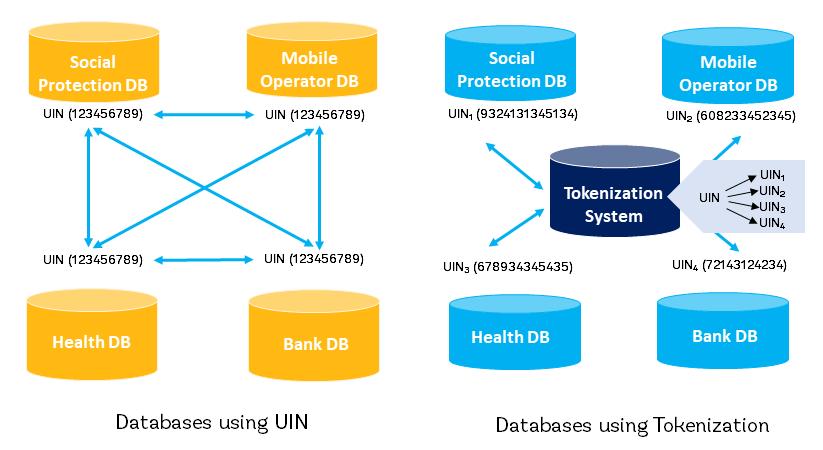
A strong pattern is to replace customer_email with customer_key before events reach widely accessible reporting tables. The customer_key can support joins between orders, subscriptions and usage without disclosing the person’s identity.
If authorized re-identification is necessary, keep the mapping between customer_key and source identity in a separate, tightly controlled store. Limit who can query it, log access and prevent the BI service account from reading it by default.
For deterministic keys, consider a managed tokenization service or a keyed cryptographic construction with appropriate secret management. Naively hashing an email address is often weak because common addresses can be guessed and compared against hashes. A random token plus a protected mapping can be safer for reversible workflows.
Key rotation, token consistency across systems, collision handling and deletion of the mapping all require explicit design. Tokenization reduces exposure; it does not automatically make the underlying events anonymous.
5. Decide where to remove sensitive fields
The earliest safe removal point is often the best one. If an analytics connector can select columns, exclude unnecessary PII at extraction. If the source API forces a full payload, restrict landing access and strip unwanted fields during the first controlled transformation.
A common pipeline has a restricted landing area, a sanitized staging layer and curated reporting marts. Raw data may be needed briefly for recovery or reconciliation, but it should not be an unrestricted permanent copy of every source field.
Do not assume that removing PII from the final dashboard is enough. It may still be present in raw tables, query results, temporary tables, materialized views, notebook outputs, data extracts, logs and developer test datasets.
Treat every persistence point as a potential exposure surface. Draw the data flow from source API through connector, landing storage, transformations, warehouse, BI semantic model, export and backup. For teams building that end-to-end model, Actiknow’s Business Intelligence practice covers data integration, modeling and dashboard implementation.
6. Masking is useful, but it is not minimization
Dynamic data masking can show different values to different roles at query time. An authorized service team might see a complete email address, an analyst might see a partial value, and a broad reporting role might receive NULL.
This is useful defense in depth when the warehouse must retain a sensitive column for a justified purpose. But the original data still exists. A misconfigured privileged role, export path or copied table can expose it.
Snowflake documents policy-based dynamic masking for tables and views, while BigQuery documents data policies and column masking. These are real platform capabilities, not substitutes for deciding whether a field belongs in the dataset at all.
Prefer removing unneeded columns from analytical marts, then masking the smaller set of justified sensitive fields that remain. Test the exact roles used by BI connections, scheduled refreshes and service accounts rather than testing only an administrator login.

7. Restrict dimensions as carefully as measures
A report can leak personal information through dimensions even when all obvious identifier columns are hidden.
Consider an executive dashboard showing revenue by branch, customer age, medical category and date. One unusually specific combination may correspond to a single person. Drill-through, slicers, tooltips and downloadable detail can make that person identifiable.
Review the minimum group size and the combinations users can create. For higher-risk data, consider suppressing small cells, coarsening geography or age bands, limiting drill-down, adding carefully designed noise or using privacy-preserving aggregation methods.
Avoid relying on a fixed small-cell threshold as a universal guarantee. Repeated queries and differencing between totals can reveal a suppressed value. Review the complete interaction pattern, especially if users can export or query underlying data.
8. Build access around the user’s actual job
Warehouse roles should reflect business purpose rather than organizational seniority alone. A CFO may need revenue by region but not a list of employee health details. A customer support specialist may need a customer’s email but not every customer’s payment history.
Use least-privilege access at the table, column and row level. Where appropriate, combine role-based permissions with attributes such as business unit, geography, customer tenant or approved purpose.
Separate data administration from unrestricted data viewing when the platform supports it. Review inherited privileges, secondary roles, shared service accounts and BI gateways. A report’s row-level security may not protect a direct SQL query against the underlying warehouse.
The access test should ask what a real user can retrieve across every supported interface, not only what appears on the dashboard’s first screen.
9. BI extracts and exports are part of the privacy boundary
A well-protected warehouse can still be undermined when a dashboard imports a full dataset into a BI service, allows underlying-data export or sends scheduled reports as attachments.
Inventory import versus live-query modes, extract refresh credentials, cached results, subscriptions, PDF exports, CSV downloads, embedded analytics, API access and personal workspaces. Identify where data is copied and which permissions govern each copy.
Where a report needs only aggregates, publish a purpose-built aggregate dataset. Where authorized drill-through is necessary, make it role-specific and audited.
Document what happens after a user’s access is revoked. The warehouse policy may update immediately while previously exported files, emailed attachments and offline extracts remain outside its control.
10. Use a purpose-based retention schedule
Retention should be tied to the reason a dataset exists, not a blanket rule that all warehouse history is valuable forever.
For each data product, define the business purpose, lawful basis where applicable, source owner, fields retained, retention period, disposal method and any legal hold or contractual exception. The correct period may differ for raw ingestion records, pseudonymized events, identity mappings, aggregate marts, logs and backups.
A retention policy should explain what is deleted, what can remain in aggregated form and how long recovery copies persist. It should also distinguish the live warehouse from backup restoration and time-travel features.
Avoid arbitrary “seven years for everything” defaults. Some records have mandated retention periods, while others should be deleted much sooner. Confirm requirements with counsel and records owners rather than treating a technical storage setting as a legal determination.
11. Engineer deletion as a repeatable workflow
A deletion request is rarely satisfied by deleting one row from a CRM. A person’s data may have propagated into raw landing files, staging tables, event streams, analytical marts, identity maps, extracts and downstream applications.
Create a subject-to-data lineage map. The workflow should locate the relevant identity and tokens, determine which records are in scope, apply approved legal exceptions, delete or transform the appropriate data, and record completion without retaining unnecessary personal details in the audit log.
Use idempotent jobs so a retry does not produce inconsistent outcomes. Define what happens to immutable snapshots, warehouse time travel, backups and restored environments. Some systems require deletion to propagate when a backup is restored rather than physically rewriting every historic backup immediately.
The privacy team should own the decision about scope; engineering should own the reliable execution and evidence. Neither should operate in isolation. Where deletion crosses applications, APIs and warehouses, Actiknow’s Custom Solutions practice includes system integration and database work.
12. Prevent re-ingestion after deletion
Deleting a customer from a warehouse does little good if the next connector sync restores the record from an unchanged source, an old event queue or a replayed file.
Establish an authoritative deletion or suppression signal and ensure ingestion respects it. If upstream systems must also erase data, coordinate the sequence. If some data must remain for a legitimate obligation, distinguish that restricted record from ordinary analytics use.
A carefully controlled tombstone or suppression key may be necessary to prevent re-creation, but it too needs a justified purpose, limited retention and restricted access.
Test deletion with a replay scenario: remove a subject, rerun historical ingestion, refresh the BI model and confirm the subject does not silently reappear.
13. Protect development, testing and support environments
Privacy controls frequently fail outside production. Engineers copy a real customer table into a development project, download a CSV for troubleshooting or attach a query result to a support ticket.
Default to synthetic data or a purpose-built sanitized subset. If production-like patterns are essential, transform the data under a reviewed process that preserves analytical distributions without exposing identity.
Limit developer access to the identity map, production secrets and raw sensitive fields. Apply retention to temporary datasets and tickets. Scan notebooks, logs, query history and cloud object storage for accidental copies.
An environment labeled “non-production” is not inherently low risk when it contains real personal data.
14. Understand the limits of encryption and hashing
Encryption protects data against some threats while it is stored or transmitted, but an authorized query can still return plaintext. Hashing can make a value harder to recognize, but low-entropy inputs such as phone numbers or emails may be recoverable through guessing.
Pseudonymization separates identifying information from analytical activity and reduces exposure. Anonymization requires a stronger conclusion: people are no longer identifiable in the relevant context. The ICO explicitly distinguishes these concepts.
Choose controls according to the threat model. Encryption at rest, TLS, secret management, access policies, tokenization, minimization and aggregation address different failure modes.
The practical rule is to avoid calling a dataset anonymous unless a documented assessment supports that claim.
15. Do not overlook data quality and reconciliation
Removing PII can break reporting if the team discards the only stable join key or fails to handle changes in source identifiers. Privacy design must preserve necessary analytical relationships without preserving unnecessary identity.
Define the entity grain: customer, account, household, device, order or transaction. Use a surrogate key that remains stable for the approved analytical purpose. Track merges, splits, account transfers and source-system changes.
Reconcile totals before and after sanitization. Confirm that revenue, order counts, unique customers, cohort retention and attribution still match within documented tolerances. If a new policy changes historical comparability, annotate the dashboard and update metric definitions.
A privacy improvement is not complete if it silently corrupts the business’s numbers.
16. A practical example: customer retention reporting
Consider a hypothetical subscription business that wants to understand 90-day retention by acquisition channel and plan.
The source contains customer name, email, phone, billing address, subscription ID, plan, signup date, cancellation date and transaction history. The retention model needs a stable customer key, dates, plan, channel and status. It does not need the person’s name, phone or full billing address.
A restricted ingestion step maps source identity to a token. The reporting mart stores the token and relevant activity. Executives see monthly cohort aggregates. A small authorized operations team can use a separate workflow to locate a specific account when a legitimate support need exists.
The model still supports retention, conversion and lifetime-value analysis. It reduces the number of users and systems that handle direct identifiers. This is an illustrative architecture, not a claimed Actiknow client implementation.
17. Where platform-native controls fit
Snowflake’s dynamic masking policies can protect sensitive columns at query time. Its broader governance features also support access controls and classification, subject to configuration and edition. BigQuery offers column-level access controls and masking through data policies and tags. These controls are useful when teams must support multiple access levels over shared data.
However, platform policies need operational discipline. A query that materializes results into another table may not carry every original policy with it. Google Cloud’s documentation explicitly notes that policy tags are not automatically propagated in most query-result copy scenarios.
Build policy tests into transformations and deployment pipelines. Review copies, external tables, extracts, data sharing and cross-project permissions. Avoid assuming that a tag on a source column protects every downstream derivative forever.
18. Ownership: privacy, data and business teams need different responsibilities
A privacy officer can define obligations but should not be expected to repair a broken warehouse deletion job. A data engineer can implement masking but should not independently decide that all personal information is necessary.
Assign clear responsibilities. Business owners define the reporting purpose and acceptable loss of detail. Data owners approve access and retention. Privacy and legal teams determine obligations and exceptions. Data engineering implements minimization, lineage, masking and deletion. Security manages identity, secrets, monitoring and incident response. BI teams verify report-level exposure and export behavior.
Document who can approve exceptions and when those exceptions expire. Treat a temporary need for identifiable data as a time-bound permission, not a permanent role.
19. Monitor exposure, not just pipeline uptime
A successful daily pipeline tells you little about privacy risk. Track sensitive columns newly introduced, users with unmasked access, unauthorized query attempts, overdue access reviews, copies of restricted datasets and deletion-job failures.
Measure the percentage of reporting tables with classified columns and documented owners. Monitor whether sensitive fields appear in newly deployed models. Alert on unusual bulk exports and changes to masking policies.
Be careful with monitoring itself. Query logs, error messages and incident tickets can contain identifiers or snippets of sensitive data. Log metadata and correlation IDs where possible rather than full payloads.
Privacy observability should make exposure measurable without creating another uncontrolled data store. Actiknow’s security and data privacy page describes its own approach to information handling, permissions and access controls.
20. A 60-day implementation plan
Days 1–10: inventory high-value dashboards and the datasets behind them. Identify direct and indirect identifiers, user groups, exports and downstream copies. Select one reporting domain with meaningful exposure and a cooperative business owner.
Days 11–20: define the minimum fields and granularity for that domain. Agree on a tiered data model, token strategy, access matrix, retention requirements and deletion obligations. Record baseline report accuracy and refresh performance.
Days 21–40: implement restricted ingestion, sanitized staging and a governed mart. Apply masking and role policies where justified. Remove sensitive fields from general BI datasets. Test exports, service accounts, copied tables and development environments.
Days 41–50: implement or rehearse a deletion workflow, including re-ingestion prevention. Run negative-access tests with real role configurations and verify metric reconciliation.
Days 51–60: release the domain, document ownership, train analysts and set monitoring. Use the results to prioritize the next domain. This is an illustrative plan; complex regulated environments may require more time and formal assessment.
21. The executive scorecard
The most useful metrics combine reduced exposure with preserved business value.
Exposure: number of direct identifiers in broadly accessible marts, count of users who can retrieve unmasked values, number of uncontrolled exports and number of unclassified sensitive columns.
Control effectiveness: percentage of access reviews completed, deletion requests completed within policy, negative-permission tests passed, and sensitive-data findings resolved.
Analytical continuity: dashboard accuracy against approved reconciliations, refresh latency, critical metric availability and analyst time spent working around restrictions.
The objective is not to maximize the number of masking rules. It is to reduce unnecessary sensitive-data exposure while keeping reporting reliable and useful.
22. Common failure patterns
Masking the dashboard but leaving raw data open: a user with SQL access can bypass the visual layer.
Replacing names with unsalted hashes: low-entropy identifiers may be guessed, and the data may remain linkable.
Using one BI service account for every audience: warehouse-level controls may see only the service identity rather than the viewer’s individual entitlement.
Deleting from the mart but not the source or replay queue: the next refresh reintroduces the record.
Treating aggregate data as automatically anonymous: small groups and differencing queries may reveal individual information.
Copying restricted tables into development without equivalent controls: the privacy boundary moves to the least protected environment.
These are architecture and operating-model failures, not problems solved by a single product setting.
23. Questions leaders should ask before approving the design
Can we name every sensitive field in the executive reporting model and explain why it is necessary?
Can a typical analyst join the event data without obtaining the identity mapping?
Can a customer-facing report user retrieve another customer’s data through exports or direct queries?
Can we trace a deletion request from the source system to every derivative and prevent re-ingestion?
Can we prove that masking and row restrictions work for the actual BI service identities?
Can we show that core metrics remain accurate after removing unnecessary fields?
If the answers are unclear, the project needs a short design and testing phase before broader rollout.
Frequently asked questions
What is the difference between PII and personal data?
PII is a commonly used term for identifying information. Legal definitions of personal data or personal information may be broader and can include indirect identifiers and linkable activity data. Apply the definitions relevant to your jurisdiction.
Should a data warehouse contain any PII?
Sometimes. Identity may be necessary for a justified operational or regulatory use. The goal is to restrict it to approved purposes and avoid distributing it through general analytics.
Is a hashed email address anonymous?
Not necessarily. Hashes can be guessed or linked, especially when the input has a limited search space. Pseudonymized data may still be personal data.
What is the difference between masking and tokenization?
Masking changes what a user sees, often at query time. Tokenization substitutes an identifier, with any re-identification mapping kept separately under tight controls. Both require sound access governance.
Can we retain customer cohorts after deleting personal data?
Potentially, if the retained output is genuinely anonymous or another lawful basis permits retention. A stable token or a small-cell aggregate may still be personal data. Assess the specific output and legal requirements.
Does warehouse row-level security protect exported files?
Not after an export leaves the controlled environment. Manage BI download permissions, destinations, retention and sharing separately.
How do we handle deletion in backups?
Document backup retention, restoration controls and deletion replay. The right approach depends on applicable obligations and technical capabilities; a live-table delete alone is insufficient.
Will removing PII break customer lifetime value reporting?
It need not. A stable pseudonymous customer key can preserve approved longitudinal analysis while reducing direct identification. Test joins, deduplication and historical reconciliation.
Who should own the privacy controls?
Business, privacy, security, data engineering and BI teams have complementary roles. One accountable data owner should coordinate purpose, access and lifecycle decisions.
Conclusion: make identity an exception, not the default
The most effective PII strategy is not to hide every sensitive field behind a masking policy. It is to avoid moving unnecessary identity into analytics in the first place.
Start with the decisions executives need to make. Preserve stable analytical relationships where justified, separate identity mappings, restrict detailed access, review small-group exposure and engineer deletion into the pipeline. Then prove that reporting still works.
If you are evaluating a privacy-aware reporting architecture, contact Actiknow to discuss the specific systems, controls and reporting requirements involved.