

The executive decision: test the impact, not necessarily the entire warehouse
A change to one staging model should not automatically force a data team to rebuild every transformation in its analytics estate. But testing only the edited SQL file is equally risky. The edit may change a metric that flows through intermediate models into executive dashboards, regulatory extracts or customer-facing reports. The useful middle ground is to identify the changed resources, include the downstream models that could be affected and reuse stable upstream data where appropriate.
That is the purpose of Slim CI in dbt. It uses a previous project manifest to detect what changed, dbt’s dependency graph to expand the test scope and deferral to avoid rebuilding unrelated upstream models. Snowflake’s native dbt Projects support for these workflows became generally available on September 10, 2026, according to the Snowflake release announcement. Availability does not eliminate the need to design an appropriate testing policy.
The management question is not simply whether CI finishes faster. It is whether the organization can deliver trustworthy analytics changes more frequently while retaining enough evidence to detect material regressions before production users see them.
What Slim CI actually does
A traditional full-build CI job executes the entire dbt project in a separate environment, then runs its associated tests. This is straightforward to reason about, but execution cost and elapsed time can grow with project size, especially when expensive upstream models are repeatedly rebuilt.
Slim CI compares the proposed project against a reference state, normally the manifest from a successful production execution. A selector such as state:modified+ identifies modified resources and their downstream dependents. The trailing plus sign matters: it expands the selection to descendants, not merely the changed model itself.
A separate flag, –defer, tells dbt how to resolve references to upstream models that are not being built in the CI target. Where eligible, those references can point to existing production relations instead of rebuilding the same upstream data. Selection decides what to execute; deferral decides where unbuilt dependencies are read from. They are complementary controls, not interchangeable features.
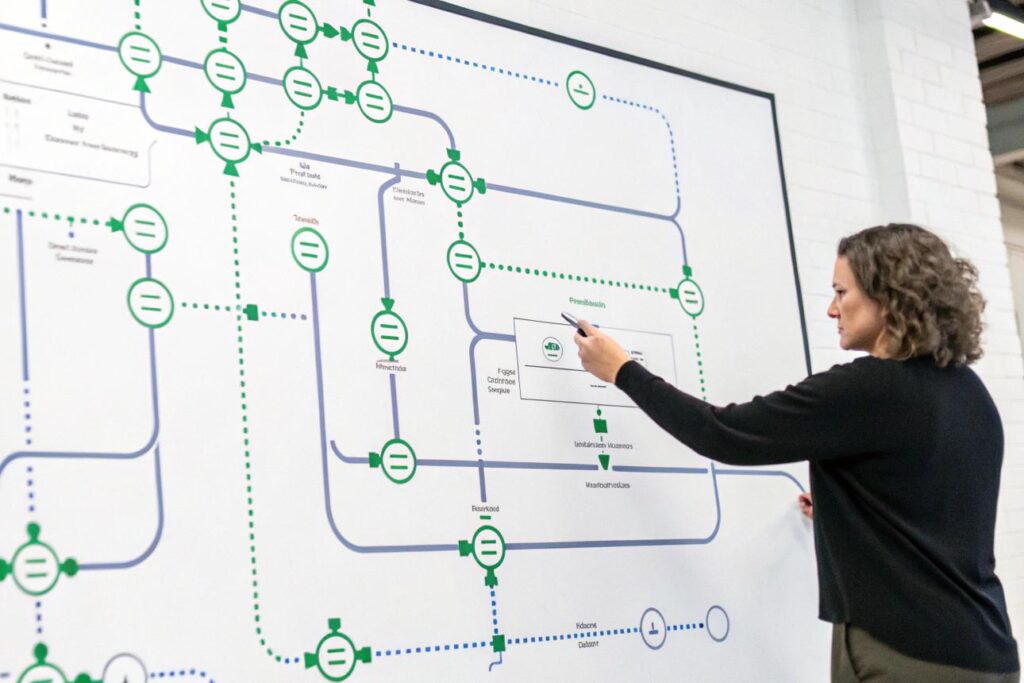
Consider a simplified dependency chain: raw orders feeds stg_orders; stg_orders feeds fct_orders; fct_orders feeds mart_revenue; mart_revenue supports a finance dashboard. If a pull request changes stg_orders, a properly scoped selection should include affected downstream transformations and relevant tests. It need not reconstruct an unrelated customer-service pipeline. If an unchanged upstream customer dimension is required, deferral may reuse its production relation.
Slim CI is not the same as an incremental model. Slim CI decides which nodes of the transformation graph to execute during a validation run. Incremental materialization decides which rows a selected model processes. A team can use both, but they solve different problems.
Why Snowflake’s native support matters now
Historically, teams running dbt outside Snowflake often stored production artifacts in a CI system, object storage or a managed dbt platform. Snowflake’s native dbt Projects can now make artifacts from recent executions available directly to development and CI workflows. That reduces the need for a separate artifact-handling mechanism for this particular deployment pattern.
The important files are manifest.json, which records resource definitions and dependencies; run_results.json, which records execution outcomes; and sources.json, when source freshness comparisons are relevant. Not every selector needs every file. The state:modified+ selector relies on the manifest, while result:error+ relies on run results.

The Snowflake guide to dbt artifacts and deferral describes system functions for retrieving the last successful production run’s target artifacts and importing them into a new execution. It also documents a CI workflow using Snowflake CLI and isolated pull-request databases.
Native support is a convenience, not an instruction to migrate every dbt deployment into Snowflake. Teams with established dbt platform or self-managed pipelines should compare functionality, operational responsibilities, access controls and total cost before changing their execution model.
The architecture: five boundaries that must remain clear
A pull request should identify the Git commit, changed files, reviewers and the reason for the change. CI must test that exact revision. A successful test against an earlier commit is not a valid approval for a later one. Preserve the branch and commit reference alongside the CI execution record.
2. Production state is a controlled baseline
The reference manifest should come from a known, qualifying production execution, not an arbitrary developer run. Store or retrieve enough metadata to establish its origin, recency, dbt version and deployment target. If the reference is stale or unavailable, the pipeline should fail clearly or switch to a documented full-build fallback.
3. CI writes only to isolated destinations
Each pull request needs its own target schema or database, or another isolation strategy that prevents collisions between concurrent jobs. The CI role should be unable to overwrite production models. Names should be deterministic, cleaned up after use and traceable to the pull request.
4. Production references are read-only
Deferral can make CI read production relations. That requires explicit authorization and an assessment of sensitive data exposure. Use a narrowly scoped read role, masking and row-access policies where applicable, and synthetic or restricted test data when production access is inappropriate.
5. Release gates are separate from execution
A green dbt command is necessary but not sufficient. The pipeline should also check freshness, reconciliation, business-critical metrics, documentation changes and reviewer approvals according to the risk of the proposed change. Merge and deployment permissions should remain distinct.
A practical example: what runs after a change?
Imagine a Snowflake project with 180 models across marketing, finance, membership and operations. The numbers here are illustrative, not an Actiknow client result. A developer changes a customer-status transformation that feeds six downstream marts and two executive reporting datasets.
A file-only test might compile the edited model and miss a changed join cardinality that duplicates customers in a downstream mart. A full project build might detect the problem but also spend resources rebuilding independent marketing and operations models. A state-aware selection targets the edited transformation, its descendants and the relevant tests, while deferring eligible unchanged ancestors.
The team should still add targeted assertions: customer IDs remain unique, membership totals reconcile to the approved source, status classifications match documented rules and sensitive records remain appropriately restricted. These checks test business meaning, not just SQL validity.
If a shared macro changes, the affected set may be far larger than expected. State comparison can flag dependent resources, but dynamic SQL, macros, environment variables, cross-project dependencies and external systems can complicate impact analysis. Review the selected node list rather than assuming that a small Git diff always produces a small execution set.
How to implement Slim CI in Snowflake
Step 1: Establish a reliable production artifact
Deploy the production dbt project object and execute a qualifying run. Snowflake documents a requirement for a recent qualifying production execution before artifact retrieval; check the current retention window and ensure scheduled production runs keep the reference available. Compilation at deployment alone does not substitute for a qualifying run.
Confirm that the project object uses the live-version behavior required by the relevant features. Snowflake’s 2026_06 behavior change and migration guidance are important for older project objects. Verify the account’s actual state before attempting to migrate or recreate anything.
Step 2: Provision the CI identity
Grant the CI role only the rights it needs to deploy and execute the test object, use the designated warehouse, read permitted upstream relations and monitor the production dbt project object. Snowflake’s documented artifact retrieval path requires MONITOR on the production object. Do not grant production write privileges merely to simplify setup.
Step 3: Create an isolated target
Use a per-pull-request database or schema. Define naming, retention and cleanup rules. When cloning is appropriate, assess what objects and policies are included and whether the clone exposes production data. Isolation should be demonstrable in permissions and resource naming, not merely an environment variable.
Step 4: Import state and execute the changed graph
A representative Snowflake CLI pattern, adapted from the official guide, is:
snow dbt deploy tester_dbt_project –source ./path/to/dbt_project –no-auto-compile
snow dbt execute –import “SYSTEM$DBT_GET_LAST_SUCCESSFUL_RUN_TARGET(‘MY_DB.MY_SCHEMA.PROD_DBT_PROJECT’) AS ‘state'” tester_dbt_project build –target dev –state ./imports/state –defer –select state:modified+
These commands are an architectural example, not a copy-and-run production script. Replace identifiers, configure authentication, ensure the dev target resolves to the isolated destination, and validate CLI syntax and supported versions in your environment. The shell may require escaping the dollar sign in the system function name. In Snowflake Workspaces, equivalent advanced options can enable deferral and select the reference run.
Step 5: Inspect the selection before trusting it
Record the selected nodes and the reason each was selected. Flag unusually broad selections, unexpectedly empty selections and changes to shared macros, packages or project configuration. A pipeline that executes zero models can be correct for a documentation-only change, but it should not silently declare a business-logic edit safe.
Step 6: Publish test evidence to the pull request
Attach the execution outcome, selected-node count, tests passed and failed, artifact provenance, elapsed time, warehouse usage where measurable and links to diagnostic logs. Reviewers should be able to answer which models were validated and which production references were used without opening a terminal.
Step 7: Keep deployment separate
After review, merge the approved commit, deploy that commit to production and monitor the first production execution. Record the production query or run identifier. Do not treat a successful CI run as proof that the next production refresh will produce identical values under different data volumes or access policies.
The tests that must survive a smaller build
Slim CI reduces execution scope; it should not reduce the standard of evidence for important business outcomes. Tests should be attached to the resources and contracts they protect so that dependency selection includes them when relevant.
Structural and contract tests
Check uniqueness, non-null keys, accepted values, relationship integrity and documented column types. Add schema-contract enforcement for interfaces consumed by multiple teams. Treat renaming or removing a published field as a compatibility change, not just a refactor.
Business-rule and reconciliation tests
Validate key measures against authoritative systems or agreed control totals. For example, an order mart may need to reconcile gross sales, refunds and cancellations by accounting period. A green row-count test alone cannot prove that revenue is correct.

Regression checks for high-impact marts
For executive-facing datasets, compare approved baseline outputs with proposed outputs using controlled fixtures or a bounded, explainable production slice. Define tolerances in advance. An unexpected 8% change in an executive KPI is a review event even if every dbt generic test passes.
Freshness and upstream availability
Slim CI does not automatically guarantee that production upstream data is fresh. A deferred model can be structurally valid but stale. Add freshness checks and distinguish an upstream ingestion incident from a transformation regression.
Security and privacy checks
Verify that changed models do not widen access, bypass masking or expose restricted attributes through new joins. Production deferral must respect the same access constraints as ordinary queries. Never make a CI role more privileged than the business process requires.
Performance checks
Measure the cost and execution characteristics of materially changed models. A new join may be correct but substantially more expensive. Use representative volumes for performance-sensitive paths; a small CI sample is not an adequate substitute for production-scale testing.
Where Slim CI can mislead teams
A manifest is a code-state record, not a data-quality certificate
State selection compares project definitions and dependency metadata. It does not know whether a source system silently changed a field’s meaning or whether today’s data contains a new anomaly. Source monitoring, periodic broader regression suites and production observability remain necessary.
Deferral can mix environments
An isolated target may contain a newly built child model reading an unchanged parent from production. This is intentional, but it means the test can span environments with different data volumes, access policies or refresh times. Document this behavior and decide when a fully isolated data snapshot is safer.
Tests can cross environment boundaries
Relationship tests involving multiple parents may operate against a mix of CI and production relations. Review test selectors and the dbt documentation on deferral behavior before treating every test as an isolated rehearsal.
Package upgrades, macros, materialization changes, project-level variables and external dependencies may affect resources beyond a simple file diff. Use explicit impact review and expand to full builds when the dependency graph is insufficient.
If no qualifying recent production execution exists, the intended reference state may not be retrievable. Define a fallback rather than letting CI compare against a random or stale manifest. Alert on missing state and repair the production artifact pipeline.
Faster CI does not prove lower total cost
Per-PR databases, clones, parallel jobs, frequent retries and long-running warehouses can offset savings from narrower model selection. Measure total warehouse credits and elapsed time across the release process rather than extrapolating from one successful run.
An executive release policy: three risk tiers
Tier 1: Routine, bounded changes
Examples include a clearly isolated dimension enhancement or a nonbreaking transformation correction with well-defined dependencies. Require state-aware CI, relevant tests, peer review and a monitored deployment. A full project build may be unnecessary if coverage is demonstrably adequate.
Examples include changes to customer identity, revenue definitions, common macros or broadly reused staging models. Require Slim CI plus business reconciliation, representative data comparisons, data-owner approval and explicit inspection of the dependency selection. Expand testing when the selected graph does not capture known external consumers.
Tier 3: High-consequence or platform-wide changes
Examples include a major package upgrade, cross-project contract change, access-control redesign or a transformation that feeds regulated reporting. Require a full or specially designed integration regression suite, documented rollback or correction procedures, and a formal release window if operationally necessary.
The classification should depend on business consequence and blast radius, not on the number of edited lines. A one-line change to a shared currency conversion can be more consequential than a 100-line refactor of an unused model.

Metrics that show whether the approach works
Track pull-request CI duration at the median and 95th percentile, not just the best run. Measure selected versus total models, but do not use a low selected percentage as a success metric in isolation. A small selection is valuable only if it captures the real impact.
Track warehouse credits per pull request, total retries, artifact retrieval failures, cleanup failures, and time from first review to deployable approval. For quality, measure escaped defects, production rollback or correction events, failed downstream reports and incidents attributable to transformation changes.
Add two governance indicators: the share of material changes with an approved business-level test, and the share of production releases traceable to an exact tested Git commit. These make the efficiency conversation accountable to reliability.
Use a baseline period with the existing full-build process, then compare similar classes of changes after adoption. Workload mix, project growth and data volume can distort a simple before-and-after percentage.
A 30-day implementation roadmap
Week 1: Inventory and baseline
Map the project DAG, identify critical downstream reports, list current CI tests, record median and tail CI times, and confirm how production artifacts are generated. Classify high-impact models and define a small pilot project or domain.
Week 2: Prove state selection and isolation
Configure a dedicated CI role, a per-PR target and artifact retrieval. Test one trivial edit, one downstream-impacting edit, one shared-macro change and one intentionally failing test. Verify that the selected node list matches the expected blast radius.
Week 3: Add business controls
Implement reconciliation and contract tests for important marts. Publish execution evidence into pull requests. Exercise stale-artifact handling, missing production relations, permission failures and cleanup. Document when the pipeline must fall back to a broader build.
Week 4: Operate and evaluate
Run the pilot alongside the existing process for representative changes. Compare execution time, credits, defect detection and reviewer effort. Approve wider rollout only after the team can explain observed gaps and has owners for the remaining risks.
What the CTO or analytics leader should ask before approval
- Can we trace each CI result to an exact commit and a known production reference run?
- Are modified models and downstream dependents included, and can reviewers see the selected graph?
- Can the CI identity read only approved production inputs and write only to isolated targets?
- What happens if production artifacts are stale, unavailable or incompatible?
- Which business-critical metrics are reconciled, and who signs off on material changes?
- When do we require a full build, a larger integration test or a controlled release?
- How do we detect regressions after deployment, and who owns the response?
- Are we measuring end-to-end cost and reliability rather than only CI runtime?
Frequently asked questions
1. Does Slim CI mean only the edited model is tested?
No. With state:modified+, dbt selects modified resources and their downstream dependencies. The precise selection depends on the manifest and project graph. Teams should inspect the selected nodes, especially after macro or configuration changes.
2. What does the plus sign in state:modified+ do?
The trailing plus selects descendants of modified nodes. Without it, downstream consumers that may break because of an upstream change could be omitted from the selected build.
3. Does –defer copy production tables into CI?
No. It generally resolves eligible unbuilt upstream references to existing relations described by the reference manifest. It is not a data copy, and the CI role needs permission to read those relations.
4. Can Slim CI replace a full regression suite?
Not universally. It is appropriate for many routine pull requests, but major platform changes, external dependencies, data drift and critical business rules may require broader tests or representative snapshots.
5. Does it work with incremental dbt models?
Yes, but node selection and row-level incremental processing are different mechanisms. Test incremental logic carefully, including merge keys, backfills, late-arriving data and full-refresh behavior when relevant.
6. What if the production manifest is missing?
The pipeline should stop with a clear error or use a preapproved fallback. Snowflake’s native artifact retrieval depends on qualifying recent executions; do not silently use an unrelated manifest.
7. Can developers use production data safely?
Only when access and privacy requirements permit it. Deferral may read production relations, so apply least privilege, masking, access policies and documented data-handling rules.
8. Is this feature generally available in Snowflake?
Snowflake announced general availability for Slim CI and defer-to-production support in dbt Projects on Snowflake on September 10, 2026. Specific prerequisites, live-version behavior and supported command combinations still need validation for each account.
9. What should be measured to justify adoption?
Compare end-to-end pull-request duration, warehouse credits, selected-model coverage, escaped defects, artifact failures and production incident rates. Avoid asserting savings without an actual workload baseline.
10. Should every dbt team move execution into Snowflake?
No. Existing dbt platform or self-managed deployments may already support state-aware CI effectively. Evaluate security, integration, orchestration, governance, operational support and cost before migrating.
The bottom line
Snowflake dbt Slim CI offers a practical way to stop rebuilding unaffected transformations on every pull request. Its value comes from combining reliable production artifacts, graph-aware selection, controlled deferral and business-level regression checks. The goal is not the smallest possible test run. It is the smallest defensible test run for the risk of the change.
Teams improving their release process should start with a measured pilot, publish evidence that reviewers can understand and reserve broader tests for changes with wider consequences. A faster pipeline is useful only when the numbers executives depend on remain trustworthy.
How Actiknow can help
Actiknow’s business intelligence consulting and implementation services cover data integration, modeling and analytics delivery. Teams revisiting their Snowflake and dbt release process can connect that engineering work to the reporting contracts and KPI checks their stakeholders actually use. Its business intelligence dashboard services also provide relevant context for protecting downstream reporting from transformation regressions.
If your organization needs to assess a current analytics release workflow, define meaningful regression gates or plan a measured Slim CI pilot, contact Actiknow to discuss the requirements. The first useful deliverable is a clear dependency map, risk classification and test-coverage plan, not a promise of a particular percentage of savings.
Technical references
Snowflake: dbt artifacts, Slim CI and defer-to-production documentation (verified November 2026).
Snowflake: September 10, 2026 general-availability release notes.
dbt Labs: state selection and deferral reference documentation.