

The real problem is not a slow worker. It is uncontrolled demand.
A business process can appear healthy when every individual API call works and still fail at scale. A sales platform may produce thousands of customer updates in minutes, while an ERP accepts only a limited number of writes. An approval workflow may generate work around the clock, while the downstream document service slows during business hours. A batch that once finished before breakfast can begin spilling into the next business day.
Adding more workers sounds like the obvious fix. It may be the worst one. More concurrent requests can exhaust a vendor quota, overload a database connection pool, increase lock contention and trigger a wave of retries. A well-designed queue absorbs bursts, but it does not create downstream capacity. The design must explicitly control how quickly work enters, waits, executes, fails and recovers.
For executives, the central question is not ‘How many messages can we enqueue?’ It is ‘Can every important business action reach a correct outcome before its deadline, including when a dependency slows or fails?’ That requires capacity planning, queue-age service levels, fairness, idempotency and operational ownership.
1. Define the business promise before choosing a queue
Separate work that must complete before a user receives confirmation from work that can safely finish later. A checkout screen should not say ‘inventory reserved’ if the reservation has merely been queued and could still fail. By contrast, sending a confirmation email, refreshing a dashboard or synchronizing a CRM record may be asynchronous if the product clearly communicates any pending state.
Write down four things for each workflow: the trigger, the authoritative system of record, the deadline and the failure consequence. ‘Process new leads quickly’ is not a measurable contract. ‘Ninety-five percent of accepted leads appear in the CRM within five minutes, and no accepted lead is silently lost’ is much closer. The target is an example, not a universal benchmark; set actual values with the business owner.
An architecture may combine a synchronous transaction for the critical decision with a durable asynchronous step for follow-up. For example, commit the order and its outbox event in one database transaction, then publish that event for downstream processing. This avoids declaring success based solely on a message that may not have been durably recorded.
2. Understand arrival rate, processing rate and backlog
Queue behavior begins with two rates. Arrival rate (λ) is the amount of work accepted per unit of time. Effective service rate (μ) is the amount successfully completed per unit of time, after accounting for downstream latency, throttling, retries and worker availability. When λ exceeds μ for long enough, backlog grows. A queue buys time; it cannot reverse that arithmetic.
Use an illustrative scenario. An automation receives 120 jobs per minute, but its downstream integration completes only 90 per minute. Backlog grows by 30 jobs per minute, reaching 1,800 after one hour, assuming no starting backlog or losses. If capacity later rises to 150 jobs per minute while new arrivals remain at 120, only 30 jobs per minute are available to drain the old backlog. Clearing 1,800 waiting jobs takes approximately 60 additional minutes. Real workloads vary, so model distributions rather than relying on one average.

Backlog change over a period is approximately arrivals minus successful completions, adjusted for cancellations, expirations and other state transitions. Recovery time is roughly backlog divided by spare processing capacity, provided spare capacity stays positive. If the normal arrival rate is already at the downstream limit, recovery requires reduced demand, greater permitted capacity, batching or a negotiated quota change.
Little’s Law, L = λW, relates average work in a stable system to throughput and average time in the system. It is useful for sanity-checking capacity, but it assumes a stable observation period and does not guarantee that urgent items meet deadlines. Use it alongside tail latency, oldest-message age and per-priority performance.
A capacity worksheet leaders can request
Capture peak arrivals per minute and hour; normal and p95 processing duration; maximum vendor requests per minute; requests consumed per job; retry rate; worker concurrency; database or service connection limits; payload size; acceptable queue age; recovery time after a two-hour outage; and the maximum backlog that can be retained. Measure actual limits in a representative environment and distinguish contractual quotas from observed performance.
If each job makes three vendor requests, a limit of 600 requests per minute does not support 600 jobs per minute. It supports at most 200 jobs per minute before retries, other consumers and safety margin. A batch endpoint may change that equation, but its partial failures, asynchronous status and batch size limits need separate testing.
3. Design a durable, observable queue lifecycle
A robust message should contain a stable job ID, tenant or business unit, work type, creation time, deadline or priority class, schema version, correlation ID and a reference to the payload. Avoid embedding secrets or unnecessary personal data. Large payloads may belong in encrypted object storage, with the queue carrying a durable reference and an appropriate retention policy.
Define explicit states such as accepted, available, leased or in progress, retry scheduled, completed, dead-lettered, cancelled and expired. State transitions should be observable and auditable. A message disappearing from the queue is not proof that its business operation completed; retain an application-level outcome record where the workflow warrants it.
The normal path is: validate the request; durably accept it; enqueue or publish; reserve processing capacity; claim the message; perform the idempotent operation; persist the outcome; acknowledge the message. If a worker crashes after the side effect but before acknowledgement, the broker may deliver the job again. The application must be able to recognize that it already performed the logical action.
For database-triggered events, use a transactional outbox when a business record and the event representing it must commit together. A publisher can then relay committed outbox rows to the broker. On the consumer side, an inbox or processing ledger keyed by business operation can prevent duplicate side effects. Neither technique makes an external vendor magically transactional; uncertain outcomes still need lookup, idempotency keys or reconciliation.

4. Backpressure: slow the source before the system collapses
Backpressure means communicating or enforcing that downstream capacity is constrained. It may operate at the producer, broker, consumer or vendor-client layer. The goal is to keep the amount of outstanding work within a safe bound rather than accepting an unlimited number of tasks that cannot meet their business deadlines.
For a synchronous API that cannot durably accept more work, return a clear overload response and retry guidance rather than a misleading success. For a request that has been durably recorded, a 202 Accepted response can be appropriate if the caller receives a job identifier and a way to check progress. Never return ‘completed’ when the work is only queued.
Apply bounded in-flight concurrency, token-bucket or leaky-bucket rate limiting, and vendor-specific throttling. For pull consumers, stop fetching new messages when the configured in-flight message or byte limit is reached. Google Cloud’s documented Pub/Sub flow-control behavior is one implementation of this principle, not a reason to assume all brokers behave identically.
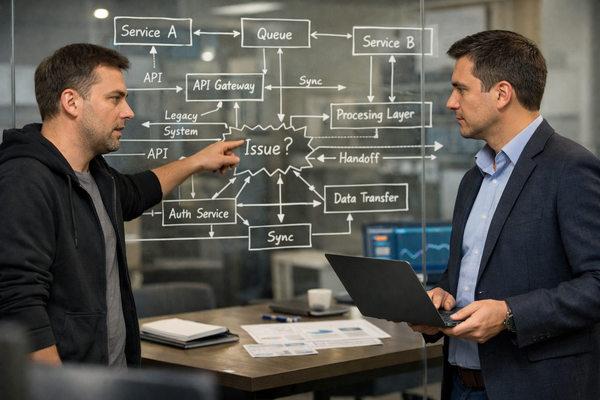
When a shared API quota serves several applications, centralize quota accounting or reserve explicit capacity. Otherwise one batch integration can starve interactive transactions. If a vendor provides Retry-After, honor it; a worker should not turn a rate-limit response into hundreds of immediate retries.
Backpressure is also a product decision. Decide what users see when work is delayed: a pending state, a delayed completion estimate, a manual alternative, or a refusal to accept new requests. For safety-critical or financially consequential operations, a hard stop may be preferable to a silently growing queue.
5. Concurrency should be bounded by the weakest dependency
Worker count is not equivalent to useful throughput. Suppose a worker spends most of its time waiting on network calls. Higher concurrency may initially help. Eventually a shared quota, database lock, CPU, memory, third-party rate limit or transaction contention becomes the bottleneck. Beyond that point, adding workers increases errors and cost.
Set concurrency by dependency and operation type, not merely by the number of messages waiting. An export worker, an email worker and a payment worker have different safe limits. Maintain separate controls for global concurrency, per-vendor concurrency, per-tenant concurrency and per-key serialization where business ordering requires it.
Autoscaling can respond to sustained queue age and demand, but scale-up must respect downstream ceilings. Scale-down should allow in-flight jobs to finish or safely release their leases. Load tests must include throttling and slow dependencies, not just an ideal sandbox. For a cloud-native application, Actiknow’s cloud application development offering is relevant to the surrounding application and integration architecture, but the specific broker and scaling model should follow measured requirements.
6. Prioritize business-critical work without starving everyone else
Not every task has the same cost of delay. A fraud-review event, a customer-facing status update and a weekly analytics export should not necessarily compete in one undifferentiated first-in-first-out queue. Define priority classes using business impact and deadlines, not who complains most loudly.
A practical design can use separate queues or worker pools for critical, standard and bulk work, with reserved capacity for the critical class. Add weighted fair scheduling or per-tenant quotas so one large customer does not monopolize the system. Periodically age lower-priority work upward or reserve a minimum share to prevent indefinite starvation.
Avoid strict global FIFO unless the business requires it. One poisoned message can block every later message. If ordering is required only within an account or order, partition by that key and process keys independently. Ordering and parallelism trade off: the narrower the ordering constraint, the more concurrency is available.

Record deadlines on jobs. If a promotional email is no longer relevant after the campaign ends, processing it two days later may be worse than expiring it. Conversely, an invoice synchronization may need completion even after its nominal SLA has been breached. Define expiry, cancellation and compensation rules by workflow.
7. Retry deliberately; do not manufacture a retry storm
Classify failures before choosing a retry policy. Temporary network errors, selected server errors and rate-limit responses may justify another attempt. Invalid data, revoked access, unsupported operations and business-rule rejections generally need correction, not endless retry. Authentication refresh can be a separate controlled path.
Use exponential backoff with jitter and a maximum attempt count or elapsed-time budget. Keep delayed retries out of the hot processing path when the broker supports scheduled delivery or a retry queue. A message repeatedly failing should not consume the same worker slot ahead of healthy work.
Distinguish the retry budget from the original work budget. If a dependency has capacity for 1,000 calls per minute and normal work uses 950, retrying failed work at 200 calls per minute guarantees additional overload. Reserve or dynamically allocate retry capacity, and pause retries when the dependency is visibly unhealthy.
Send exhausted or permanently invalid jobs to a dead-letter queue or exception workflow with reason, original ID, attempt history and ownership. A dead-letter queue is not a disposal bin. Define alerting, investigation, correction, replay approval and retention. A replay must be safe even if the original attempt partly succeeded.
For integration-specific error classification, Actiknow’s published guide to API integration rate limits, retries and webhooks provides additional operational considerations. It complements, rather than replaces, queue-level capacity design.
8. Idempotency and ordering protect the business outcome
Most practical messaging systems can redeliver work. Even where a broker advertises exactly-once delivery under defined conditions, that does not automatically make a payment, CRM write or email send exactly once. Treat delivery semantics, database commits and external side effects as separate concerns.
Give each logical action a stable idempotency key, for example tenant ID plus source event ID plus operation type. Persist the key and final outcome with appropriate uniqueness controls. When the same action arrives again, return or reuse the prior outcome rather than repeating the side effect. For a vendor API, use its supported idempotency mechanism or reconcile the target before repeating uncertain writes.
Ordering is similarly business-specific. A ‘customer updated’ event arriving after ‘customer deleted’ may resurrect a record if consumers blindly apply messages. Compare source versions or sequence numbers, fetch current authoritative state where appropriate, and define how stale messages are rejected. Do not assume queue insertion order equals business event order across producers.
Microsoft’s documentation on Service Bus duplicate detection explains a broker-level deduplication window. That is useful, but application-level deduplication and side-effect safety are still necessary outside that window and across systems.
9. Monitor queue age and completed outcomes, not just message count
Queue depth is useful but incomplete. Ten thousand small messages may clear quickly; a hundred expensive messages may breach a deadline. The most important leading indicator is often the age of the oldest eligible message, supplemented by age percentiles and the end-to-end latency of completed business actions.
Build an operations dashboard with accepted, completed and failed jobs per minute; queue depth by state; oldest ready-message age; p50/p95/p99 time from acceptance to successful completion; retry volume; dead-letter count; worker saturation; downstream 429 and 5xx rates; processing duration; and the number of jobs already beyond their deadline.
Segment these measures by workflow, priority, tenant and vendor. A healthy global average can conceal one customer whose records are stalled. Distinguish age of ready messages from jobs intentionally scheduled for later, and distinguish messages actively leased from those available to process. Different brokers expose age metrics with different semantics, so document how each metric is calculated.
Set alert thresholds from the business SLA and expected recovery time. For a five-minute completion target, an alert at five minutes may be too late. Use early warning when backlog growth predicts a breach, escalation when the oldest job approaches its deadline, and an incident when business outcomes are late. Monitor reconciliation against the source system, not only the broker.
An executive scorecard
Report five measures in plain language: percentage completed within the promised time; number of business actions currently late; oldest critical-job delay; estimated time to clear the backlog at sustainable spare capacity; and unresolved failures requiring intervention. Add a trend and a named owner. These measures connect queue engineering to customer experience and operational risk.

10. Test the conditions that production will eventually encounter
A passing happy-path test does not establish resilience. Test a tenfold arrival spike, a sustained overload, a vendor outage, a 429 response with Retry-After, a worker crash immediately after a successful external write, duplicate delivery, a delayed message, an out-of-order event, malformed payloads and a failed replay. Confirm both system recovery and business correctness.
Run a soak test long enough to reveal memory leaks, growing retry volume and hidden bottlenecks. Inject an outage, then measure whether the backlog drains within the agreed recovery objective while normal new traffic continues. Validate that workers do not overwhelm the recovering vendor. Test the worst plausible shared-quota condition, not merely a dedicated sandbox with no other consumers.
For a multi-tenant system, verify that one tenant cannot starve another, inspect another tenant’s payload or trigger actions under the wrong identity. Apply least-privilege service credentials, encryption, scoped access, redaction in logs and explicit retention. The queue is an operational component that can contain sensitive business instructions.
11. Choose the simplest architecture that meets the contract
A managed broker such as Amazon SQS, Azure Service Bus or Google Cloud Pub/Sub may be appropriate when durable messaging, multiple workers, retries and scaling are required. A database-backed job table can be sufficient for a small internal workflow if leasing, retry safety, indexes and operational visibility are implemented properly. A workflow engine is more suitable when work spans long-running human approvals, compensating actions or explicit state transitions.
Choose based on durability, throughput, ordering, retention, dead-letter support, scheduled delivery, observability, tenant isolation, regional requirements, cost and the team’s operating capability. Do not adopt a complex event platform solely because ‘microservices’ appears in an architecture diagram. Likewise, do not use an in-memory queue for business-critical work that must survive process restarts.
Actiknow’s custom solutions practice describes integrations, custom applications and workflow automation. Those are relevant capabilities when an organization needs to connect existing systems and design a durable operational process. The right design may still be a configuration change or managed integration rather than a new custom platform.
12. A practical 30-day implementation plan
Week 1: Map the work and establish the baseline
Identify the five most consequential workflows, their source and destination systems, owner, business deadline and failure consequence. Instrument accepted and completed timestamps. Measure arrivals, service time, error classes, vendor limits, current backlog and hidden manual interventions. Confirm whether the business actually needs asynchronous processing.
Week 2: Define the queue contract and capacity controls
Design message IDs, schemas, tenant boundaries, idempotency keys, retry taxonomy, dead-letter ownership and retention. Model peak arrival and recovery scenarios. Set bounded concurrency, shared-quota rules and priority allocation. Define exactly what a successful acceptance response means to the caller.
Week 3: Implement and break it safely
Build or configure the broker, workers, durable ledger, alerting and operational dashboard. Run duplicate, timeout, rate-limit, crash and outage tests. Verify that a message can be replayed without duplicate business effects. Test permission boundaries and a controlled dead-letter recovery procedure.
Week 4: Pilot, measure and transfer ownership
Release one lower-risk workflow first, then add critical work after reviewing results. Compare completion-time percentiles and reconciliation totals with the baseline. Document runbooks, escalation contacts, vendor dependencies and capacity limits. Set a monthly review for quota changes, traffic growth and SLA breaches. A queue is not finished until someone can operate it at 2 a.m.
A decision checklist for technology and operations leaders
Before approving the design, ask: Can we state which actions may be asynchronous? Are accepted jobs durably stored? Do arrival and service rates include retries and peak demand? Is concurrency bounded by downstream limits? Can one tenant or priority class starve others? Are writes safe to retry? Can failed jobs be investigated and replayed? Is queue age measured against a business deadline? Have we demonstrated recovery after a realistic outage? Who owns the queue when a vendor is unavailable?
If any answer is unknown, the risk has not disappeared. It has been deferred to production.
Frequently asked questions
What is backpressure in workflow automation?
Backpressure is a mechanism for limiting or slowing incoming or in-flight work when processing capacity is constrained. It prevents uncontrolled backlog growth and protects dependencies from overload. It can involve producer responses, consumer flow control, rate limiting and bounded concurrency.
Does adding a message queue make an integration faster?
Not necessarily. A queue can improve responsiveness and absorb bursts, but it does not increase the downstream system’s sustainable throughput. If processing capacity is lower than average demand, the backlog will continue growing until capacity or demand changes.
What is the difference between queue depth and queue age?
Depth counts waiting messages. Age measures how long work has waited. Age is usually more directly connected to business deadlines, while depth helps forecast the amount of work to drain. Both should be segmented by state and priority.
How do we calculate backlog recovery time?
Estimate sustainable completion rate minus new arrival rate. Divide backlog by that positive spare capacity. Then validate the estimate with a recovery test that includes retries, vendor quotas, competing workloads and variable job sizes.
Should every workflow have a dead-letter queue?
Every business-critical asynchronous workflow needs a defined path for work that cannot complete automatically. That may be a broker dead-letter queue or an application exception state. It must have ownership, investigation, retention and safe replay procedures.
How many retries should a worker attempt?
There is no universal number. Choose based on failure type, business deadline, downstream recovery behavior and capacity budget. Use backoff with jitter, stop on permanent errors and escalate when the retry or elapsed-time budget is exhausted.
Can we guarantee exactly-once processing?
A broker may provide specific exactly-once delivery or deduplication guarantees, but end-to-end side effects across external systems need separate controls. Use stable idempotency keys, transaction boundaries, outcome ledgers and reconciliation to protect business correctness.
When should we use separate queues?
Separate queues are useful when work has materially different deadlines, resource profiles, security requirements or failure modes. Avoid excessive fragmentation if it complicates operations without improving isolation or predictability.
Is FIFO always better for business automation?
No. Strict global ordering can reduce throughput and let one bad message block unrelated work. Use ordering only where business correctness requires it, often within a customer, order or aggregate key rather than across the entire system.
What should trigger autoscaling?
Use a combination of sustained queue age, arrivals, worker utilization and downstream headroom. Scaling only on queue depth can flood a rate-limited vendor. Apply hard concurrency ceilings even when autoscaling adds workers.
If the business permits deferred completion, durably retain accepted work, stop harmful retries, communicate delayed status and resume at a controlled rate. If the business requires immediate confirmation, fail or offer an explicit manual fallback rather than promising a result that has not occurred.
How do we know whether our automation queue design is working?
Track on-time completed business actions, unresolved exceptions, backlog recovery, oldest critical-job age, duplicates prevented and reconciliation differences. Healthy infrastructure metrics are useful, but the business outcome is the final test.
Conclusion: design for the rate you can safely complete
Reliable workflow automation is not a race to enqueue the most tasks. It is the discipline of accepting only work that can be accounted for, processing it within dependency limits, preserving correctness across retries and making delays visible before they become business failures. Capacity math, backpressure, priority, idempotency and queue-age SLAs belong in the initial design, not the incident postmortem.
If your integrations or internal workflows are struggling with bursts, vendor limits or delayed processing, Actiknow can help assess the workflow, integration boundaries and recovery requirements. Discuss your automation architecture with Actiknow to define a proportionate next step.
Further technical reading
Google Cloud Pub/Sub documentation: subscriber flow control and limits on outstanding work.
Microsoft Learn: Azure Service Bus duplicate detection and its configured deduplication window.
Google Cloud Pub/Sub documentation: exactly-once delivery semantics and regional constraints.