

The decision is about business guarantees, not just speed
An order changes status in an ecommerce platform. A CRM needs to reflect it, a finance application must reconcile it, and an operations team expects an alert if fulfillment stalls. Should those systems wait for an event notification or repeatedly ask the source API for updates? The choice between webhooks and polling determines not only how quickly the update arrives, but also what happens when the network fails, credentials expire, the provider throttles requests or an event is missed.
A webhook is an event-driven HTTP notification sent by a provider to an endpoint you operate. Polling is a client-initiated request, typically on a schedule, asking the provider what has changed. Neither mechanism inherently guarantees exactly-once processing, ordered delivery or complete historical recovery. Those properties must be designed and verified against the particular provider’s contract.
For executive sponsors, the right question is: What is the acceptable delay, loss risk and operating cost for each business process? A lead-routing workflow may require near-real-time action. A nightly invoice reconciliation may value completeness and auditability over immediacy. A resilient architecture can use both.
How webhooks actually work
The receiving application registers an HTTPS endpoint and, where supported, subscribes to selected events. When the provider observes a qualifying change, it sends a request containing event metadata, identifiers and sometimes the changed record. The receiver authenticates the request, persists it durably, acknowledges receipt promptly and processes it asynchronously. If processing is slow, the HTTP acknowledgment should not be held hostage to downstream systems.
A production webhook endpoint should normally validate a provider-specific signature or equivalent authentication, enforce payload-size limits, record an event identifier, reject replay attempts where supported and enqueue work before returning a success response. Do not assume a signature exists for every provider; check its documented security model. A successful HTTP acknowledgment usually confirms receipt, not completion of all business effects.
Webhooks excel when the provider supports relevant events, notification latency matters, changes are sparse or irregular, and your team can operate a reachable secure endpoint. They are less suitable as the sole truth source when event types are incomplete, delivery retention is short, payloads omit essential details, or recovery and replay are not supported.

How polling actually works
A polling worker requests a list of changed records at an interval, ideally using a documented updated-since filter, cursor or change feed. It stores a checkpoint only after the returned page or batch has been processed successfully. The worker must account for pagination, rate limits, timestamp precision, delayed updates, clock skew and records that disappear from ordinary list endpoints.
Polling is straightforward when the provider exposes a reliable change API and the business tolerates bounded delay. It also works when inbound HTTP access is prohibited. However, frequent requests can consume API quotas even when nothing changes, and a poorly chosen query can repeatedly scan large datasets. Polling is not automatically complete: an updated_at field may not reflect deletions, relationship changes or provider-side corrections.
A robust poller often uses a sliding overlap window and idempotent upserts rather than trusting a single timestamp boundary. For example, it can query records updated since the previous checkpoint minus a safety overlap, then deduplicate by stable record ID and version. This is a design pattern, not a universal guarantee; verify the source’s timestamp semantics.

Webhook vs polling: seven decision dimensions
1. Freshness and latency
Webhooks often deliver updates sooner because the provider pushes events as changes occur. But delivery latency can vary and provider queues can stall. Polling offers a predictable request cadence, not necessarily a predictable data-freshness SLA: a five-minute interval can still yield much older data if API updates lag or jobs fail. Define freshness as the time from a source business change to a verified downstream state, measured at percentiles rather than averages.
2. API quotas and cost
Polling cost grows with request frequency, number of tenants and endpoints, including empty responses. Webhooks reduce routine reads but may still require follow-up GET requests for full records. Estimate calls per tenant per day, response size, provider quotas, compute, queue storage and incident effort. For illustration, polling one endpoint every minute makes 1,440 scheduled calls daily per tenant before retries or pagination; 100 tenants would create 144,000 calls daily. That is arithmetic, not a claim about any vendor’s quota or pricing.
3. Reliability and missed changes
A webhook can be lost if an endpoint is unavailable beyond the provider’s retry window or if a receiver acknowledges before durable storage. A poller can miss records because of pagination errors, non-monotonic timestamps or incomplete API coverage. Reliability depends on durable checkpoints, retries, reconciliation and a defined repair path, not the transport label.
4. Ordering and duplicate delivery
Events may arrive out of order or more than once. Even providers that document ordered delivery may have limits on scope. Design consumers to be idempotent and compare source versions or authoritative timestamps before applying state changes. For financial workflows, preserve an immutable event audit trail and avoid blindly applying a late ‘pending’ event after a newer ‘paid’ state.
5. Security and network constraints
Webhooks require a reachable endpoint, secure secrets and verification against spoofed or replayed messages. Polling requires outbound API credentials, safe token refresh and controlled schedules. Both need least privilege, encrypted transport, secret rotation, tenant isolation, audit logging and a plan for credential revocation. IP allowlisting alone is not a substitute for payload authentication where signatures are available.
6. Provider capabilities
Read the actual API documentation before choosing. Confirm which events exist, whether payloads include record IDs, whether deletion events are emitted, how retries work, whether historical event replay is available, how long events are retained, and whether change queries support stable pagination. Some providers offer neither comprehensive events nor a trustworthy updated-since endpoint. In that case, additional snapshots and reconciliation may be necessary.
7. Operational ownership
An integration is a service, not a one-time connector. Assign an owner for provider API changes, signature validation, retry queues, token health, data mapping and incident escalation. Without this ownership, a design that looks cheaper in development can become expensive after launch.
A practical selection framework
Choose webhook-first when a relevant event exists, prompt response has business value, and you can durably receive and process notifications. Choose polling-first when the source lacks reliable webhooks, the business accepts scheduled freshness, and the API supports efficient incremental queries. Choose hybrid when webhooks provide speed but a periodic source comparison is needed for completeness, or when a provider offers webhook events that signal which objects to fetch.
For a sales-lead workflow, a webhook may initiate assignment in seconds, while an hourly reconciliation job identifies records missed during outages. For an accounts-payable ledger, scheduled polling or a formal change feed may be more appropriate if approved totals must be reconciled at a cutoff. For a field-service app with intermittent connectivity, neither mechanism alone resolves device-side synchronization conflicts; that requires a separate state and conflict-resolution design.
The integration architecture should be aligned with the application contract. Actiknow’s custom solutions services describe API-based system integration and workflow automation; those capabilities are relevant when a business needs more than a simple point-to-point connection.
Reference architecture for a resilient hybrid
- Receive: Verify the webhook and write the raw payload, provider event ID, tenant ID and receipt time to durable storage or a queue before acknowledgment. Return the provider’s required success code within its timeout.
- Normalize: Convert provider-specific events into a versioned internal contract. Preserve original identifiers and raw payload references for audit and debugging.
- Apply: Fetch authoritative record state when event payloads are incomplete. Use idempotency keys, transaction boundaries and version checks. Distinguish retryable failures from permanent mapping or permission errors.
- Recover: Retry with bounded exponential backoff and jitter. Route poison messages to a dead-letter queue with actionable context. Never retry indefinitely without visibility or limits.
- Reconcile: Run a scheduled comparison against the source using incremental cursors, periodic snapshots or provider replay APIs. Record mismatches and replay or repair them through a controlled process.
- Observe: Track source-change-to-target latency, delivery failures, queue age, duplicate rate, API throttling, reconciliation discrepancies and manual interventions. Segment metrics by provider and tenant to avoid hiding localized failures.
- Govern: Define retention, privacy controls, ownership, incident response, data deletion handling and version compatibility. Test provider outages and credential rotation before launch.
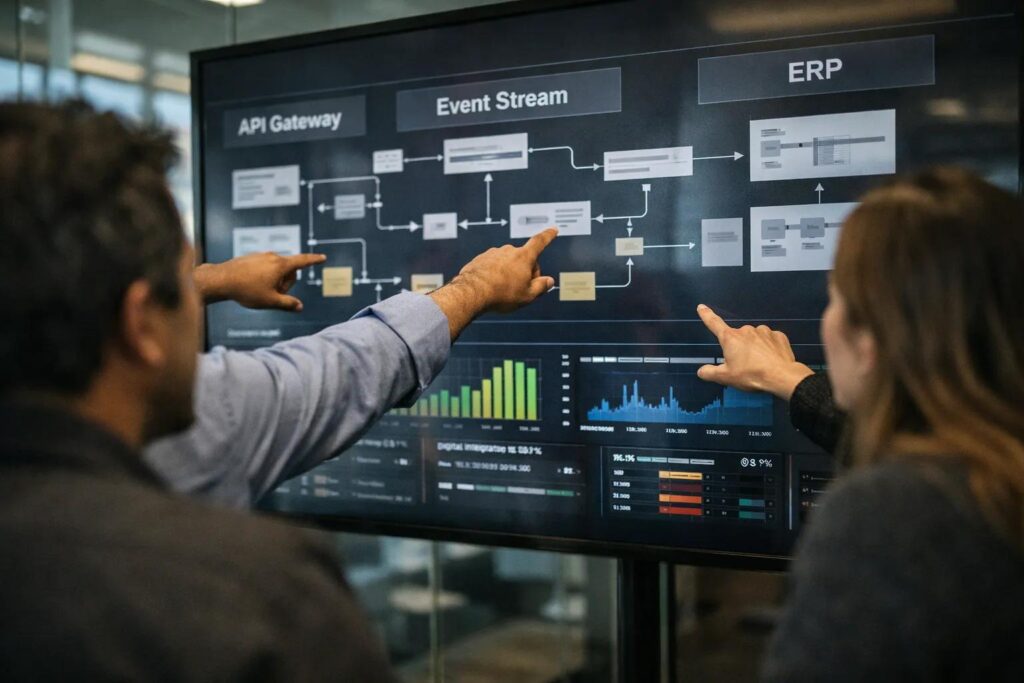
What to test before production
A useful acceptance suite injects duplicate events, reversed event order, malformed signatures, missing IDs, network timeouts, HTTP 429 responses, expired tokens, large backlogs and partial downstream failures. Verify that no business action is duplicated, checkpoints advance only after successful processing, and recovery produces the same authoritative final state as a clean run.
Also test deleted records and records modified during pagination. Measure peak traffic rather than average event volume. Verify that a temporarily unavailable downstream system does not force a webhook receiver to discard events or exhaust the provider’s retry budget.

Business metrics and service levels
Define a freshness objective by workflow, such as ‘95% of eligible updates visible within five minutes’ and a completeness objective such as ‘all source records reconciled by the next business-day cutoff.’ These are illustrative targets to be negotiated, not promises of any platform. Measure each against source timestamps and independent checks. Count stale records and exceptions, not merely successful HTTP requests.
A concise operating scorecard should show end-to-end latency percentiles, events accepted, events successfully applied, retry backlog age, reconciliation match rate, failed tenants, API quota utilization and unresolved exceptions. Establish who receives alerts and who can authorize a replay or manual correction.
Implementation plan: four phases
Phase 1: Discover and classify
Inventory systems, event types, API limits, credentials, data sensitivity and business-critical workflows. Document source-of-truth fields, deletion semantics and required freshness. Rank failure impact and reversibility. The output is a decision record for each integration, not a blanket enterprise preference.
Phase 2: Prototype the difficult cases
Build a small end-to-end path using real sandbox events and incremental API reads. Test signatures, idempotency, version checks and retry behavior. Capture measured latency, provider behavior and API consumption.
Phase 3: Harden and reconcile
Add durable queues, dead-letter handling, token monitoring, observability, reconciliation jobs and controlled backfills. Conduct security review and incident drills. Ensure records are not silently dropped when events are unsupported or source APIs change.
Phase 4: Launch with evidence
Run in parallel where practical, compare record counts and business totals, approve exceptions and establish an operational owner. Roll out gradually by tenant or workflow and document rollback criteria. After launch, review performance and costs against the agreed service levels.

Common mistakes to avoid
Treating a 200 response as proof that a transaction completed; applying every event without deduplication; using timestamps as the only ordering control; polling all records instead of changes; retrying 429 responses aggressively; storing webhook secrets in application code; assuming webhooks report deletions; and launching without a reconciliation process are recurring design risks. Each can be addressed with explicit contracts, durable state and operational testing.
Frequently asked questions
Are webhooks always real-time?
No. They are event-driven, but provider delivery queues, network delays and consumer processing can introduce lag. Measure actual end-to-end latency.
Is polling more reliable than webhooks?
Not inherently. Polling can recover missed events if the source exposes a complete change history, but it can also skip changes when queries or checkpoints are flawed.
Can we use webhooks and polling together?
Yes. A common pattern uses webhooks for prompt notification and scheduled polling or reconciliation for completeness.
What if the provider sends the same webhook twice?
Use a stable event ID where available, record processed IDs and make downstream actions idempotent. For state updates, compare authoritative versions.
What if webhook events arrive out of order?
Do not assume arrival order equals business order. Fetch current source state or use documented version numbers, sequence IDs or business rules.
How frequently should an API be polled?
Start from business freshness requirements, then test API quota, rate-limit, data volume and cost constraints. Adaptive schedules can reduce unnecessary calls.
How do we secure webhooks?
Use HTTPS, provider-documented signature verification or equivalent authentication, replay protections, least privilege, secret rotation and audit logs.
What happens when a webhook endpoint is down?
Behavior depends on provider retry and retention policies. Design durable receiving infrastructure and a documented source reconciliation or replay mechanism.
Can polling detect deletions?
Only if the API exposes deletion markers, a change feed or enough information to compare snapshots. An updated-since query may not detect removed objects.
What is the biggest integration architecture mistake?
Choosing a transport before defining business correctness, recovery requirements and who operates the integration after go-live.
The executive takeaway
Webhooks optimize responsiveness; polling offers controlled retrieval. Neither is a substitute for durable processing, idempotency, security, source reconciliation and accountable operations. The best design is the least complex approach that meets documented freshness, completeness and recovery requirements.
Discuss your integration requirements
If your application needs dependable connections between CRM, finance, operations or other SaaS systems, explore Actiknow’s custom integration and automation services. To review a specific workflow, API limitation or recovery requirement, contact the Actiknow team for a scoped discussion.