

An automation that runs is not necessarily an automation that works
A workflow can report 99.9% technical uptime while orders wait unprocessed, approvals expire and employees quietly revert to spreadsheets. The difference is between a system being available and a business obligation being fulfilled. Once a workflow goes live, operations leaders need a service-level agreement (SLA) that measures outcomes, not just infrastructure health.
Consider an invoice-processing workflow. Its scheduler fires every five minutes, the API responds successfully and its logs show no crash. Yet 200 invoices sit in an exception queue because vendor identifiers stopped matching. A technical dashboard looks green; accounts payable is falling behind. A meaningful SLA would flag queue age, exception volume, end-to-end completion and the number of invoices awaiting human review.
The right operating model separates the promises made to the business, the measurements used to evaluate them, and the internal objectives used to intervene before commitments are missed. That separation makes automation accountable without pretending every process can or should be fully automatic.
SLA, SLO and SLI: three terms worth distinguishing
An SLA is an agreed service commitment, including scope, service hours, exclusions, escalation and remedies or review procedures. An SLO is an internal performance target, usually set tighter than the external commitment. An SLI is the measurable indicator used to assess performance. For example, an SLA might promise that 95% of eligible invoices are posted within one business day; the SLO might be 98%; the SLI is the percentage of eligible invoices actually posted within that period.
Do not write an SLA until the business event, start and end points, denominator, calendar and treatment of exceptions are defined. Otherwise, teams can disagree about whether the workflow met its target even when they agree on the underlying data.

The 12 automation SLA metrics that matter
1. End-to-end completion time
Measure elapsed time from the accepted business request to its confirmed business outcome, not from when a worker first picks up a task. Report median, 90th and 95th percentiles, plus the percentage within the agreed deadline. Averages conceal the long tail that creates operational complaints. Separate elapsed calendar time from business-hours time where relevant.
2. Completion within SLA
Formula: eligible items completed by their deadline ÷ eligible items due in the measurement period. Define the cohort by due date to avoid making a slow backlog disappear simply because items remain unfinished. Show the numerator, denominator and late-but-open items. A percentage without volume is easy to misread.
3. Oldest queue age and age distribution
Queue depth alone is insufficient. Twenty new items may be healthy; two items stuck for a week may be critical. Monitor the oldest eligible item, counts by age band and the share approaching breach. Distinguish waiting for a system, waiting for capacity and waiting for an authorized human decision.

4. Exception rate
Formula: items entering an exception state ÷ eligible items started. Classify exceptions into business-rule failures, missing data, integration errors, permissions, duplicates and unknown causes. Trend both rate and absolute count; a declining percentage can still hide rising manual workload if volume grows.
5. Manual intervention rate
Measure items requiring a human correction, approval, override or re-entry. Keep necessary approvals separate from unplanned rescue work. A risk-controlled approval is not an automation failure, whereas repeatedly fixing invalid customer IDs is a design or data-quality problem.
6. Retry success and recovery time
Track initial failure rate, percentage recovered by automatic retry, retries per item, and time to recovery. Report items exhausted after retries as unresolved rather than counting the retry attempt as successful. Use idempotency keys and bounded backoff so retries do not duplicate invoices, payments or notifications.
7. Business outcome accuracy
A completed API call does not prove the right outcome. Sample or reconcile posted amounts, account mappings, status transitions and downstream confirmations against an authoritative source. Track erroneous completions and reversals. For high-risk workflows, accuracy and control failures deserve separate thresholds from timeliness.
8. Data freshness and synchronization lag
Measure how old the latest confirmed business state is when it becomes available to users or downstream systems. Include source event time, ingestion time and final availability time. A workflow may complete its internal step on schedule but leave the reporting dashboard or CRM stale.
9. Availability of the complete workflow
Measure the ability to accept and finish eligible work, not merely whether an endpoint returns HTTP 200. Include dependency health, credentials, message brokers, scheduled jobs and downstream services. State planned maintenance windows and whether partial degradation counts.
10. Backlog burn-down and throughput
Compare arrivals, successful completions and pending work per hour or day. If arrivals consistently exceed processing capacity, the system is accumulating operational debt even before SLA breaches appear. Watch for peak-period behavior, not just monthly totals.
11. Time to detect, acknowledge and resolve incidents
Measure detection lag, acknowledgement time, restoration time and time to reconcile affected records. Restoration is not complete until lost or delayed business work has been replayed or explicitly dispositioned. Keep incident severity linked to business impact.
12. Cost per correctly completed transaction
Combine infrastructure, platform/API fees, licensing and manual handling costs, then divide by correctly completed business outcomes. Use it as an efficiency measure, not as a substitute for service quality. A cheaper workflow that creates more downstream corrections is not necessarily better.
Build the SLA around a business contract
For each workflow, document: the trigger and unique business-item identifier; the accepted and excluded item types; the start timestamp; the completion event; the service calendar and timezone; the deadline; the system of record; the owners of technical failures and business exceptions; and the escalation path. Define pause rules narrowly. If a supplier must provide missing documentation, the workflow may be placed in a documented external-wait state, but that wait must remain visible rather than disappearing from reporting.
A useful contract for an employee-onboarding automation might say: eligible onboarding requests received before 3 p.m. on a business day must have accounts provisioned and confirmed before the next business day, except requests explicitly awaiting manager authorization. The report should show how many requests were excluded and why. It should also separately measure approvals waiting beyond policy limits.
Set thresholds by consequence, not convenience
An expense reimbursement and an access revocation should not share the same target. Prioritize regulatory deadlines, financial exposure, customer promises, reversibility and whether failure can be caught before harm. Use historical baselines to propose targets, then negotiate them with operations, risk and technology owners. Avoid arbitrary universal standards such as ‘99% of everything in one hour.’
Illustrative tiers, not industry benchmarks: a critical security revocation may require immediate alerting and tightly bounded resolution; a same-day order handoff may use a two-hour warning threshold; a low-priority archive task may allow a next-business-day target. The right numbers depend on the process, staffing model and contractual commitments.
Instrument the workflow so the numbers can be trusted
Every item should carry a durable correlation ID through trigger, validation, queue, execution, retry, approval and downstream confirmation. Record timestamped state transitions with reason codes, attempt numbers, owner and terminal status. Keep business outcomes distinct from technical events. A successful webhook delivery is not the same as a successfully fulfilled order.
A minimal event model includes workflow_id, item_id, event_time_utc, event_type, state_from, state_to, reason_code, attempt_number, system, owner_team and trace_id. Protect personal and financial information: logs should carry stable identifiers and operational metadata rather than unnecessary payloads or secrets. Retain events according to policy and make state changes auditable.
A practical data model uses one event history table and one current-state table. Compute SLA cohorts from the event history so historical reports can be reproduced after a status is corrected. Build reconciliation checks for missing starts, duplicate terminal events, impossible time ordering and items that vanish between systems.
An illustrative scorecard
Suppose 10,000 eligible cases are due this month. Of these, 9,600 reach confirmed completion on time, 250 finish late and 150 remain overdue. Completion within SLA is 96%, not 9,600 divided by the 9,850 completed cases. If 800 cases entered an exception state, the exception rate is 8%. If 500 required unexpected manual correction, the manual-intervention rate is 5%. These figures are hypothetical examples for demonstrating denominators, not Actiknow client results or performance benchmarks.
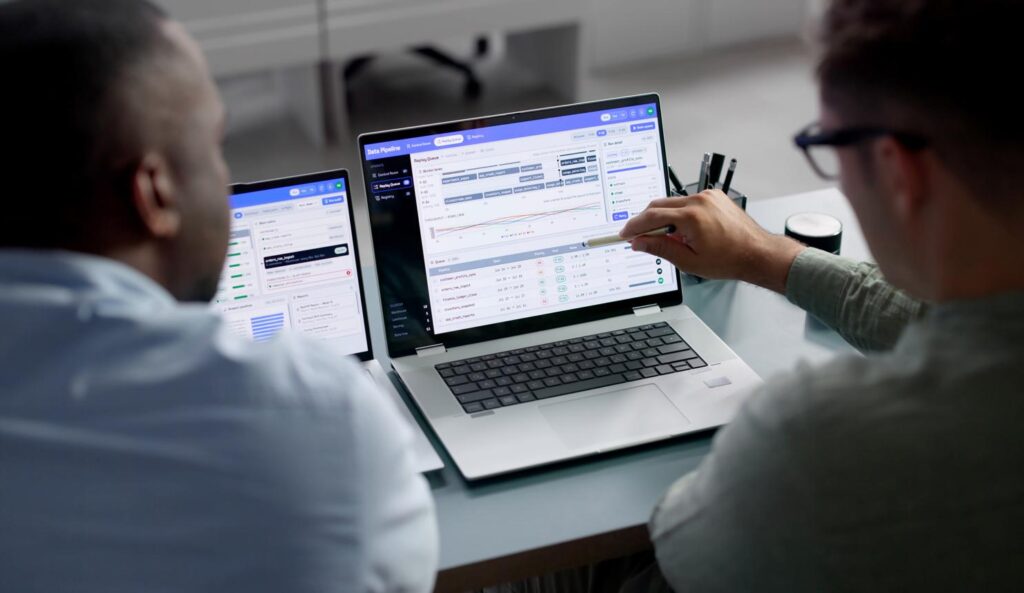
A useful executive view would display SLA attainment with due-volume context, overdue queue by age, top exception reasons, accuracy/reversal counts, trend by business unit, and an owner for each unresolved incident. A drill-down should take managers from a red metric to the affected items and their next action. For broader KPI design and reporting, Actiknow’s business intelligence services cover dashboard implementation and integration across data sources.

Alerting: warn early and route to someone who can act
Avoid alerts for every failed attempt. Alert on business risk: an item approaching its deadline, an aging queue, repeated failures for the same dependency, a sudden exception spike or a discrepancy between submitted and confirmed outcomes. Include severity, affected count, oldest item, probable dependency, owner, runbook and a link to the impacted cohort.
Use two thresholds: an early-warning threshold that allows intervention, and a breach threshold that triggers incident handling. Apply deduplication and escalation so teams are not overwhelmed by dozens of identical notifications. An incident should have a clear acknowledgement owner even when its root cause belongs to a vendor.

A four-week post-launch measurement plan
Week 1: define the business promises
Meet process owners, risk, finance and engineering. Identify the five most consequential failure modes and agree on eligible items, clocks, exclusions, severity and ownership. Publish a one-page SLA contract per workflow.
Week 2: establish trustworthy telemetry
Instrument state transitions and correlation IDs. Validate timestamps and service calendars. Reconcile event counts with source and target systems. Create exception categories and test the ability to reconstruct a single transaction.
Week 3: establish baselines and response
Run a shadow scorecard against actual activity, review p95 completion time and queue age, and simulate failures such as revoked credentials, vendor downtime and duplicate events. Tune alert thresholds and document incident response, retries and manual fallback.
Week 4: operationalize governance
Publish the scorecard, agree on business reviews and assign remediation owners. Review the worst recurring exceptions, prioritize fixes by volume and consequence, and capture approved SLA changes with effective dates. Do not silently rewrite historical definitions to make results look better.
Common mistakes that make automation reporting misleading
Counting task executions rather than business items inflates success when retries occur. Excluding unfinished cases from the denominator hides backlog. Reporting only averages masks severe outliers. Treating approved manual decisions as failures discourages sensible controls. Resetting the clock when a task is retried disguises delays. Measuring only the automation platform ignores upstream and downstream failures. And displaying a red metric without an owner creates visibility without accountability.
Where the process crosses APIs, web applications and approval tools, the monitoring design must follow the whole business transaction. Actiknow’s custom solutions offering explicitly includes integrations and operational automation, which makes the end-to-end service boundary a natural part of solution design.
Executive acceptance checklist
Before declaring an automation operationally mature, confirm that business owners can answer six questions from the dashboard:
- What work was due?
- What completed correctly and on time?
- What remains overdue?
- Why are items stuck?
- Who is responsible for each exception?
- What changed after the last remediation?
If any answer requires manual spreadsheet reconstruction, the SLA instrumentation is incomplete.
Frequently asked questions
What is an automation SLA?
An automation SLA is a defined commitment for a business workflow, including expected outcomes, time limits, service hours, exclusions, measurement and escalation. It should not be limited to application uptime.
Which metric should we implement first?
Start with percentage of eligible business items completed correctly by their deadline, accompanied by overdue count and oldest queue age. These reveal both outcome and hidden backlog.
Should we measure average processing time?
Yes, but pair it with p90 or p95 and deadline attainment. An average can improve while the slowest cases become materially worse.
How do we treat cases waiting for human approval?
Record a separate approval-wait state and an approval SLA. Exclude or pause time only where the contract explicitly permits it, while keeping the volume and age of paused cases visible.
Are retries failures?
A recovered retry is not necessarily a failed business outcome, but it is a reliability signal. Track retry attempts, recovery rate and extra delay separately from final business completion.
How frequently should the SLA dashboard refresh?
Refresh according to the consequence of a breach. High-impact workflows may need near-real-time queue and incident monitoring; lower-risk processes may be reviewed daily. Monthly SLA reports alone are too slow for intervention.
What is a reasonable automation SLA target?
There is no universal percentage. Set targets using business deadlines, observed distributions, risk tolerance, dependency behavior and the capacity to respond. Publish the denominator and exclusions alongside the target.
How do we avoid false green dashboards?
Require downstream business confirmation, include unfinished due items, reconcile source and target counts, and surface accuracy and exception metrics alongside technical availability.
Who should own an automation SLA?
The business process owner owns the service outcome. Engineering or platform teams own technical reliability, while operations owns exception handling. Escalation must identify a named accountable role across those boundaries.
How should SLA targets change over time?
Review them at defined intervals using historical data, changes in volume and risk, and agreed service commitments. Version the contract and retain prior-period calculations so trend comparisons remain defensible.
The next step: make automation measurable
The first milestone after go-live is not a perfect dashboard. It is a shared, testable definition of successful work, supported by reliable event data and clear intervention ownership. Start with one critical workflow, prove that the reported SLA matches actual business outcomes, and expand the framework once teams trust the numbers.
If you are designing or improving an automated business workflow, discuss your requirements with Actiknow to explore the integration, monitoring and reporting approach that fits your operating model.