

API Integration Cost: How to Estimate a Multi-System Software Project
API integration projects are often estimated too simply.
A requirement such as “connect our CRM to our accounting system” sounds like one connection. In practice, the work may include authentication, data mapping, synchronization rules, error handling, rate limits, webhooks, historical migration, reconciliation, security, monitoring, testing, deployment, and ongoing support.
That is why two integrations involving the same pair of products can have very different costs.
The useful question is not “How much does an API integration cost?” in isolation. It is: what behavior must the integration guarantee, under what conditions, and what happens when something goes wrong?
This guide explains the major cost drivers in a multi-system integration project and provides a practical way to scope the work before asking for an estimate.
Why API Integration Cost Varies So Much
An API is an interface, not a completed integration.
Good API documentation can reduce development effort, but the engineering team still has to decide how information moves between systems and how the combined workflow should behave.
A simple integration might send a new lead from one application to another. A complex integration might synchronize customers, products, invoices, payments, files, permissions, and status changes across several systems while maintaining an audit trail and resolving conflicting updates.
Actiknow’s custom solutions practice explicitly includes integrations that connect systems using APIs and harmonize CRM and other tools for data management and operations. That is a useful description of the broader engineering problem: the project is not merely making an API call; it is making multiple systems behave as one dependable workflow.
The Core Cost Drivers
1. Number of Systems and Interfaces
Count systems, but do not stop there.
A three-system project does not necessarily contain three integrations. If a central application exchanges several independent objects and workflows with two external platforms, the engineering surface can be much larger.
For each system, identify:
- Inbound interfaces.
- Outbound interfaces.
- REST, GraphQL, SOAP, file, database, or webhook mechanisms.
- Sandbox or test environments.
- Separate regional or business-unit instances.
- Different API versions.
The estimate should be based on actual interfaces and workflows rather than a simple system count.

2. Authentication and Authorization
Authentication can range from a static API key to a multi-step OAuth implementation.
Common patterns include API keys, basic authentication, OAuth 2.0, signed requests, service accounts, JWTs, and vendor-specific mechanisms.
OAuth often requires additional work around authorization flows, token storage, refresh tokens, expiration, revoked access, scopes, tenant selection, and reconnection.
Security requirements also affect architecture. Actiknow’s security documentation states that OAuth access tokens are used whenever possible for API data-source access and that connections to customer APIs and destinations are encrypted using SSL. Those are examples of concerns that belong in the integration design rather than being treated as an afterthought.
Questions to scope include:
- Who authorizes the connection?
- Is authorization per customer, organization, or environment?
- Which scopes are required?
- How are credentials stored and rotated?
- What happens when authorization expires or is revoked?
- Does the vendor require application approval before production access?
3. Data Mapping
Data mapping is frequently underestimated because matching field names looks straightforward in a spreadsheet.
Real mapping decisions involve meaning.
A “customer” in one system may represent a company, while another system uses separate company and contact records. One platform may allow multiple addresses; another may support only one. Status values, currencies, time zones, tax treatment, units, identifiers, and deletion behavior may differ.
For every object being integrated, define:
- Source object and destination object.
- Source and destination fields.
- Required transformations.
- Lookup or reference data.
- Default values.
- Null handling.
- Validation rules.
- Canonical identifiers.
- Parent-child relationships.
- Currency and timezone handling.
The more semantic translation required, the more design, development, and testing the integration needs.
4. Direction of Synchronization
One-way integrations are generally easier to reason about than bidirectional synchronization.
In a one-way flow, one system is clearly authoritative for the relevant data. In a bidirectional flow, the project must define what happens when both systems change the same record.
That creates questions such as:
- Which system owns each field?
- Does the newest update win?
- Are some fields allowed to flow in only one direction?
- How are conflicts detected?
- Can users overwrite synchronized data manually?
- How are deletions handled?
- Can a failed update be replayed safely?
Bidirectional synchronization should therefore be estimated as a distinct problem, not as “the same integration in reverse.”
5. Volume and Frequency
Moving 500 records overnight is different from processing thousands of events throughout the day.
Estimate expected and peak volumes for each workflow. Consider the number of records, payload size, frequency, concurrency, and acceptable latency.
A near-real-time integration may require webhooks, queues, event processing, deduplication, and monitoring. A nightly batch may be architecturally simpler, although large batches can introduce their own pagination and recovery requirements.
The business should define how fresh the data actually needs to be. “Real time” is often requested by default even when a five-minute or hourly delay would have no meaningful impact.
6. API Rate Limits
Many third-party APIs limit how many requests an application can make over a period.
Rate limits can affect both architecture and operating cost.
An integration may need request throttling, queues, backoff, caching, batching, incremental synchronization, or prioritization. The system should also know how to behave when it approaches or exceeds a limit.
Rate-limit design becomes particularly important when one integration serves many customers through the same vendor application credentials or when historical backfills generate much more traffic than normal daily operation.
7. Pagination and Incremental Sync
APIs commonly return records in pages rather than returning an entire dataset.
The integration must reliably traverse those pages, remember synchronization state, and avoid repeatedly downloading everything.
Possible incremental strategies include an updated-at timestamp, change token, cursor, sequence number, webhook event, or vendor-specific delta endpoint.
The chosen approach affects development and recovery. If an API provides no reliable change tracking, the integration may need to compare snapshots or maintain additional state.

8. Error Handling and Retries
An integration is not production-ready merely because it works when every system responds correctly.
Failures are normal.
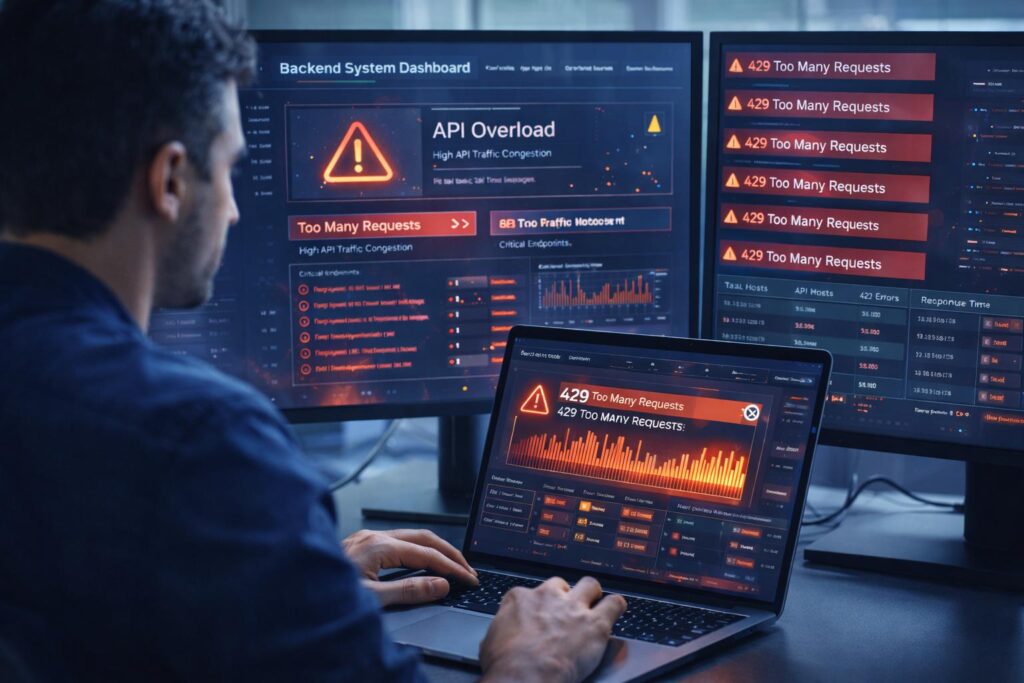
APIs time out. Tokens expire. vendors return 429 or 500 errors. Records fail validation. Networks are interrupted. A destination may accept one record and reject the next.
A robust design distinguishes temporary failures from permanent data errors.
Temporary failures may be retried automatically with controlled backoff. Permanent failures should be recorded with enough context for investigation and correction.
Retries also need idempotency. If the same request is repeated after a timeout, the integration should avoid creating duplicate customers, orders, invoices, or payments.
This engineering is one of the biggest differences between a proof of concept and a dependable business integration.
9. Webhooks and Event Handling
Webhooks can reduce polling and improve freshness, but they introduce their own requirements.
The receiving endpoint must authenticate or validate events where supported, respond within vendor time limits, handle duplicate delivery, process events that arrive out of order, and recover if an event is missed.
A useful pattern is to acknowledge receipt quickly and process the business event asynchronously. The exact design depends on the vendor and the consequences of delayed or duplicated events.
10. Historical Data Migration
“Integrate the systems” and “migrate our history” are separate pieces of work.
Historical migration can require extraction, cleansing, transformation, deduplication, attachment transfer, relationship reconstruction, validation, and reconciliation.
Define explicitly:
- How much history moves.
- Which objects move.
- Whether attachments or documents are included.
- Whether inactive and deleted records are included.
- How duplicates are identified.
- How historical identifiers are retained.
- How migrated totals and relationships will be validated.
Do not assume the same logic used for daily synchronization can efficiently migrate years of data.
11. Business Rules and Workflow Orchestration
The integration may need to do more than copy data.
For example, an approved order could trigger inventory checks, customer creation, invoice generation, notification, and status updates across multiple systems.
Each branch adds business logic and failure scenarios.
Document the workflow as states and transitions. Identify which actions are automatic, which require approval, and which can be reversed.
This is especially important in financial or operational workflows where a technically successful API call can still produce the wrong business outcome.
12. Reconciliation and Auditability
Business-critical integrations need a way to prove that data arrived correctly.
Reconciliation might compare record counts, financial totals, object identifiers, statuses, or other control values between systems.
An audit trail should make it possible to answer questions such as:
- What record was processed?
- When was it processed?
- What source event triggered it?
- What destination record was created or updated?
- Did the operation succeed?
- If it failed, why?
- Was it retried or manually corrected?
Reconciliation is not merely reporting. It is part of operating the integration safely.
13. User Interface and Administration
Some integrations run invisibly. Others need an administrative interface.
A support team may need to connect accounts, view sync status, inspect failures, retry records, map values, pause jobs, or change configuration.
These features can materially increase scope, but they often reduce long-term support effort.
When estimating, distinguish the integration engine from the operational interface required to manage it.
14. Testing Requirements
Integration testing is broader than unit testing.
The team may need to test authentication, field mapping, workflow logic, permissions, pagination, webhooks, retries, rate limits, duplicate prevention, data reconciliation, and failure recovery.
External sandboxes can also be imperfect. Some vendors provide limited test environments, different sample data, or functionality that behaves differently from production.
Actiknow’s custom web application development process includes migration and integration, iterative development and testing, deployment, and ongoing support. For integration work, those stages matter because the interface between systems must be validated in realistic end-to-end scenarios.
15. Vendor API Quality and Change Risk
You do not control a third-party API.
Vendors can deprecate endpoints, change authentication requirements, introduce new limits, modify schemas, or release new API versions.
Before estimating, review documentation quality, versioning policy, changelog, support process, sandbox availability, known limitations, and deprecation timelines.
A poorly documented API can require more discovery and experimentation than a mature, stable interface.

Architecture Choices That Affect Cost
1. Direct Point-to-Point Integration
System A talks directly to System B.
This can be appropriate for a small number of stable integrations. It becomes harder to manage when many systems are connected through independent custom logic.
2. Central Integration Service
A dedicated service manages connections, mapping, orchestration, retries, and monitoring.
This introduces an additional component but can make multi-system environments easier to govern.
3. Integration Platform or iPaaS
Platforms can provide connectors, workflow tooling, monitoring, and hosting.
They may reduce custom development for supported use cases, but the estimate should include platform subscription costs, connector limitations, custom logic, usage-based pricing, and long-term maintainability.
4. Custom and Platform-Based Integration Can Coexist
The choice does not have to be all custom or all platform.
A company might use a standard connector for a common SaaS flow while building custom services for proprietary systems or business-critical logic.
Estimate the architecture that fits the workflow rather than forcing every connection through the same tool.

A Practical API Integration Estimation Framework
Instead of asking a vendor for a single number based on a short description, create a scope matrix for each workflow.
For every integration flow, capture:
- Source system.
- Destination system.
- Business event or schedule.
- Objects involved.
- Direction.
- Authentication method.
- Expected volume.
- Freshness requirement.
- Transformation complexity.
- Rate limits.
- Webhook availability.
- Retry requirements.
- Reconciliation requirements.
- Historical migration.
- Administrative interface requirements.
- Security constraints.
- Testing dependencies.
- Support expectations.
Then estimate by workstream.
1. Discovery and Solution Design
Includes API review, workflow mapping, data mapping, architecture, security requirements, failure scenarios, and acceptance criteria.
2. Integration Development
Includes authentication, API clients, transformations, orchestration, state management, webhooks, queues, and business rules.
3. Data Migration
Includes historical extraction, cleansing, transformation, loading, deduplication, and reconciliation.
4. Testing and UAT
Includes automated tests, sandbox testing, end-to-end scenarios, failure testing, data validation, and business acceptance.
5. Deployment and Operations
Includes environments, secrets, scheduling, monitoring, alerting, logging, runbooks, and release procedures.
6. Ongoing Support
Includes vendor API changes, credential issues, failed-record investigation, production defects, monitoring, and planned enhancements.
This decomposition produces a much more defensible estimate than multiplying the number of APIs by a standard price.

How to Think About Fixed Price vs Time and Materials
A fixed-price estimate works best when the interfaces, workflows, data mapping, volumes, and acceptance criteria are well understood.
Time and materials may be more appropriate when API behavior is uncertain, documentation is incomplete, legacy systems must be investigated, or the project includes substantial discovery.
A hybrid approach can also work: a defined discovery phase produces the integration specification, followed by a fixed or bounded implementation estimate.
The important point is to price uncertainty explicitly rather than hiding it inside a development estimate.
What Information Should You Give an Integration Partner?
Better inputs produce better estimates.
Provide:
- The systems to be connected.
- Links to available API documentation.
- The business workflows being automated.
- Objects and fields involved.
- Examples of real or anonymized data.
- Expected transaction volumes.
- Sync frequency or latency expectations.
- Historical migration requirements.
- Known rate limits.
- Authentication constraints.
- Security and compliance requirements.
- Existing architecture diagrams.
- Error-handling expectations.
- Reporting and reconciliation requirements.
- Target launch constraints.
- Who owns each source and destination system.
If documentation is unavailable, say so. Discovery effort can then be included rather than implicitly assumed away.
Questions to Ask Before Approving an API Integration Estimate
- Does the estimate include authentication and token lifecycle handling?
- Are historical migration and ongoing synchronization separated?
- Who owns field mapping and business-rule decisions?
- How are rate limits handled?
- What happens when an API is unavailable?
- How are duplicate transactions prevented?
- How are failed records surfaced and retried?
- What reconciliation proves the integration is complete?
- Does the estimate include monitoring and alerting?
- What environments are included?
- Who handles vendor API changes after launch?
- What is explicitly excluded?
A proposal that answers these questions is much easier to compare than one that gives only a total number of hours.
Common Estimation Mistakes
Estimating from endpoint count alone. Ten simple read endpoints may be easier than one bidirectional financial workflow.
Ignoring authentication. OAuth and tenant authorization can be meaningful pieces of the implementation.
Treating mapping as clerical work. Semantic mismatches often require business decisions.
Assuming retries are trivial. Safe retries require error classification and duplicate prevention.
Forgetting historical migration. Initial backfill often has different scale and validation requirements from daily sync.
Ignoring rate limits until testing. Architecture may need to change if expected volume exceeds available capacity.
Leaving monitoring out of scope. An integration that fails silently creates operational risk.
Not budgeting for vendor change. External APIs evolve, and production integrations need ownership after launch.
Skipping reconciliation. “The job completed” does not prove that all required business data is correct.
How to Control API Integration Cost Without Cutting Reliability
Reduce unnecessary real-time requirements. Batch or short-delay processing can simplify architecture when the business does not require immediate updates.
Define a system of record for each object. Clear ownership reduces conflict logic.
Limit the first release to essential objects and workflows. Add lower-value synchronization after the critical path is stable.
Use vendor-supported bulk and delta endpoints where appropriate.
Design reusable authentication, logging, retry, and monitoring components when several integrations share the same architecture.
Retire unnecessary historical data rather than migrating everything by default.
Make exception handling operationally usable. A support team that can diagnose and replay a failed record may avoid repeated developer intervention.
Most importantly, spend enough time on discovery to prevent expensive assumptions from becoming code.
Frequently Asked Questions
What is the biggest driver of API integration cost?
Usually complexity rather than the number of APIs. Bidirectional synchronization, complex mappings, business rules, historical migration, failure handling, and reconciliation can make a single integration substantial.
How much does a simple API integration cost?
There is no responsible universal figure without knowing the systems and workflow. A one-way integration using stable APIs and simple mappings can be relatively contained, while the same two systems may require much more work if synchronization is bidirectional or business-critical.
Does using Zapier, Make, or an iPaaS always reduce integration cost?
No. Platforms can reduce development for supported workflows, but cost depends on connector capability, custom logic, transaction volume, subscription pricing, monitoring, and maintainability. They are tools, not automatic substitutes for integration design.
Why does OAuth increase development effort?
OAuth can require user authorization flows, secure token storage, refresh handling, scopes, revocation, reconnection, and vendor application configuration. The exact effort depends on the provider.
Do webhooks make integrations cheaper?
Sometimes. Webhooks can reduce polling and improve freshness, but they require reliable event receipt, validation, deduplication, ordering considerations, retries, and recovery strategies.
Should historical data migration be included in the integration estimate?
Yes, if history must move. It should normally be scoped separately because migration volume, cleansing, deduplication, and reconciliation can differ substantially from ongoing synchronization.
Who should own data mapping?
Business and technical stakeholders should collaborate. Engineers can identify structural differences, but business owners should confirm the meaning of fields, statuses, ownership rules, and exceptions.
What happens after the integration goes live?
Production integrations need monitoring, credential maintenance, error handling, vendor API change management, defect support, and sometimes capacity adjustments. Define this ownership before launch.
Conclusion: Estimate the Workflow, Not the API
API integration cost becomes much easier to understand when the project is decomposed into real engineering and operational responsibilities.
Count systems and interfaces, but also define authentication, ownership, mapping, synchronization direction, volumes, rate limits, retries, webhooks, historical migration, reconciliation, monitoring, testing, and support.
The best estimate is not the one with the smallest number. It is the one that makes the assumptions visible and tells you what is required for the integration to remain dependable after launch.
If you are planning a multi-system integration, Actiknow can help map the workflows, review the APIs, define the integration architecture, and turn the requirements into an implementation scope before development begins. Discuss your integration requirements with Actiknow.