

Legacy PHP Application Modernization: Rewrite, Refactor or Replace?
A legacy PHP application can be old without being obsolete. Age alone is not a reason to rewrite software that still supports important workflows, produces reliable results, and can be maintained safely.
The real modernization question is different: where is the application creating unacceptable business or technical risk, and what is the least disruptive way to remove that risk?
For some systems, the answer is targeted refactoring. Others need a staged move to a newer architecture. A smaller group genuinely warrants a full rewrite or replacement. Treating every legacy system as a rewrite project can destroy working business logic, stretch budgets, and create a long period in which the organization must support two systems at once.
This guide provides a practical framework for deciding among refactoring, incremental modernization, rewriting, and replacement. It is intended for CTOs, product owners, and business leaders responsible for software that the organization still depends on.
What “Legacy PHP” Actually Means
Legacy should describe risk and maintainability, not simply the programming language.
PHP remains an actively maintained technology. A PHP application becomes a modernization concern when characteristics of the application make change, security, reliability, or operations unnecessarily difficult. Typical warning signs include unsupported PHP or framework versions, abandoned dependencies, tightly coupled modules, weak automated testing, undocumented business rules, manual deployments, fragile integrations, inconsistent data models, or a shortage of developers who can safely change the code.
An older application may therefore be perfectly serviceable, while a newer one may already have significant technical debt.
The assessment should focus on the condition of the system and its business role. Actiknow’s custom web application development practice includes PHP among its backend technologies and explicitly covers migration, integration, legacy-system modernization, testing, deployment, and ongoing support.
Start With Business Criticality, Not Code Quality
Before choosing an architecture, establish what the application actually does for the business.
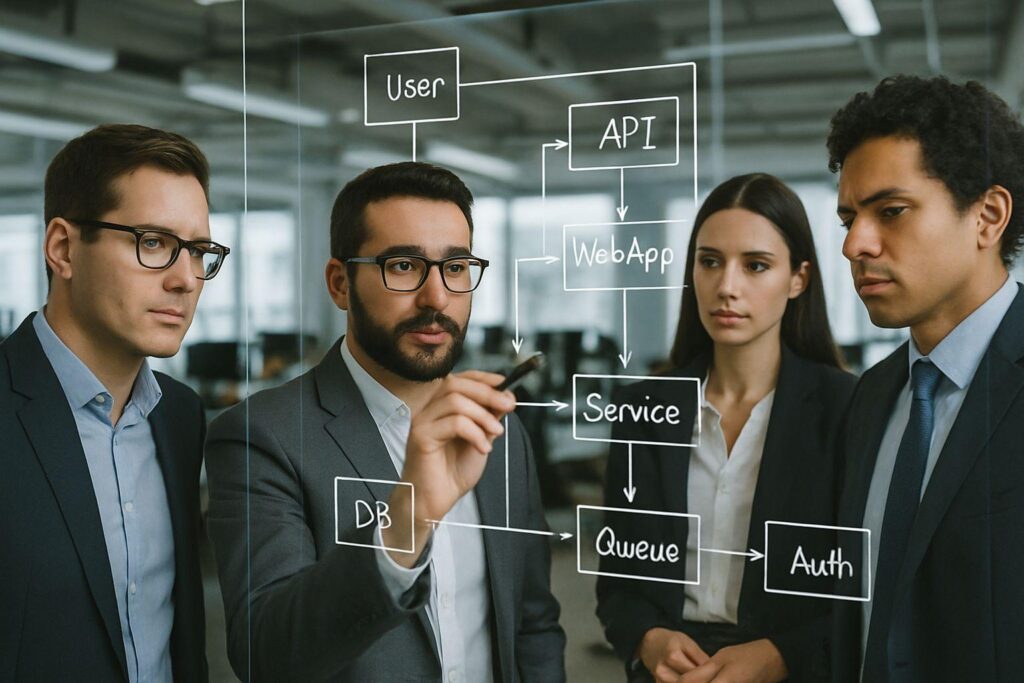
Document the workflows it supports, user groups, integrations, scheduled jobs, reports, regulatory or audit requirements, data it owns, upstream and downstream dependencies, peak usage periods, and the cost of downtime. Then identify which functions are genuinely differentiating and which are commodity capabilities that could potentially be replaced.
This matters because the modernization strategy for an internal utility used by ten employees should not automatically be the same as the strategy for an application that handles customer orders, billing, or operational workflows.
A useful first step is to classify each major capability across four dimensions:
- Business criticality. What happens if the capability is unavailable or produces the wrong result?
- Change pressure. How frequently does the business need to modify this area?
- Technical risk. Is the component difficult to secure, test, deploy, scale, or support?
- Replacement feasibility. Could an existing platform perform the function without forcing the business into unacceptable compromises?
That exercise turns “our PHP application is old” into a set of specific modernization problems.
Option 1: Refactor the Existing Application
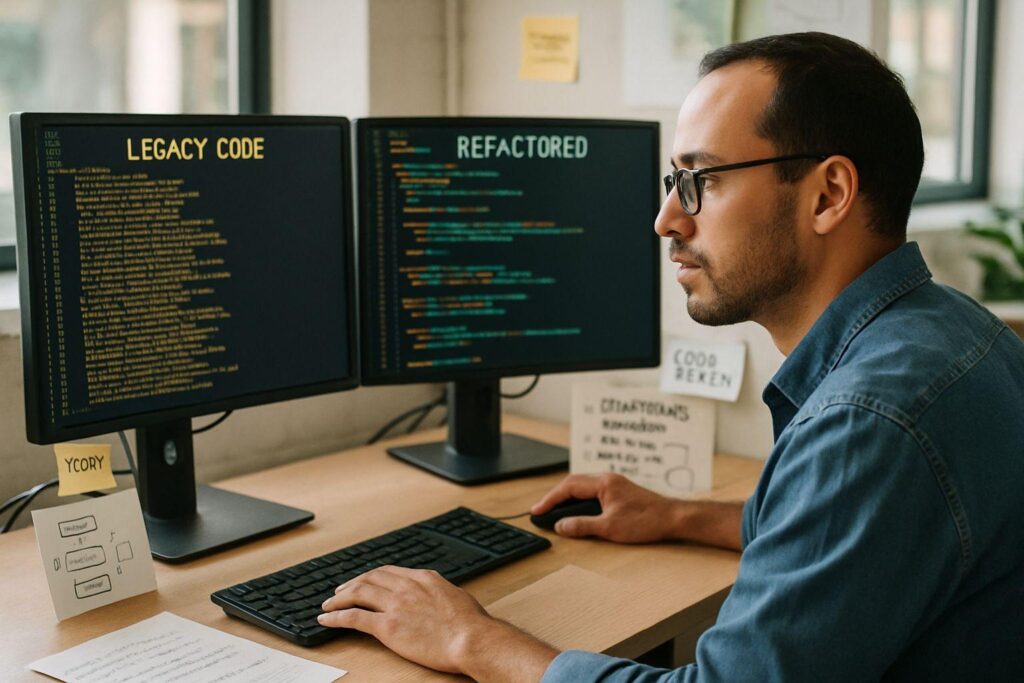
Refactoring means improving the internal structure of the application while preserving its essential behavior.
This can include upgrading the PHP runtime and framework, replacing unsupported libraries, separating tightly coupled modules, improving database access, introducing automated tests, standardizing configuration, adding APIs, improving logging, containerizing deployment, or moving selected workloads to managed infrastructure.
Refactoring is often the strongest option when the core business logic is still valuable and the application fundamentally works.
When refactoring makes sense
Refactoring is worth serious consideration when:
- The application supports the right workflows.
- The database model is broadly usable.
- The biggest problems are maintainability, dependencies, deployment, performance, or security rather than product-market fit.
- Business rules are complex and poorly documented, making a rewrite risky.
- The organization needs improvements incrementally rather than waiting for a new platform.
- Existing integrations and downstream dependencies would be expensive to recreate simultaneously.
The main advantage is risk containment. Teams can improve one part of the system at a time while keeping the current application operational.
The limitation is that refactoring cannot fix every architectural problem economically. If every meaningful change requires touching a large portion of the codebase, incremental improvement can become a permanent renovation project.
Option 2: Modernize Incrementally
Incremental modernization goes further than conventional refactoring. Instead of merely cleaning up the existing codebase, the team gradually changes the system’s architecture and boundaries.
For example, an organization might keep the existing PHP application as the system of record while exposing stable APIs around selected capabilities. A new frontend could then consume those APIs. Later, high-change modules might be separated into independent services, while stable legacy functions remain untouched.
This approach is sometimes described as replacing a system “around the edges” rather than rebuilding everything at once.
Actiknow’s custom solutions work spans web applications, integrations, databases, automation, and mobile applications, which are common components in staged modernization programs where an existing system must continue operating while new capabilities are introduced.
Where incremental modernization works best
This approach is attractive when the application is too important for a big-bang cutover, but parts of the architecture clearly need to change.
Good candidates include systems where:
- The user interface needs replacement but backend rules remain sound.
- New channels, such as mobile apps or customer portals, need access to existing business functions.
- Integrations should move from direct database access to governed APIs.
- One or two modules create most of the development bottleneck.
- The organization wants to move gradually to cloud infrastructure.
- The database cannot be replaced immediately because too many applications depend on it.
The important design principle is to create explicit boundaries. Without clear interfaces and ownership, incremental modernization can simply add a modern layer on top of existing complexity.
Option 3: Rewrite the Application
A rewrite means rebuilding the application while attempting to preserve or improve its required business capabilities.
It is appealing because teams can choose a cleaner architecture, current frameworks, better development practices, and a more modern user experience. But a rewrite also discards years of encoded behavior.
That hidden behavior is the central risk.
Legacy systems frequently contain business rules that are not documented anywhere else. Some are visible in code. Others are embedded in database procedures, reports, scheduled jobs, integrations, manual workarounds, or operational habits. Rebuilding the visible screens does not guarantee that the new application reproduces the real system.
When a rewrite may be justified
A rewrite becomes more defensible when several conditions exist together:
- The existing architecture prevents important business changes.
- Large portions of the technology stack are unsupported or impractical to upgrade.
- The application has accumulated structural problems that cannot be isolated.
- The desired future product is materially different from the existing one.
- The team can define and test the required business behavior.
- There is enough time and budget to operate old and new environments during migration.
- Data migration, reconciliation, rollback, and cutover can be planned explicitly.
A rewrite should therefore be treated as a migration program, not merely a development project.
The business needs acceptance criteria for parity. Critical calculations, permissions, integrations, reports, workflows, and data outputs should be compared between old and new systems. “The new screens work” is not sufficient evidence that the application is ready to replace the old one.
Option 4: Replace the Application With a Product
Sometimes the correct modernization decision is not to modernize the custom application at all.
If the application primarily performs standardized functions already handled well by established SaaS or enterprise products, replacement may reduce the amount of software the organization has to own.
The decision depends on fit, not fashion.
A replacement product should be assessed against workflow requirements, integration needs, identity and permissions, data ownership, reporting, configurability, migration effort, recurring licensing, vendor constraints, and exit options.
Replacement becomes less attractive when the legacy application contains processes that materially differentiate the business or when adapting a packaged product would require extensive customization.
A Practical Rewrite vs Refactor Decision Framework
A modernization decision becomes easier when leadership separates the application into capabilities rather than evaluating the entire codebase as one object.
For each capability, ask five questions.
1. Does this capability still serve the business?
If the answer is no, retire it. Modernizing unused functionality simply preserves unnecessary complexity.
2. Is the implementation safe to maintain?
Consider supported versions, dependency health, security exposure, test coverage, deployment reliability, monitoring, and developer familiarity.
3. Can the risk be isolated?
A problematic module that has clear boundaries may be replaceable without rewriting the rest of the system.
4. Is the business behavior understood well enough to rebuild?
If the existing system is the only reliable specification, invest in discovery and characterization testing before committing to a rewrite.
5. What is the cost of running both worlds during transition?
Modernization plans often underestimate parallel operations. During migration, organizations may need dual infrastructure, synchronization, reconciliation, user training, duplicated support, and rollback capability.
The result does not have to be one answer for the whole application. A sensible roadmap may retire one module, refactor another, rebuild a high-change area, and leave a stable component alone.
Security and Dependency Risk Need Their Own Workstream
Security is often used as a blanket argument for rewriting legacy software. The concern may be valid, but the response should be specific.
Inventory the PHP runtime, framework, operating system, web server, libraries, package manager dependencies, database versions, authentication mechanisms, encryption, secrets management, and externally exposed endpoints.
Then distinguish immediate remediation from structural modernization.
A vulnerable dependency may require an urgent patch or upgrade regardless of the long-term modernization plan. Conversely, a rewrite that takes eighteen months does not reduce today’s exposure unless the existing system is maintained during those eighteen months.
Security work and modernization planning should therefore run in parallel where necessary.
Do Not Start a Rewrite Without Characterization Tests
One of the most useful techniques in legacy modernization is characterization testing: tests that document what the current system actually does before developers change it.
The purpose is not to prove that every existing behavior is desirable. It is to make behavior visible.
For critical workflows, capture representative inputs and expected outputs. Cover calculations, permissions, state transitions, API responses, exports, scheduled processes, and integration side effects. Where feasible, compare the old and modernized implementations against the same scenarios.
This creates a safer foundation for both refactoring and rewriting.

Treat the Database as a Separate Modernization Decision
Application code and data architecture do not have to move together.
A database may contain years of operational history, reporting dependencies, integration contracts, stored procedures, and data-quality exceptions. Replacing it at the same time as the application can multiply migration risk.
Consider whether the existing database should initially remain in place while application layers are modernized. Alternatively, a new data model may be necessary if the old schema fundamentally prevents the future product from working cleanly.
Either way, define migration and reconciliation rules before cutover. Record counts alone are rarely enough. Validate important totals, relationships, status values, historical records, permissions, and business-specific calculations.
Plan Integrations Before You Change System Boundaries
Legacy applications often sit at the center of a web of integrations that accumulated over time.
Some may use APIs. Others may exchange files, read shared databases, run scheduled scripts, or depend on undocumented exports. These dependencies can determine the modernization sequence.
Create an integration inventory that records the source, destination, owner, authentication method, data exchanged, frequency, failure handling, and business impact.
Then decide which interfaces should be preserved temporarily and which should become explicit contracts in the modern architecture.
This is particularly important if modernization introduces APIs around previously internal functions. API boundaries should be designed around stable business capabilities rather than mirroring every table or legacy screen.
Modernize Delivery Practices Too
Replacing old PHP code with a current framework does not create a modern application if the organization retains fragile delivery practices.
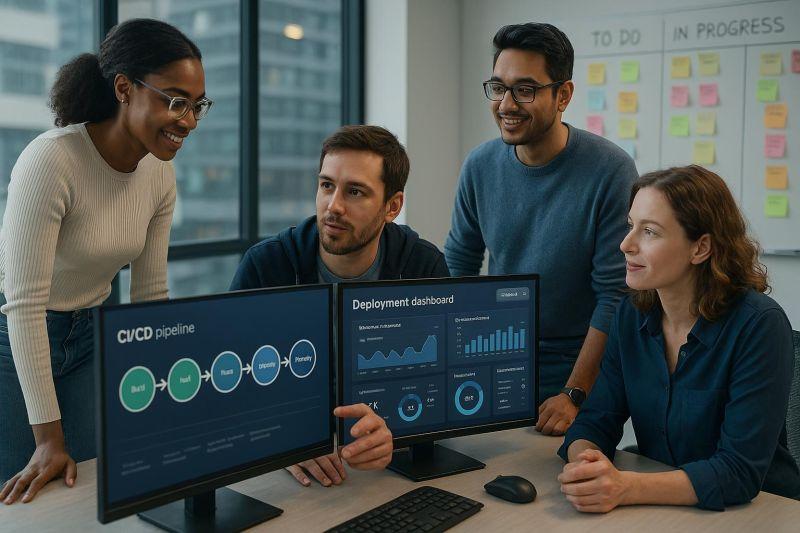
A modernization program should consider source control conventions, automated testing, CI/CD, environment management, infrastructure configuration, secrets handling, observability, backups, rollback procedures, and release ownership.
Actiknow’s web application development process describes discovery, prototyping, iterative development, quality assurance, deployment, and optimization as distinct stages. That lifecycle perspective is useful for modernization because architecture changes must be paired with a controlled path to production.
What Should You Measure During Modernization?
Avoid measuring progress primarily through lines of code rewritten or percentage of modules migrated. Those measures say little about business risk.
More useful indicators include:
- Percentage of critical workflows covered by automated tests.
- Number of unsupported runtime or dependency components remaining.
- Deployment frequency and deployment failure rate.
- Mean time to restore service after an application failure.
- Number of manual deployment or operational steps.
- Defect rate in modernized versus unchanged areas.
- Percentage of integrations with documented ownership and failure handling.
- Number of critical business capabilities successfully reconciled during migration testing.
- Volume of legacy functionality retired rather than recreated.
These metrics help leadership see whether modernization is actually reducing operational risk and increasing the organization’s ability to change the software safely.
A Sensible Modernization Sequence
For many organizations, the safest sequence is not “approve rewrite, then start coding.”
- Begin with discovery. Map business capabilities, dependencies, integrations, data ownership, security risks, and operational constraints.
- Stabilize urgent risks. Patch critical vulnerabilities, improve backups, address severe reliability issues, and establish enough monitoring to understand current behavior.
- Create a test safety net. Add characterization tests around the most important workflows and outputs.
- Define target boundaries. Decide which components will be retained, refactored, rebuilt, replaced, or retired.
- Modernize in business-relevant slices. Select a bounded capability that can be delivered and validated without waiting for the entire program.
- Reconcile continuously. Compare data and behavior between old and new components before expanding the migration.
- Plan cutover and rollback. Define how traffic, users, integrations, and data will move, and what happens if acceptance criteria are not met.
- Retire deliberately. Remove old infrastructure only after dependencies, retention requirements, and operational sign-off have been addressed.

Common Mistakes to Avoid
Rewriting because the code “looks old.” Code aesthetics are not a business case.
Changing the framework, database, infrastructure, user interface, and business process simultaneously. Every additional dimension makes failures harder to isolate.
Assuming documentation is the specification. Real behavior may differ from documentation, especially in long-lived systems.
Ignoring background jobs and reports. Users may rely on processes that are invisible in the main application interface.
Underestimating data reconciliation. A technically successful migration can still fail if balances, statuses, histories, or relationships differ.
Keeping every legacy feature. Modernization is an opportunity to retire functionality that no longer creates value.
Treating launch as the end. A modernized application still needs monitoring, patching, dependency management, backups, and support. Actiknow’s maintenance plans explicitly include application bug fixes, backup restoration, monitoring-related support, and ongoing maintenance options.
Frequently Asked Questions
Is PHP itself a reason to rewrite a legacy application?
No. The decision should be based on supported versions, dependencies, architecture, maintainability, security, business fit, and operational risk. A maintained PHP application can remain viable, while an unsupported or highly coupled system may need significant modernization.
Is it cheaper to refactor or rewrite a legacy PHP application?
There is no universal answer. Refactoring can reduce near-term disruption when the core system remains sound. A rewrite may become more economical when structural constraints make ordinary changes consistently expensive, but it also introduces migration, parity, testing, and cutover costs. Estimate the full transition, not only development effort.
Can we modernize a PHP backend without replacing the frontend?
Yes. Application layers can often be modernized independently if interfaces are well understood. The reverse is also possible: a new frontend can be introduced while parts of an existing backend remain operational behind stable APIs.
Should we move to microservices during modernization?
Not automatically. Microservices introduce operational and organizational complexity. Use them when independent deployment, scaling, ownership, or clear domain boundaries justify that complexity. A well-structured modular application may be simpler to operate.
How do we reduce risk during a full rewrite?
Document business capabilities, build characterization tests, inventory integrations, define data reconciliation, migrate in controlled stages where possible, run old and new systems in parallel when justified, and establish explicit cutover and rollback criteria.
How long should a legacy PHP modernization take?
Duration depends on application size, business-rule complexity, integration count, data migration, test coverage, team capacity, and the chosen strategy. A credible estimate should follow discovery rather than relying on application age or codebase size alone.
What should we modernize first?
Start with areas where business value and technical risk intersect. Urgent security problems may need immediate remediation. For architectural work, choose a bounded capability that reduces meaningful risk and can be tested independently.
Conclusion: Modernize the Risk, Not the Age
Legacy PHP modernization should not begin with a predetermined answer.
A rewrite is appropriate when the existing architecture cannot support the future business and the organization can safely reproduce the behavior it still needs. Refactoring is often better when the core system remains valuable but technical debt makes change difficult. Incremental modernization can reduce migration risk by creating new boundaries around an operating system. Replacement can be the right answer when the capability is standardized and a suitable product already exists.
The best modernization roadmap may combine all four approaches.
The objective is not to eliminate old code for its own sake. It is to create a system that can be secured, changed, tested, deployed, and supported at a level appropriate to its importance to the business.
If you are assessing an existing application, Actiknow can help evaluate the current architecture, identify migration and integration constraints, and define a practical modernization path before development begins. Talk to Actiknow about your application.