
Apache Iceberg solves a real enterprise problem: how to treat files in object storage like reliable analytical tables without tying those tables permanently to one compute engine.
That matters when an organization wants Spark, Snowflake, Trino, Flink or other compatible engines to work with the same analytical data while preserving table-level semantics such as snapshots, schema evolution and partition evolution.
But openness is not free.
An Iceberg architecture introduces decisions around storage, catalogs, writers, compaction, metadata, governance and interoperability. If one warehouse already serves every meaningful workload, adding an open table format can create complexity without creating business value.
The right question is not:
“Is Iceberg modern?”
It is:
“Do we have a real requirement for storage ownership, engine interoperability or lakehouse-scale data that justifies an open table architecture?”
Actiknow’s data engineering and business intelligence work starts with workload and ownership requirements before choosing the table format.
The Short Answer
Iceberg is worth serious consideration when:
- Multiple compute engines need governed access to the same tables.
- You want analytical data in object storage you control.
- Large lake datasets need transactional table semantics.
- Schema and partition layouts must evolve without rebuilding tables.
- Open catalog/REST interoperability matters.
- You want to reduce coupling between storage and a single query engine.
A conventional warehouse-native table is often simpler when:
- One platform serves nearly all analytics.
- BI is primarily structured SQL reporting.
- The team does not need external-engine access.
- Operational simplicity matters more than storage portability.
- The data team is small.
- Existing warehouse performance and cost are acceptable.
Iceberg is an architectural capability, not an automatic upgrade.
What Apache Iceberg Is
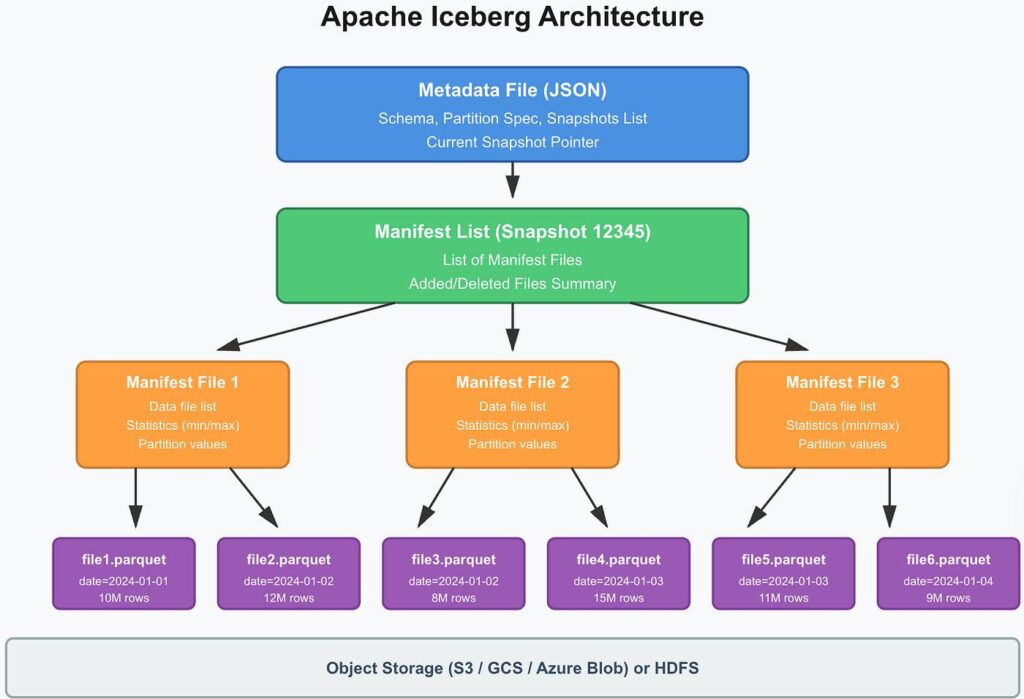
Apache Iceberg is an open table format for large analytical datasets.
It defines table metadata that tracks:
- Schemas.
- Snapshots.
- Data files.
- Delete files.
- Partitions.
- Manifests.
- Table history.
Compute engines interact with a logical table rather than scanning directories and guessing table state from files.
That distinction is fundamental.
Parquet Is a File Format; Iceberg Is a Table Format
These are not alternatives at the same layer.
Parquet defines how columnar data is stored in individual files.
Iceberg defines how many files together behave as a table.
An Iceberg table commonly uses Parquet data files.
Iceberg adds the metadata needed for:
- Atomic commits.
- Snapshots.
- Schema evolution.
- Partition evolution.
- Time travel.
- Concurrent writes.
- Efficient planning.
So “we already use Parquet” does not mean you already have Iceberg semantics.
Why Enterprises Care About Open Tables
Traditional cloud warehouses often combine:
- Storage format.
- Catalog.
- Governance.
- Query engine.
That is operationally convenient.
But it can make data access dependent on one platform.
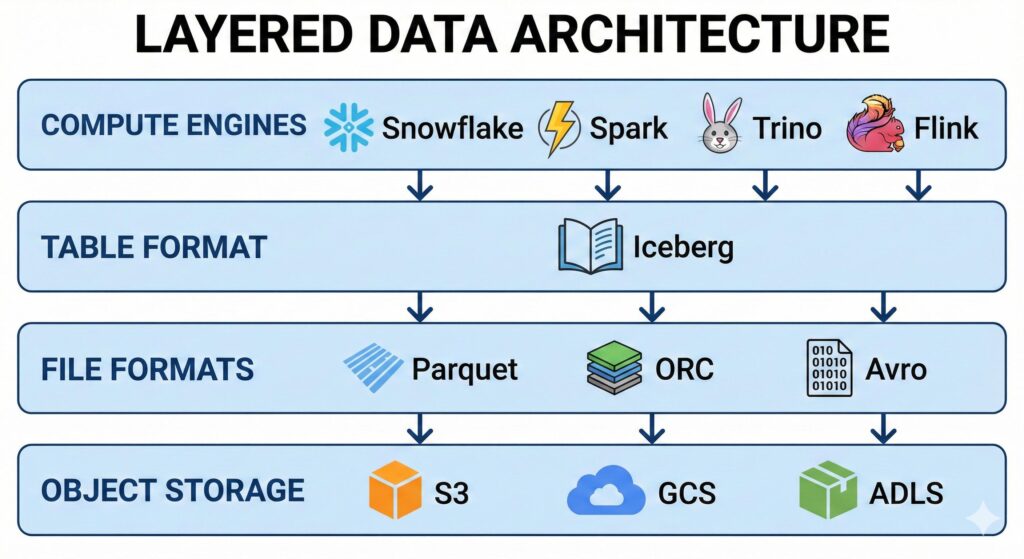
An open table architecture can separate storage from compute.
Data can live in object storage while multiple compatible engines access the same table format.
This can improve flexibility.
It can also multiply the number of components you must govern.
Interoperability Is the Main Strategic Argument
Suppose:
- Data engineering uses Spark.
- BI uses Snowflake.
- Data science uses another engine.
- Streaming uses Flink.
Without a shared table format, teams may create several copies or pipelines between platforms.
With Iceberg, compatible engines can potentially work with common tables.
The potential benefit is:
- Fewer copies.
- Less data movement.
- Consistent table semantics.
- More compute choice.
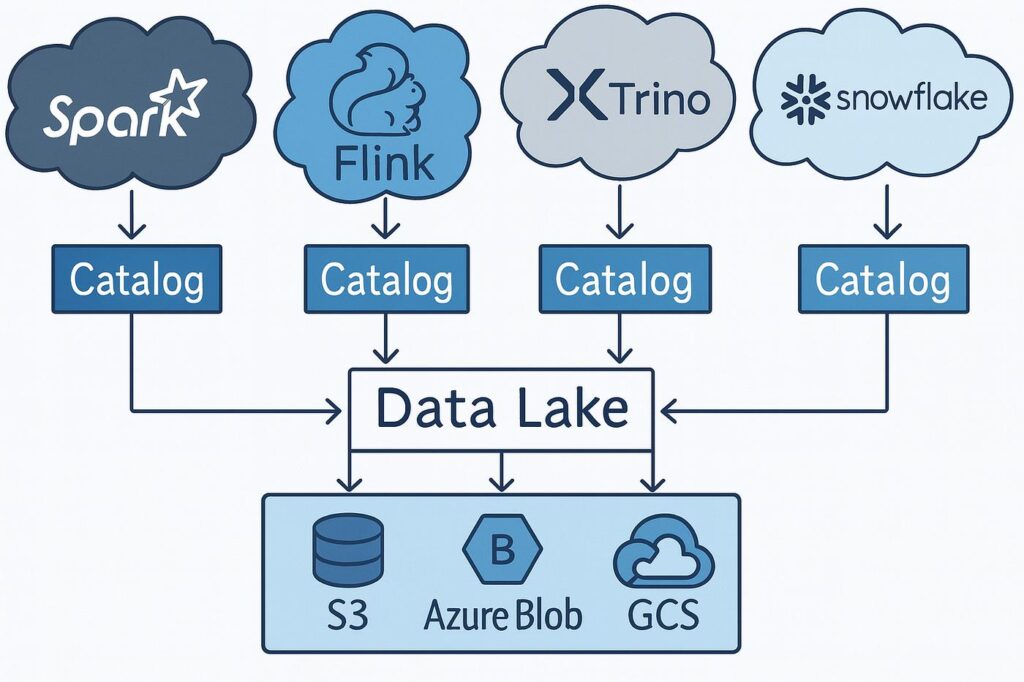
But “compatible” must be tested at the feature level.
Engine Support Is Not Binary
Two products can both support Iceberg and still differ in:
- Read support.
- Write support.
- Iceberg spec version.
- Delete behavior.
- Catalog integration.
- Partition transforms.
- Data types.
- Maintenance.
- Security.
- Branch/tag support.
- DDL.
- Streaming writes.
Create a compatibility matrix for your actual engines.
Do not buy an architecture based on logos on an ecosystem slide.
Storage Ownership
Iceberg can be attractive when the organization wants table data in its own cloud object storage.
This can support:
- Data sovereignty.
- Independent lifecycle management.
- Multi-engine access.
- Storage transparency.
- Separation of compute from data.
But ownership creates responsibilities.
You may need to manage:
- Buckets.
- IAM.
- Encryption.
- Lifecycle rules.
- Replication.
- Object versioning.
- Orphan cleanup.
- Cross-region strategy.
“Own the storage” is valuable only if you want to own the storage.
Catalogs Are Central
An Iceberg table is not just a folder of files.
Engines need a catalog to discover tables and coordinate metadata.
Possible catalog patterns include:
- REST catalogs.
- Cloud catalogs.
- Vendor-managed catalogs.
- Snowflake Horizon Catalog.
- Other Iceberg-compatible catalog implementations.
The catalog becomes part of the control plane.
Evaluate:
- Availability.
- Authentication.
- Authorization.
- Cross-engine compatibility.
- Commit behavior.
- Vendor support.
- Disaster recovery.
A highly available data lake with an unreliable catalog is not a reliable table platform.
Snowflake-Managed Iceberg
Snowflake currently supports Snowflake-managed Iceberg tables.
Snowflake can manage the Iceberg catalog and table lifecycle while table storage can use Snowflake-managed storage or external cloud storage, depending on the chosen model.
Snowflake documentation now recommends Snowflake storage when you do not require your own external cloud storage.
That simplifies configuration.
External engines can access supported Snowflake-managed Iceberg tables through Horizon Catalog using the Iceberg REST protocol.
This creates an interesting middle ground:
Open table format plus managed Snowflake operations.
Snowflake Storage vs External Volume Storage
Snowflake documents two storage models for Iceberg tables.
Snowflake storage:
Snowflake stores and manages the Iceberg files.
External volume:
Files live in cloud storage you configure and control.
Choose Snowflake storage when:
- Operational simplicity is the priority.
- You do not need direct ownership of the bucket.
- Snowflake is the primary control plane.
Choose external storage when:
- Your cloud account must own the files.
- An external catalog requires it.
- Storage-level policies are important.
- Other architecture requirements demand direct storage control.
Do not choose external storage merely because “lakehouse data should be in S3.”
Externally Managed Iceberg
Another model is for an external catalog/engine to manage the table while Snowflake accesses it.
This can make sense when:
- Spark or another platform owns writes.
- The lake catalog is already authoritative.
- Snowflake is one consumer among several.
This architecture requires careful coordination of:
- Catalog.
- Storage.
- Writers.
- Refresh/discovery.
- Security.
- Maintenance.
Ownership must be explicit.
Multi-Engine Writes Need Governance
Multiple engines writing the same table sounds attractive.
It also creates operational questions:
- Who owns schema changes?
- Who changes partition specs?
- Who runs compaction?
- Which engine may delete data?
- Who manages snapshots?
- How are incompatible features prevented?
Iceberg provides concurrency semantics.
It does not provide organizational ownership.
Define a table owner.
Schema Evolution Is a Real Benefit
Iceberg supports safe schema evolution patterns such as:
- Add column.
- Drop column.
- Rename column.
- Widen compatible types.
- Nested schema changes.
Iceberg tracks fields using stable identifiers rather than relying only on physical position.
That makes evolution safer than older file-table patterns.
Still, schema evolution can break consumers logically.
A renamed field may be technically valid but still break a downstream semantic model.
Use data contracts and change review.
Partition Evolution Reduces Physical Lock-In
Traditional partitioned file layouts often expose physical partition columns directly to queries.
Iceberg uses hidden partitioning.
Users filter on business columns and the table format translates those filters to physical partitions.
Partition schemes can evolve over time.
Old files can keep one layout while new files use another.
This is valuable as volume and query patterns change.
It reduces the need for full table rewrites simply to change partition strategy.
Time Travel and Snapshots
Iceberg tables maintain snapshots.
This supports:
- Reproducible analysis.
- Historical inspection.
- Rollback patterns.
- Auditing.
- Debugging.
But snapshots consume metadata and retain references to files.
Define retention.
Unlimited historical metadata is not free.
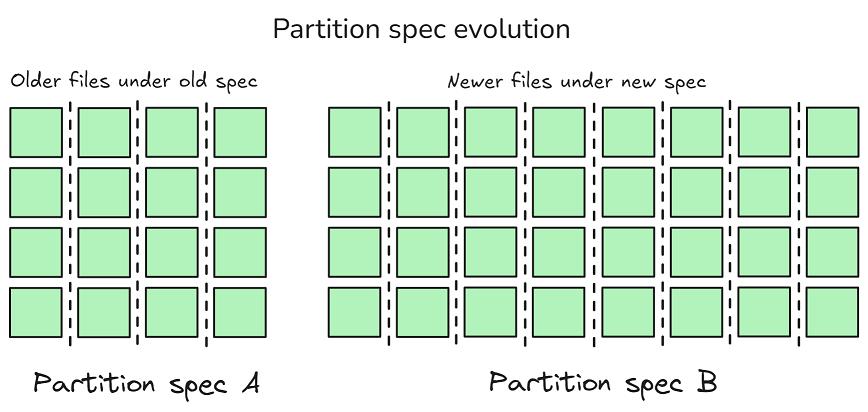
Table Maintenance Still Exists
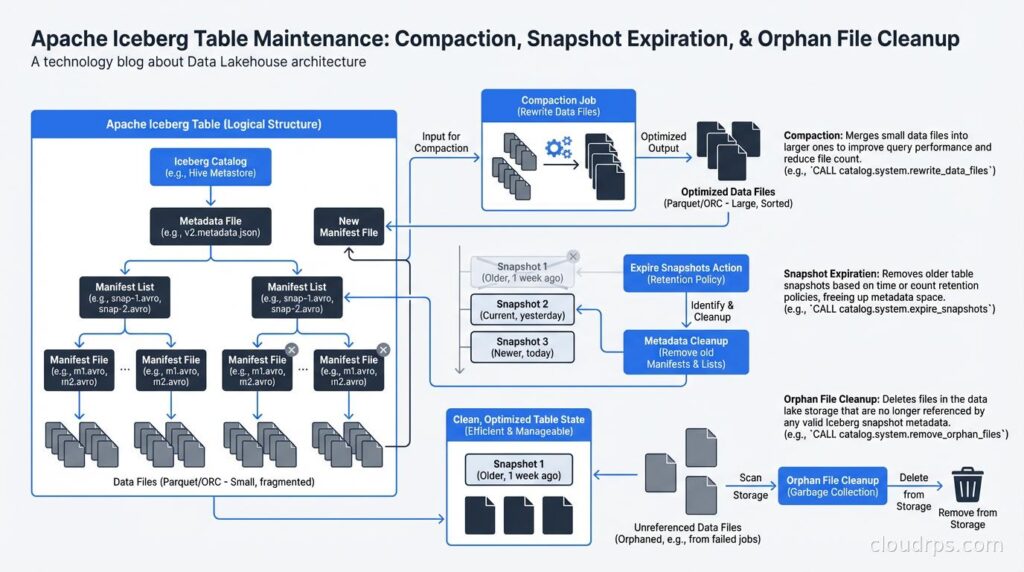
Open tables need maintenance.
Depending on engine/platform, tasks can include:
- Compaction.
- Snapshot expiration.
- Orphan-file cleanup.
- Manifest rewriting.
- Clustering/sorting.
- Statistics.
- Metadata optimization.
Small files are a common problem in high-frequency ingestion.
A system that writes thousands of tiny files can degrade query planning and performance.
Managed platforms can automate some maintenance.
Understand exactly what your chosen platform manages.
Write Patterns Matter
Batch append is straightforward.
High-frequency streaming, updates and deletes require more thought.
Evaluate:
- File size.
- Commit frequency.
- Delete representation.
- Merge behavior.
- Concurrent writers.
- Compaction.
- Partition strategy.
Do not evaluate Iceberg only with read benchmarks.
Production pain often comes from write and maintenance patterns.
Open Does Not Mean Zero Lock-In
Iceberg reduces lock-in at the table-format layer.
You can still be coupled to:
- Catalog.
- Cloud IAM.
- Vendor-specific extensions.
- Governance layer.
- SQL features.
- Maintenance tooling.
- Orchestration.
- Semantic models.
The right goal is not “no lock-in.”
It is deliberate lock-in at layers where it creates value, with portability where it matters.
Governance Across Engines
If several engines can access the same files, governance becomes harder.
Ask:
- Where is access policy defined?
- Do all engines enforce it?
- Can users bypass the catalog?
- Who can access the bucket directly?
- How are row/column policies handled?
- How is audit centralized?
A vendor catalog may provide strong governance for access through that vendor endpoint.
Direct storage credentials can bypass those controls if poorly designed.
Secure the storage layer too.
Data Quality Is Independent of Format
Iceberg does not make data correct.
You still need:
- Freshness checks.
- Volume checks.
- Uniqueness.
- Referential integrity.
- Schema contracts.
- Business reconciliation.
An open table with bad data is still bad data.
Semantic Modeling Still Matters
Executives do not care that a table is Iceberg.
They care whether:
- Revenue is correct.
- Customer definitions agree.
- Dashboards are fast.
- History is consistent.
Keep table-format architecture separate from semantic-model design.
Iceberg can underpin a gold layer.
It does not define the gold layer.
Performance Depends on More Than Format
Query performance depends on:
- File sizes.
- Partitioning.
- Clustering/sorting.
- Metadata volume.
- Statistics.
- Query engine.
- Caching.
- Predicate selectivity.
- Network/storage.
- Compaction.
Do not claim Iceberg is inherently faster or slower than native warehouse tables.
Benchmark your workload.
Cost Evaluation
Include:
- Object storage.
- Query compute.
- Catalog.
- Data transfer.
- API/metadata operations.
- Compaction.
- Maintenance compute.
- Engineering.
- Observability.
- Cross-region replication.
Open storage can be economical.
Multi-engine complexity can also create hidden operating cost.
Model the whole system.
When Iceberg Is Valuable for Snowflake Customers
Iceberg can be attractive when a Snowflake customer wants:
- External engines to access governed tables.
- Data files in customer-owned object storage.
- An existing lakehouse integrated with Snowflake.
- Open-table interoperability.
- A gradual multi-engine architecture.
Snowflake’s 2026 capabilities have expanded here, including GA external-engine read/write support for Snowflake-managed Iceberg through Horizon Catalog in supported configurations.
This makes the choice more nuanced than “Snowflake native tables versus external lake.”
When Native Snowflake Tables Are Simpler
Use native tables when:
- Snowflake is the only meaningful compute engine.
- Storage ownership is not a requirement.
- The team values managed operations.
- BI performance and governance are already strong.
- There is no credible portability requirement.
Adding Iceberg solely for architectural fashion increases surface area.
A simpler system is often a better system.
When Iceberg Is Valuable Outside Snowflake
Iceberg is particularly natural when:
- Spark/Flink are primary processing engines.
- Object storage is the durable data layer.
- Several engines query the same datasets.
- The organization already operates a lakehouse platform.
- Table portability is a strategic requirement.
The format then solves an existing problem rather than creating a new architecture.
Migration Strategy
Do not convert the entire estate first.
Choose candidate datasets where open-table benefits are clear.
Good candidates:
Large shared fact datasets.
Data science/BI shared data.
Cross-engine curated tables.
Object-storage-first domains.
Poor candidates:
Tiny reference tables.
Warehouse-only marts.
Operational tables with no external consumer.
Datasets with no portability need.
Prove value on a small portfolio.
POC the Hard Parts
Test:
- Writes from intended engines.
- Concurrent commits.
- Schema changes.
- Partition changes.
- Deletes/updates.
- Time travel.
- Compaction.
- Catalog outage.
- Storage permissions.
- Cross-engine consistency.
- Performance.
- Security.
Do not POC only SELECT COUNT(*).
Define Table Ownership
For every Iceberg table, record:
- Business owner.
- Technical owner.
- Catalog owner.
- Primary writer.
- Allowed secondary writers.
- Maintenance engine.
- Retention.
- Partition strategy.
- Schema-change process.
- SLA.
This operating model prevents “open” from becoming “nobody owns it.”
A Practical Decision Framework
Choose Iceberg if at least one major strategic requirement exists:
- Multiple compute engines.
- Customer-owned object storage.
- Open table portability.
- Lakehouse-first architecture.
- Very large shared analytical datasets.
Then confirm the team can operate:
- Catalog.
- Storage.
- Security.
- Maintenance.
- Compatibility.
- Observability.
If the strategic requirement is weak and the operating burden is high, use simpler native tables.
Frequently Asked Questions
Is Apache Iceberg a database?
No. It is an open table format. A catalog, storage layer and compute engine are still required.
Is Iceberg the same as Parquet?
No. Parquet is a file format. Iceberg organizes data files and metadata into a transactional analytical table.
Does Iceberg support schema evolution?
Yes. The specification supports operations such as adding, dropping and renaming fields and compatible type evolution.
Does Iceberg support partition evolution?
Yes. Partition specifications can evolve, and hidden partitioning separates queries from the physical partition layout.
Can Snowflake query Iceberg tables?
Yes. Snowflake supports managed and externally managed Iceberg architectures, with specific configuration depending on storage and catalog ownership.
Can external engines access Snowflake-managed Iceberg tables?
Yes. Snowflake documents GA access for compatible external engines through Horizon Catalog for Snowflake-managed Iceberg tables. Some capabilities for externally managed tables through the same catalog remain feature-specific and should be checked for current release status.
Does Iceberg eliminate vendor lock-in?
It reduces coupling at the table-format/storage layer, but catalogs, governance, SQL features and operations can still create platform dependencies.
Should a mid-sized BI team adopt Iceberg?
Only if there is a concrete interoperability, storage-ownership or lakehouse requirement. A single-platform BI estate may be better served by native warehouse tables.
Sources and Further Reading
- Apache Iceberg: Introduction and features.
- Apache Iceberg: Evolution.
- Apache Iceberg: Specification.
- Snowflake Documentation: Create Iceberg tables.
- Snowflake Documentation: Iceberg storage.
- Snowflake Documentation: External-engine access through Horizon Catalog.
Conclusion
Apache Iceberg is most valuable when openness solves a real architectural problem.
It gives enterprises a standardized table layer over object storage with strong evolution and snapshot semantics.
That can reduce data duplication and increase compute choice.
But it also introduces a control plane that must be operated.
Catalogs.
Storage.
Writers.
Maintenance.
Security.
Compatibility.
If one managed warehouse already meets the organization’s needs, simplicity may be more valuable than portability.
If several engines genuinely need the same governed analytical data, Iceberg can be the right foundation.
If you are evaluating native Snowflake tables, Iceberg or a mixed lakehouse architecture, Actiknow can help map workloads, ownership and BI requirements before committing to the storage model. Discuss your enterprise data architecture with Actiknow.