
A data warehouse is not a prerequisite for becoming data-driven.
For many organizations, the conversation starts backwards. Reporting is slow, teams disagree about numbers, or leadership wants better dashboards. Someone proposes Snowflake, BigQuery, Redshift, or another analytical platform. The organization then begins designing a data warehouse before establishing whether the underlying problem actually requires one.
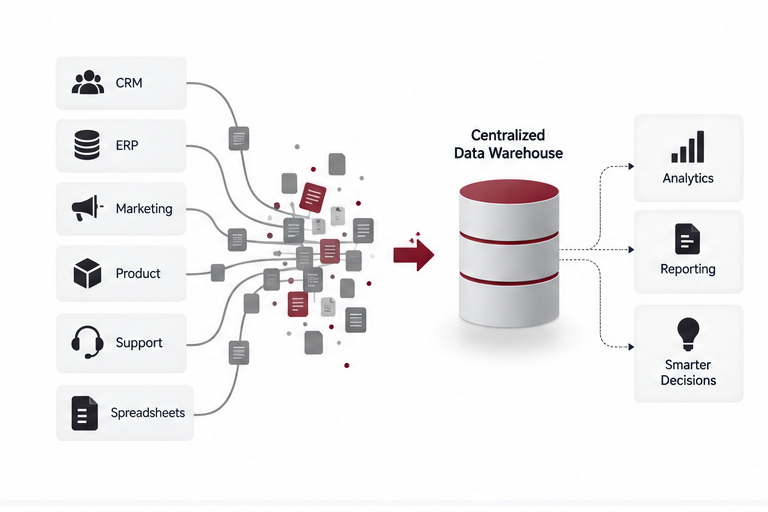
A warehouse can be a powerful foundation. It can integrate fragmented systems, preserve history, standardize transformations, improve analytical performance, and give reporting teams a controlled place to work. It can also introduce new pipelines, models, infrastructure, security responsibilities, monitoring, skills requirements, and recurring costs.
The right question for a CTO is therefore not, “Should we have a data warehouse?” It is, “Which business and technical constraints cannot be solved reliably with our current architecture, and is a warehouse the simplest sustainable answer?”
What does a data warehouse actually solve?
A data warehouse is an analytical data store designed to consolidate and organize information for reporting, analysis, and decision support. Modern cloud warehouses can handle substantial analytical workloads and integrate data from many operational applications.
Its value usually comes from capabilities around the warehouse rather than from storage alone. Data must be extracted from source systems, transformed into consistent business concepts, tested, secured, documented, and delivered to reporting or analytical applications.
The warehouse is therefore one layer in a broader data platform. Buying warehouse capacity does not automatically create trusted metrics.
When you probably do not need a data warehouse yet
A warehouse may be unnecessary when most important questions can be answered from one application, the application’s reporting is adequate, and there is little need to combine detailed data across systems.
Consider a growing services business that runs most commercial activity in a CRM and financial reporting in its accounting platform. If sales leaders need pipeline reports from the CRM and finance needs statutory or management reports from the accounting system, forcing both into a warehouse may initially create more engineering than business value.
The same applies when reporting requirements are small, stable, and low frequency. A carefully governed spreadsheet, application export, direct BI connection, or lightweight integration may be entirely appropriate.
Architecture should be proportionate. A simpler solution is not immature if it reliably supports the decisions the business needs to make.
Seven signs that a data warehouse is becoming justified
1. Important decisions require data from several systems
The strongest signal is repeated cross-system analysis. Customer profitability may require CRM accounts, invoices, project delivery costs, support effort, and product usage. Marketing performance may require advertising, web analytics, CRM opportunities, and recognized revenue.
If analysts repeatedly export and join the same sources manually, the organization is already performing integration. It is simply doing so in an uncontrolled and expensive way.
A warehouse can centralize those integrations and make the resulting logic reusable.
2. Different reports recreate the same business logic
When every dashboard independently calculates active customers, recurring revenue, pipeline coverage, or product categories, inconsistencies become inevitable.
Centralized transformation models allow shared business logic to be implemented, tested, and reused. The important distinction is that centralization should create governed definitions, not merely move duplicated SQL into a new location.
3. You need historical states that source applications do not preserve
Operational systems often show what is true now, while analytics frequently asks what was true at a previous point in time.
A sales leader may want to know how the pipeline looked at the end of each month. A customer team may need historical account ownership. Finance may need to analyze how classifications changed over time.
If the source overwrites these values, a warehouse and appropriate ingestion strategy can preserve the history needed for analysis.
4. Direct reporting is affecting operational systems
Analytical queries can be very different from transactional workloads. Large joins, aggregations, and historical scans may place unnecessary load on operational databases.
Moving analytical processing to a separate platform can protect application performance and allow data teams to optimize reporting independently.
This is a technical justification, but it should be demonstrated rather than assumed. Measure the actual workload before introducing architecture solely to solve a theoretical scaling problem.
5. Data quality and reconciliation need systematic controls
Manual reporting often hides quality checks inside individual workbooks and analyst knowledge. A warehouse program can introduce repeatable tests for uniqueness, completeness, referential integrity, accepted values, freshness, and reconciliation.
For example, a revenue model can be tested against a trusted finance total with explicitly documented differences. Failed tests can prevent unreliable data from silently reaching an executive dashboard.
The warehouse does not make source data correct. It provides a controlled place to identify, transform, test, and disclose problems.
6. Security needs are becoming more complex
As analytical usage expands, organizations need clearer controls over who can see personal information, financial details, customer records, or sensitive operational data.
A centralized analytical platform can support structured roles, restricted datasets, governed access, auditability, and separation between raw and published information. However, centralization also concentrates valuable data, so poor warehouse security can increase risk rather than reduce it.
7. Reporting development has become a bottleneck
If every new analytical request requires engineers to rebuild extraction, joins, and definitions, delivery slows as demand grows.
A well-designed warehouse can provide reusable, governed models from which BI teams and qualified business users can build additional analysis. This is often the beginning of meaningful self-service analytics.
When a data warehouse will not fix the problem
- A warehouse will not resolve unclear KPI definitions.
If sales and finance disagree about what “revenue” means, loading both systems into one database does not settle the argument. Business owners must define bookings, invoiced revenue, recognized revenue, collections, and other concepts explicitly.
- A warehouse will not fix poor source processes.
If employees enter inconsistent customer identifiers or leave important CRM fields blank, pipelines can sometimes standardize values, but they cannot reliably infer missing business facts. Source-system process improvement remains necessary.
- A warehouse will not create adoption.
A technically excellent model provides little value if leadership meetings continue using manually prepared spreadsheets because users do not trust or understand the new reports.
- A warehouse will not eliminate reconciliation.
Different systems may legitimately use different timing, grains, currencies, exclusions, and adjustment rules. Reconciliation becomes more systematic, not unnecessary.
- A warehouse will not automatically reduce reporting costs.
Cloud infrastructure, ingestion, transformation, orchestration, monitoring, BI licenses, engineering, and support all have costs. The business case must compare those costs with the inefficiencies and opportunities being addressed.
Direct reporting vs data warehouse: a practical decision framework
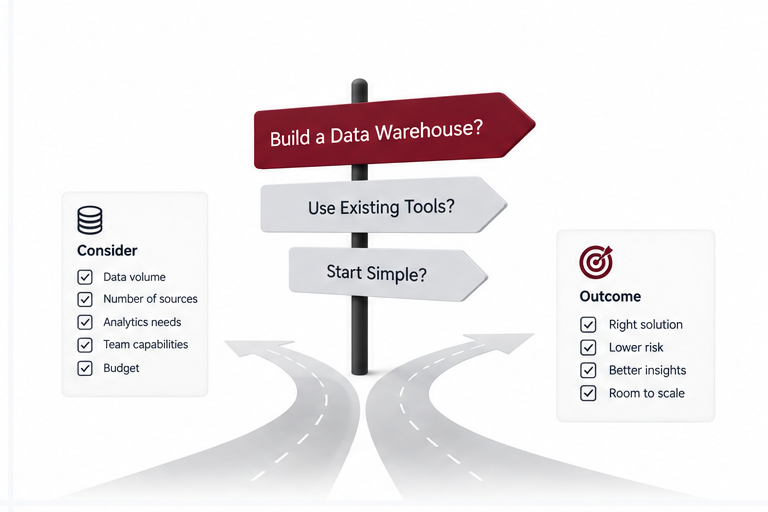
Use five dimensions when evaluating the architecture.
Data fragmentation
Ask how many systems are genuinely required for priority decisions. One or two simple sources may not justify a warehouse. Repeated integration across CRM, finance, operations, marketing, and product systems is a stronger signal.
Transformation complexity
Simple filtering and aggregation can often remain close to the reporting layer. Reusable calculations involving complex joins, mappings, slowly changing classifications, allocation rules, or multiple grains benefit more from a governed transformation layer.
History
Determine whether current source state is sufficient. If decisions depend on point-in-time history that source systems overwrite, establish how that history will be captured.
Workload and scale
Measure query volumes, dataset sizes, refresh requirements, source API limitations, and operational database impact. Do not confuse large business ambition with large data volume.
Governance
Consider how many people consume the data, how sensitive it is, how definitions are approved, and whether auditability matters. Increasing organizational complexity can justify central governance even when data volumes are modest.
What architecture should you choose?
There is no single correct warehouse architecture.
A smaller organization may begin with direct application reporting and a few controlled integrations. A growing company may use managed ingestion to copy selected systems into a cloud warehouse, transform them into tested analytical models, and expose those models to Power BI, Tableau, Looker, or another BI platform. A larger enterprise may introduce separate raw, staging, curated, semantic, and consumption layers with stronger governance and workload isolation.
Platforms such as Snowflake, Google BigQuery, and Amazon Redshift provide different commercial models, ecosystems, operational characteristics, and integrations. Platform selection should follow requirements rather than precede them.
Evaluate at least these factors: existing cloud ecosystem; internal engineering skills; workload patterns; data residency and security requirements; expected concurrency; ingestion and transformation tooling; BI integrations; operational support; and total cost at realistic usage levels.
Do not select a platform from a feature checklist alone. The best technical feature has little value if it complicates the skills, governance, or operating model your team can sustain.
Warehouse pricing is only one part of total cost of ownership.
Budget for ingestion connectors or custom pipelines, transformation development, orchestration, data quality tests, storage, compute, BI capacity, observability, security administration, documentation, incident response, ongoing source changes, and people.
Source systems evolve. APIs change. CRM administrators add fields. Finance modifies classifications. Marketing introduces a new platform. A production data platform must absorb these changes without quietly corrupting downstream reporting.
This is why a small, maintainable architecture is often preferable to an impressive architecture that depends on expertise the organization does not have.
A staged way to introduce a data warehouse
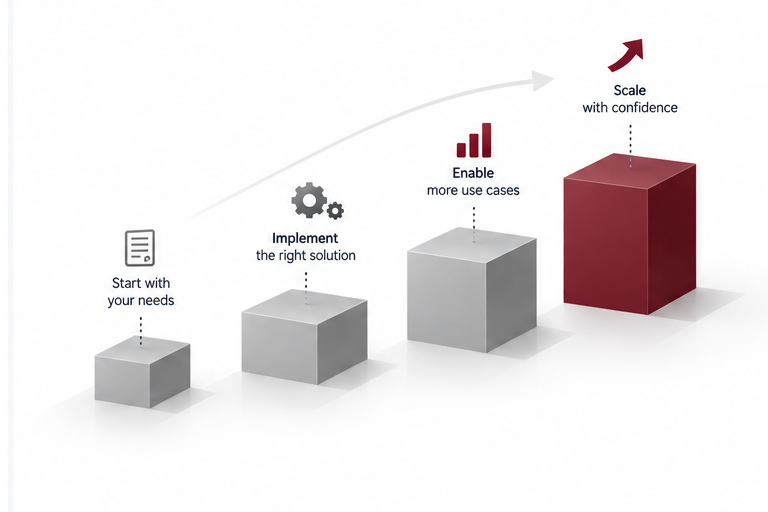
Phase 1: Prove the use case
Choose two or three decisions that genuinely require integrated data. Define the metrics, owners, source systems, expected actions, and baseline reporting effort.
Phase 2: Validate the data
Profile the necessary fields. Test identifiers and joins. Understand missing history. Reconcile key totals against trusted operational or financial reports.
Phase 3: Build the minimum foundation
Ingest only the required sources and tables. Establish raw and transformed layers appropriate to the complexity. Add tests, access controls, monitoring, and documentation from the beginning.
Phase 4: Publish a governed analytical model
Do not expose every raw table to business users. Create models aligned with business concepts and approved metric definitions. Make lineage and known limitations understandable.
Phase 5: Put the output into a real workflow
Use the reports in actual sales, finance, operations, or executive routines. Track whether preparation time, disputes, or decision turnaround improves.
Phase 6: Expand based on demonstrated demand
Add the next source or use case because it has a clear owner and business purpose, not because the warehouse is capable of storing it.
How to build the business case
A credible warehouse business case should compare the current cost of fragmented analytics with the full future operating cost.
Start with measurable baseline problems: analyst hours spent collecting and reconciling data; recurring manual reporting effort; delayed decisions; report failures caused by source changes; duplicate engineering across dashboards; operational system impact; and important analyses that cannot currently be performed reliably.
Separate hard savings from capacity and decision benefits. If automation saves analysts 30 hours per week but nobody’s payroll changes, that is released capacity rather than immediate cash savings. It can still be valuable, but label it correctly.
Decision benefits require even more care. If better customer profitability information contributes to pricing changes, measure the resulting margin where possible, but do not attribute every improvement to the warehouse.
Then model the recurring cost, not merely implementation. Include software, cloud usage, engineering, maintenance, monitoring, governance, and user support.
The decision should be based on whether the platform enables a portfolio of valuable use cases more reliably and economically than the alternatives.
Questions a CTO should ask before approving a warehouse
- Which three business decisions justify the first implementation?
- Which source systems are required for those decisions?
- What cannot be achieved reliably through native reporting or simpler integration?
- Which historical information must be preserved?
- Who owns each business definition?
- How will financial and operational totals be reconciled?
- What data is sensitive, and who should be able to access it?
- What happens when a source schema or API changes?
- Who will operate pipelines and respond to failures?
- What will the platform cost after the implementation team leaves?
- What measurable outcome would cause us to expand the platform?
- What outcome would tell us that we overbuilt it?
Frequently asked questions
Do I need a data warehouse for Power BI or Tableau?
No. Both BI platforms can connect to many applications and databases directly. A warehouse becomes more useful when several sources need repeatable integration, shared transformations, historical preservation, workload separation, or stronger governance.
How many data sources justify a data warehouse?
There is no meaningful fixed number. Two difficult sources with complex historical joins may justify centralized infrastructure, while several simple sources may not. Evaluate integration complexity and business value rather than counting connectors.
Can a small business use a data warehouse?
Yes, but it should have a specific reason. Cloud platforms have lowered the infrastructure barrier, yet engineering and operating complexity still exist. Small businesses should avoid building a platform whose maintenance costs exceed the reporting problem it solves.
Is a data lake the same as a data warehouse?
No. The terms describe different architectural concepts, although modern platforms increasingly overlap in capability. A lake commonly stores data in flexible file-based formats, while a warehouse traditionally emphasizes structured analytical processing. The correct design depends on workloads and governance requirements rather than terminology.
Should we move all company data into the warehouse?
Usually not at the beginning. Start with data required for defined use cases. Ingesting everything increases cost, security exposure, documentation requirements, and maintenance without guaranteeing additional value.
How long does a data warehouse implementation take?
It depends on source complexity, data quality, security requirements, historical needs, and the number of use cases. A focused first implementation can be much smaller than an enterprise-wide program. Use phased delivery and reconciliation rather than setting a universal timeline.
Does a data warehouse create a single source of truth?
It can support one, but technology alone does not create agreement. A trustworthy analytical environment requires explicit definitions, owners, lineage, testing, and reconciliation. Multiple valid definitions can coexist when they are clearly named and governed.
Can AI replace a data warehouse?
AI can help users query, summarize, document, and explore data, but it does not remove the need for reliable underlying information. If source systems contain inconsistent identities and conflicting definitions, a natural-language interface can make those inconsistencies easier to query without making them correct.
Conclusion: build the warehouse when the problem earns it
A data warehouse should be a response to demonstrated analytical constraints, not a milestone on a generic digital-transformation checklist.
Stay simple while native reporting and lightweight integrations reliably support important decisions. Introduce centralized analytical infrastructure when cross-system analysis, reusable transformations, historical requirements, workload separation, data quality controls, security, or reporting scale make the simpler approach fragile.
Then build incrementally. Start with decisions, not sources. Define metrics before models. Reconcile before publishing. Measure adoption and outcomes before expanding.
A good warehouse does not prove that an organization has sophisticated technology. It quietly makes trustworthy information easier to produce, govern, and use.
About Actiknow
Actiknow Consulting helps organizations design and implement practical data engineering and business intelligence solutions, including data integration, cloud data platforms, governed analytical models, and executive reporting. Our teams work with technologies including Snowflake, BigQuery, Redshift, Power BI, Tableau, and Looker Studio.
If your organization is deciding whether it needs a data warehouse, Actiknow can help assess the current reporting environment, identify the use cases that justify investment, and design a phased architecture around measurable business requirements rather than unnecessary complexity.