

An existing business API may already know how to retrieve an invoice, check an order, or open a support ticket. The challenge for an AI agent is discovering that capability, understanding its inputs, and invoking it through a consistent interface. Google Cloud API Gateway’s Model Context Protocol (MCP) support offers a way to expose selected REST operations as agent-callable tools without rewriting the underlying services. That is a useful integration option, not a shortcut around enterprise security or application design.
What changed in September 2026
Google Cloud announced public-preview MCP support for API Gateway on September 11, 2026. The gateway can act as a remote MCP server: an agent sends MCP JSON-RPC messages, the gateway maps an eligible tool call to an HTTP request, and the existing REST backend returns the result. Tool definitions are configured through an OpenAPI 3.x document and Google-specific extensions. Google’s current API Gateway documentation describes this as a pre-general-availability feature, so production adoption should explicitly account for preview terms, limits, and change risk.
The important distinction is between making an API callable and making an action safe to delegate. A gateway can expose an operation, but the business must still decide which agents may call it, whose permissions apply, what inputs are acceptable, and whether a human must approve a consequential action.
How the architecture works
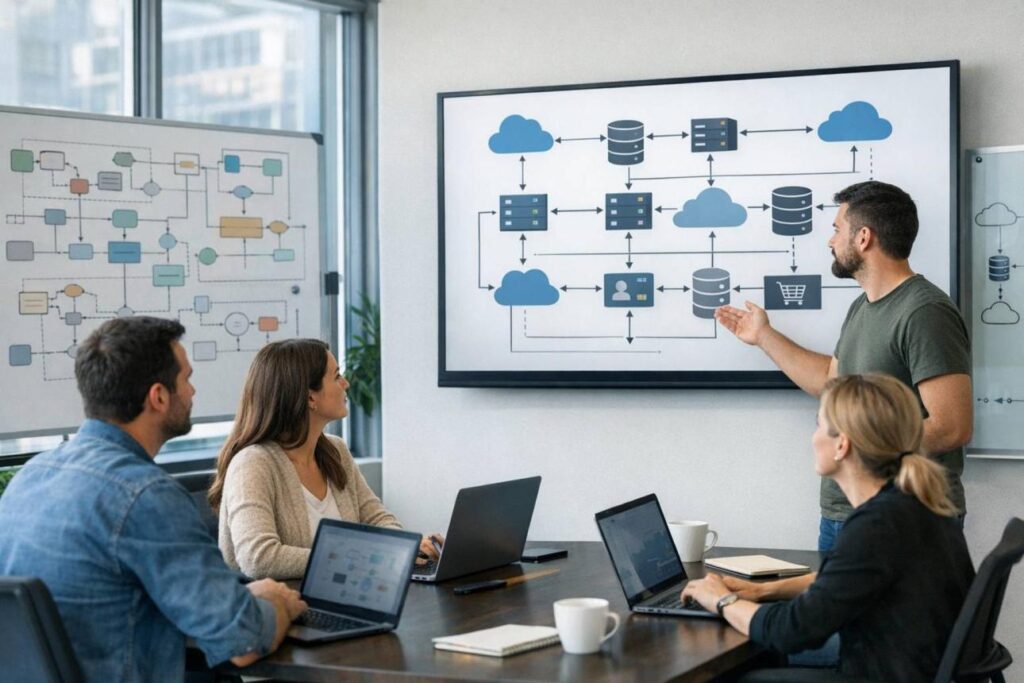
Consider a B2B operations platform with REST endpoints for order lookup, stock availability, and customer account updates. An MCP-enabled API Gateway sits in front of those endpoints. An agent connects to the gateway’s /mcp path, initializes the protocol, discovers tools with tools/list, and invokes a named tool with tools/call. The gateway validates and maps the request, calls the backend, and translates the response back into MCP. Existing applications can continue using the REST API independently.
This is a protocol adapter, not a new database or a replacement for backend business rules. Validation, transactional integrity, tenant boundaries, and audit history must remain enforceable by the backend. Tool descriptions improve discoverability, but they do not provide authorization. A tool called get_customer_balance still needs server-side checks that the caller can access that customer.
What the preview supports and what it does not
Google documents initialize, notifications/initialized, tools/list, and tools/call for API Gateway’s MCP implementation. Its current overview excludes MCP resources and prompts, stdio transport, streaming or long-running tool calls, and simultaneous MCP and model routing in the same API configuration. The configuration requires OpenAPI 3.x, not OpenAPI 2.0. Supported exposed operations use GET, POST, PUT, PATCH, or DELETE, with tool-name constraints and unique names. These boundaries matter when selecting a client and planning workflows that may take minutes rather than seconds.
Google’s September 30 update added API-key authentication for tools/list, alongside JWT support. Treat discovery controls separately from execution controls: hiding a tool list from unauthorized callers does not by itself establish fine-grained access to the underlying records. Confirm the security behavior of each exposed operation, including the identity propagated to the backend.
For teams evaluating a broader API portfolio, API Gateway MCP should not be confused with Google’s API hub MCP discovery features or Apigee’s MCP capabilities. Those products serve related but different management and integration needs. Choose on the basis of the current API estate, governance requirements, supported protocol features, and operational ownership, rather than treating every Google Cloud MCP offering as interchangeable.
Which existing APIs are good candidates?
Begin with narrowly scoped, read-only operations that answer an operational question: retrieve an order status, look up product availability, or return a customer-specific reporting summary. These are easier to test for correctness, authorization, latency, and accidental data exposure. Avoid exposing a generic execute_sql endpoint or an unrestricted administrative API as a convenience tool. Broad capabilities amplify the consequences of prompt injection, tool misuse, and configuration errors.
Write operations can be valuable, but they need stronger controls. Creating a draft ticket is different from issuing a refund or changing bank details. Classify each tool by business impact and reversibility. For high-impact actions, require a separate approval step, narrow role-based permissions, idempotency keys where appropriate, and an auditable record of who requested, approved, and executed the change.
A practical candidate scorecard should examine five dimensions: business value, sensitivity of returned data, side-effect severity, API contract stability, and ability to test with realistic permissions. A high-value read operation with a stable schema is a better first pilot than an unstable endpoint with irreversible effects.

Security architecture: the real design work
Identity and authorization: Identify the human user, agent service, and backend principal involved in every call. Determine whether access is delegated on behalf of a user or executed under a service identity. Enforce object-level and tenant-level access in the backend, not only at the gateway. Test with two users from different tenants and confirm that neither can retrieve the other’s data by changing an identifier.
Tool exposure: Prefer explicit per-operation opt-in. Google’s configuration also permits global MCP enablement for eligible operations; that can accidentally broaden the tool surface as an OpenAPI specification grows. Review generated tool lists during deployment and fail release checks if unexpected operations appear.
Input and output handling: Validate schemas, lengths, identifiers, and allowed values. Do not assume an agent-generated argument is trustworthy. Limit response fields, redact secrets and unnecessary personal data, and avoid returning raw internal errors. For write calls, use server-side business validation even when a tool schema declares required fields.
Prompt-injection and untrusted content: An agent may encounter malicious instructions in documents, tickets, or API responses. Tool authorization must not depend on the agent following a natural-language instruction. Keep sensitive operations behind explicit policies, approvals, and server-enforced scopes.

Observability: Capture tool name, API operation, authenticated principal, tenant or account context where appropriate, request ID, outcome, latency, and backend correlation ID. Log safely, without exposing credentials or sensitive payloads. Monitor denial rates, unusual tool invocation patterns, backend errors, and business-level reconciliation failures.
For organizations planning an API-to-agent layer, Actiknow’s custom solutions and integration services provide a relevant starting point for examining the existing application contracts and integration boundaries before exposing them to new consumers.
An illustrative order-status pilot
Suppose a support team asks an assistant, ‘Where is order 84721?’ The agent discovers get_order_status and supplies an order identifier. The gateway maps the tool to a REST lookup. The backend checks the user’s authorization for that order, returns a constrained status and last-update timestamp, and emits an audit event. The assistant summarizes the result. If the order belongs to another customer, the backend denies access regardless of whether the agent guessed the correct identifier.
The acceptance test is not merely that the agent returns the right status once. Test nonexistent IDs, cross-tenant IDs, expired credentials, backend timeouts, malformed inputs, ambiguous tool descriptions, rate limits, and repeated calls. Verify that a denial is not transformed into a misleading success. Compare tool results with the authoritative system of record.

A four-phase implementation plan
Phase 1, inventory and classify
Catalog candidate REST operations, owners, OpenAPI versions, data classifications, authentication methods, dependencies, and rate limits. Select one or two read-only endpoints with a clear business use case. Document the existing permission model and define measurable success criteria.
Phase 2, configure and secure
Annotate the OpenAPI 3.x specification, enable only approved tools, configure backend routing and authentication, and deploy to an isolated nonproduction gateway. Review tools/list from an authorized and unauthorized client. Validate that the backend sees the expected identity and rejects forbidden records.
Phase 3, test the workflow
Run contract, authorization, negative, load, and resilience tests. Simulate backend failures and unexpected outputs. Confirm logging, alerting, incident ownership, and rollback procedures. Measure successful task completion and human correction rate rather than counting tool calls alone.
Phase 4, controlled release
Start with a small approved user group, conservative quotas, and a documented escalation path. Compare agent-assisted outcomes with the existing manual workflow. Expand only after the team demonstrates that sensitive records remain protected and failed operations can be investigated.

Operational considerations executives should budget for
Tool contracts are product interfaces. Renaming a tool, changing an argument, or altering a response can break clients even when the underlying REST endpoint still works. Google states that API Gateway API configurations are immutable: changes to the exposed MCP tool set require creating a new API config and deploying it. Because the gateway does not send tools/list_changed notifications, clients caching tool definitions may need to refresh discovery after rollout.
Budget for API ownership, OpenAPI maintenance, integration testing, client compatibility, security reviews, monitoring, incident response, and usage charges. Gateway fees are only one component of the operating cost; backend calls and any model or agent platform costs may also apply. Verify current product pricing and preview eligibility before committing to a financial forecast.
An executive dashboard for this capability should track authorized task completion, rejected unauthorized calls, tool errors, p95 end-to-end latency, backend failure rate, sensitive-action approvals, and the share of outcomes requiring human correction. A rising call count is not evidence of business value if resolution quality deteriorates.
When not to use API Gateway MCP
Avoid forcing this architecture onto workflows requiring unsupported MCP resources, prompts, streaming, or long-running tools. If a use case needs complex orchestration, custom context retrieval, or advanced API product management, assess a dedicated MCP service, Apigee, or a workflow service instead. If the current API is poorly secured or its business rules are inconsistent, fix that foundation first. A new protocol interface makes an unreliable API more accessible, not more reliable.
Questions leadership should ask before approval
- Can we name the business owner of each tool?
- Can we show which backend identity executes the request?
- Have we tested tenant isolation with real permission differences?
- Can we disable one tool without losing the rest of the application?
- Do we have a rollback path when a tool definition changes?
- Is there a human approval policy for high-impact actions?
- Can support teams trace an agent answer to a backend request and business record?
Frequently asked questions
1. Does MCP replace our REST APIs?
No. API Gateway translates selected MCP tool calls into requests to existing REST backends. The REST services and their contracts remain in place.
2. Do we need to rewrite the backend?
Not necessarily. The documented gateway feature is designed to expose existing REST operations using OpenAPI annotations. Backend changes may still be needed for safe authorization, response shaping, or idempotency.
3. Is the feature generally available?
As of November 12, 2026, Google’s API Gateway MCP documentation labels it Public Preview and subject to pre-GA terms. Recheck the release notes before deployment.
4. Can any API endpoint become an MCP tool?
No. Eligibility depends on OpenAPI 3.x configuration, supported HTTP methods, backend mapping, and current feature limits. Select operations deliberately.
5. Does MCP authentication guarantee tenant isolation?
No. Authentication identifies a caller; the backend must also enforce authorization for each resource and tenant.
6. Can agents change business records?
Selected write endpoints may be exposed, but authorization, approval, auditability, and recovery controls should reflect the impact of each action.
7. What happens if the backend times out?
The tool invocation can fail. Design retry and user-facing error behavior carefully, especially for writes where a timeout does not prove that no side effect occurred.
8. Can we use an OpenAPI 2.0 specification?
Not directly for this feature. Google’s current configuration guidance requires OpenAPI 3.x.
9. How do we update tools after deployment?
Create and deploy a new API configuration, validate the new tools/list output, and coordinate refreshes for clients that cache definitions.
10. What is the safest first use case?
A low-risk, read-only lookup with well-defined access rules, stable schemas, measurable business value, and comprehensive negative tests.
Google Cloud API Gateway MCP support can make existing business APIs easier for agents to discover and invoke. The strategic opportunity is to reuse tested application capabilities instead of rebuilding them for every agent. The governance obligation is equally important: limit the tool surface, preserve backend authorization, test adversarial inputs, and operate each tool like a production integration.
If your team is evaluating how to expose existing APIs safely, explore Actiknow’s custom solutions offering or contact Actiknow to discuss an integration architecture review. Start with one valuable workflow and a testable security model rather than a broad agent rollout.
Source notes (verified November 12, 2026)
Google Cloud API Gateway release notes (September 11 and September 30, 2026); Google Cloud Model Context Protocol overview; Google Cloud Configure Model Context Protocol. Product status and limits should be rechecked at implementation time.