

The invisible operational risk
Many business applications appear successful at the interface while essential work continues in the background. An order is accepted but its invoice never arrives. A scheduled import runs but skips records. A notification job is retried and sends the same email twice. These failures are hard to see because the initiating user is no longer waiting for the outcome. Reliability therefore means more than a scheduler reporting that it ran. Teams need evidence that the expected business outcome happened, that exceptions are visible, and that operators can recover safely.
Define what success means
Start with a contract for each job: trigger, business purpose, input, expected output, owner, deadline, dependencies and recovery method. For recurring billing, success might mean exactly one valid invoice per eligible subscription and billing period. For a CRM synchronization, success might mean every accepted source change has a corresponding destination update or a documented exception. A process exit code of zero cannot prove either outcome. Track expected units of work as well as actual completion.
Persist the full job lifecycle
Use a durable job record with an immutable job ID and states such as queued, running, succeeded, retryable failure, permanently failed and cancelled. Store scheduled time, start and finish time, attempt count, next retry, correlation ID, worker version and sanitized error category. A heartbeat or expiring lease helps identify abandoned work after a worker crashes. Validate transitions atomically so two workers do not claim the same item simultaneously. A queue message alone is often insufficient for auditability or operator review.

Design for duplicate delivery
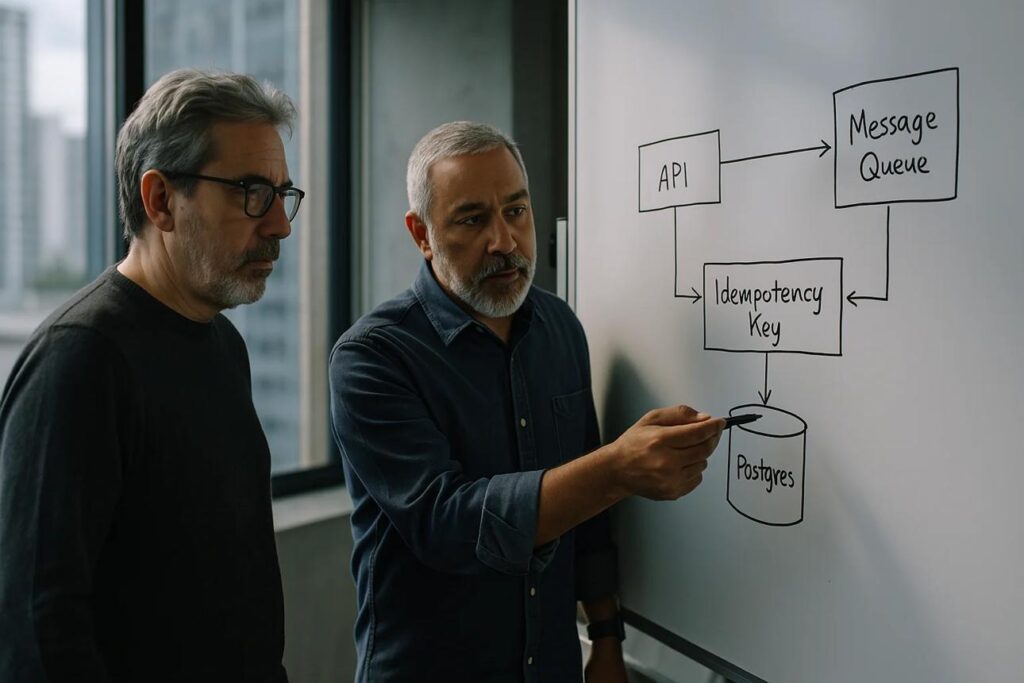
Many queues provide at-least-once delivery: a worker can finish an action and crash before acknowledging the message, causing a duplicate attempt. Idempotency is the ability to repeat the logical operation without another unintended business effect. Use stable business keys, such as customer ID plus billing period, and enforce uniqueness at the database boundary where possible. When an external provider supports idempotency keys, use them. On ambiguous API timeouts, check whether the provider already committed the operation before retrying. A simple queue deduplication flag does not guarantee end-to-end correctness.
Classify failures before retrying
A temporary timeout, vendor throttling or brief database outage may be retryable. An invalid account, unsupported state or missing required field usually requires intervention. Apply capped exponential backoff with jitter, respect Retry-After where provided, and define a maximum attempt count and retry deadline. Do not retry malformed records indefinitely. After the budget is exhausted, move the item to a controlled exception state or dead-letter queue. Retain useful identifiers and diagnostic categories, but not passwords, tokens or unnecessary personal data.
Prevent overlapping scheduled work
A job scheduled every 15 minutes can take 20 minutes during peak load. Without an overlap policy, the next run may double-process records. Decide whether to skip, serialize, partition or parallelize overlapping work. Use database-backed leases or suitable distributed coordination, with expiry and protection against stale workers. Test what happens when a process dies while holding a lease. Apply per-tenant and per-vendor concurrency limits where one customer or integration could monopolize resources.
Protect downstream capacity
A queue can absorb work faster than a database or SaaS API can process it. Limit worker concurrency, connection pools, batch sizes and outbound request rates. Introduce backpressure when downstream latency or error rates increase. For large imports, checkpoint progress using stable cursors and advance those cursors only after records have been committed. Where database updates must reliably trigger further work, consider a transactional outbox or equivalent durable handoff. A local database transaction cannot atomically commit an email or an external payment.
Monitor outcomes, not just processes
Operational signals include oldest queued job age, scheduling delay, processing duration, success and failure counts, retries, abandoned leases, throughput and dead-letter backlog. Business signals include overdue invoices, unreconciled imports, pending customer activations and undelivered notifications. Monitor by workflow and, where appropriate, tenant or integration. Alert on sustained breaches of meaningful service objectives rather than every transient retry. A green worker dashboard can coexist with critical business exceptions.

Define service objectives and incident ownership
A useful objective is expressed in business terms: for example, 99.9% of eligible nightly imports completed or explicitly classified by 7 a.m. This is an illustrative target, not an industry benchmark. Set thresholds based on operational impact. Assign a technical owner to diagnose and repair failures and a business owner to validate record-level consequences. Alerts should identify affected workflow, scope, first failure time, correlation IDs and a runbook. Document escalation, customer communication and after-hours coverage for critical jobs.
Make replay safe and auditable
An operator should be able to inspect a failed item, correct its input when authorized, retry it, and see the final outcome. Log who initiated replay, why, when and which records were affected. Limit replay permissions and batch sizes. Before repeating an action with external side effects, reconcile the vendor state. A timeout does not prove that an invoice, payment or message failed. Test duplicate, partial and out-of-order processing in a non-production environment before enabling production replay.

Reconcile expected and completed work
For each critical batch, calculate expected eligible records, completed records, quarantined records and still-pending records. Investigate gaps. Counts alone are not sufficient when duplicates can cancel omissions numerically, so compare stable business identifiers and key amounts where relevant. Keep a daily exception report visible to the business owner. This catches silent failures such as incorrect pagination, stale sync cursors, mapping changes and records rejected without a technical exception.
Illustrative example: monthly invoices
Imagine a B2B subscription platform with 8,000 active accounts. The scheduler creates one durable job for each eligible account and period. Workers use account-period idempotency keys, persist invoice records, and call the billing provider with a stable external reference. On timeout, they query the provider before retrying. A reconciliation report lists eligible accounts, confirmed invoices, pending work and exceptions. Finance reviews unresolved items before closing the run. The numbers and workflow are illustrative, not a description of an Actiknow customer.
A four-week reliability improvement plan
Week 1
inventory critical jobs, business deadlines, failure history and owners. Select measurable completion conditions.
Week 2
add durable IDs, state transitions, structured logs and correlation IDs.
Week 3
implement idempotency, failure classification, bounded retries and concurrency controls.
Week 4
build reconciliation reports, alerts, authorized replay and failure-injection tests. Prioritize billing, customer records and contractual workflows before lower-impact housekeeping tasks. Document every change and its recovery procedure.

Test the failures that matter
Simulate worker termination immediately after a successful external call, duplicate queue delivery, expired credentials, database outages, throttling, malformed payloads, overlapping schedules, partial batches and delayed vendor responses. Verify that every failed job becomes discoverable, that retries do not create duplicate side effects, and that a second engineer can follow the runbook. Include load tests to confirm that retry storms do not overwhelm dependencies. A recovery drill is a better readiness test than a demo of the happy path.
Questions executives should ask
- Can we enumerate all expected work?
- Can we prove which items completed?
- How long can a job remain stuck before anyone notices?
- Who owns the incident and the business reconciliation?
- Can someone safely replay work without the original developer?
- How do we know a vendor API call was not duplicated?
The answers reveal operational maturity more reliably than a particular scheduler, queue or cloud product choice.
How custom application engineering helps
Background job reliability depends on application data models, integration design, permissions, deployment and ongoing support. Actiknow’s custom web application development services cover tailored business applications, while its custom solutions offering includes integrations, databases and automation. Reliability improvements should be scoped against the actual workflows, business deadlines and operational ownership, not sold as a generic infrastructure upgrade.
Frequently asked questions
What is background job monitoring?
Tracking asynchronous work from scheduling through business completion, including delays, attempts, exceptions and reconciliation.
Are automatic retries sufficient?
No. Retries require classification, limits, backoff, idempotency and visibility to avoid duplicate actions or retry storms.
How is a queue different from a scheduler?
A scheduler initiates work at a time or interval; a queue durably holds work until a consumer processes it.
What does idempotency mean?
Repeating a logical operation does not create another unintended business effect, such as a duplicate invoice.
When should a job enter a dead-letter queue?
When normal processing cannot safely continue within the retry policy and an investigation or correction is required.
How can we detect jobs that never start?
Measure oldest pending job age, scheduled-to-start delay, expected schedules and worker health.
How do we avoid overlapping jobs?
Adopt an explicit overlap policy backed by durable leases, locks or partitioning and test worker crashes.
Can exactly-once execution be guaranteed?
Some platforms offer limited guarantees, but cross-system side effects still need idempotency and reconciliation.
Who owns failed jobs?
Engineering owns technical diagnosis; the accountable business team validates the impact and corrective outcome.
Which metrics should we implement first?
Business deadline misses, queue age, permanent failures and source-to-destination reconciliation exceptions.
Conclusion
Reliable background work is work that is accounted for, observable and recoverable. Durable state, idempotency, bounded retries, concurrency control and business reconciliation should be part of the design, not emergency additions after a failure.
Talk to Actiknow
If critical imports, billing tasks or integrations are difficult to monitor or recover, explore Actiknow’s custom solutions services to discuss a focused reliability assessment and remediation plan.