
The Decision Is Not SaaS Versus Engineering
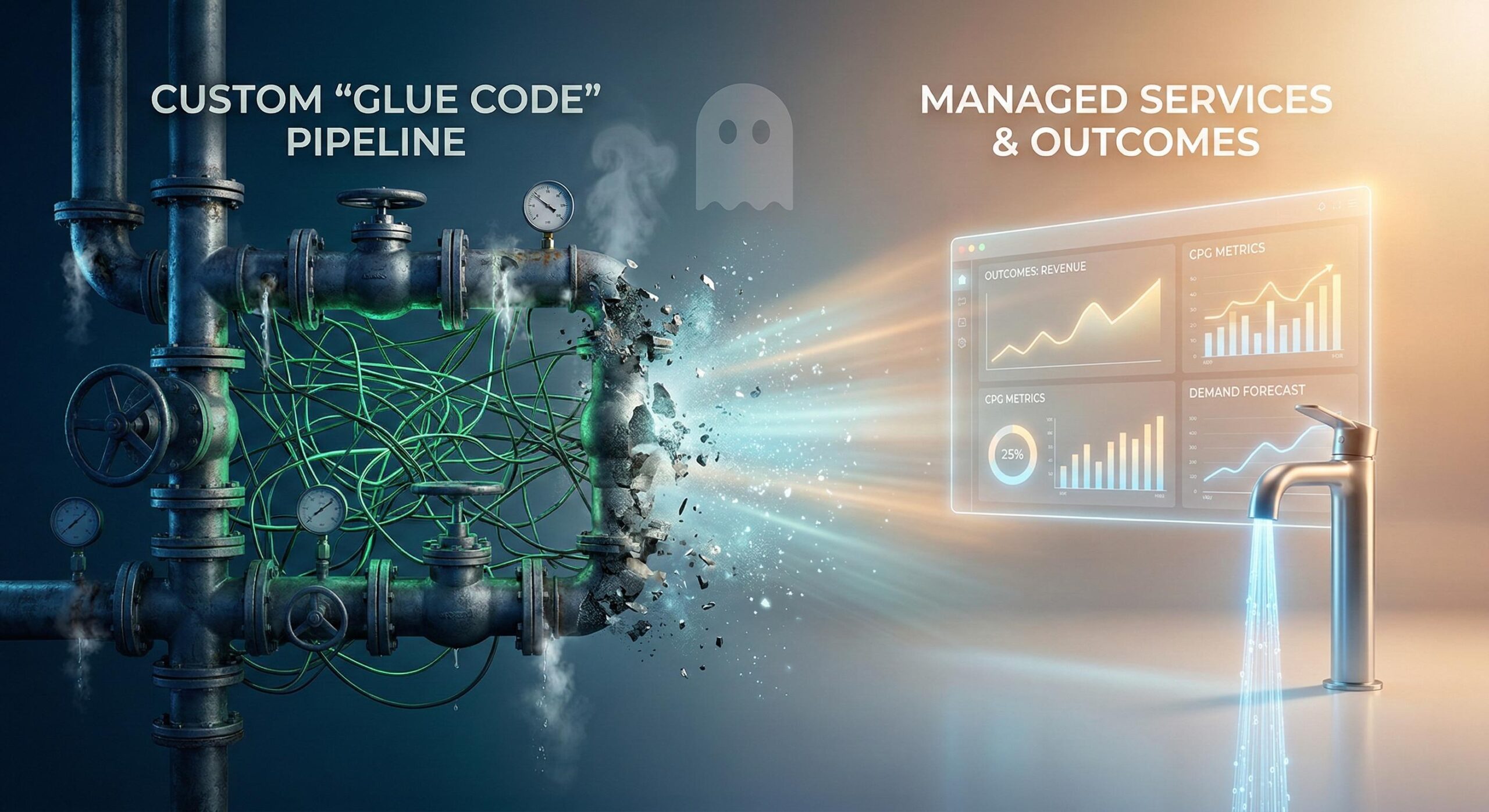
The question “Should we use Fivetran or build our own data pipelines?” sounds like a tooling decision. For a CTO, CIO, data leader, or CFO, it is really an operating-model decision.
A managed connector platform buys you abstraction. Instead of engineering authentication, incremental extraction, retries, schema handling, scheduling, and much of the operational plumbing for every source, you pay a vendor to manage a large part of that work.
A custom pipeline buys you control. Your team decides exactly what to extract, how frequently to extract it, how state is stored, how failures are retried, how data is shaped, and how infrastructure costs are managed.
Neither model is inherently cheaper or more reliable.
A managed connector can be dramatically less expensive when it eliminates months of engineering and ongoing maintenance. The same connector can become expensive when data volumes, connector counts, or sync patterns grow in ways that drive usage charges.
A custom pipeline can have a low cloud bill while quietly consuming expensive engineering capacity. It can also be the right long-term architecture when the source is unusual, the logic is specialized, the volume is predictable, or operational control matters more than convenience.
The useful comparison is therefore total cost and total operational responsibility.
Actiknow’s Business Intelligence services include integrating data from databases and APIs, solution architecture, modeling, reporting, and refresh mechanisms. That broader architecture is important because ingestion is only one part of a dependable analytics platform.
What Fivetran Is Actually Buying You
Fivetran provides managed connectors that replicate data from source systems into supported destinations. The main value is not simply that a connector can call an API. A competent engineer can call most APIs.
The value is that the connector product takes responsibility for a repeatable set of operational concerns across many sources.
Depending on the connector and configuration, this can include:
- authentication;
- incremental synchronization;
- state management;
- source-to-destination schema handling;
- retry behavior;
- scheduling;
- connector monitoring;
- platform logs;
- source API changes;
- connector upgrades;
- historical re-syncs.
Fivetran’s documentation also says application-source schemas are generally generated by Fivetran and that source schema changes are propagated into connector and destination schemas. Its release notes show why this matters: third-party APIs and connector schemas continually add, rename, or discontinue tables and fields.
This is the strongest argument for managed connectors.
You are not only buying the first successful data load. You are buying ongoing maintenance of the extraction layer.
But Managed Does Not Mean Maintenance-Free
A managed connector reduces engineering responsibility. It does not remove data engineering responsibility.
A source can add a field that appears automatically in the destination while breaking a downstream model.
A vendor can discontinue an API object.
A table can be re-synced.
A business team can change a source configuration.
A connector can remain technically healthy while the data becomes semantically wrong.
Your team still owns questions such as:
- Did all expected records arrive?
- Did a schema change break downstream transformations?
- Did a source change the meaning of a field?
- Is a re-sync duplicating or restating historical data?
- Are important tables excluded from synchronization?
- Did the pipeline finish before the executive dashboard refreshed?
- Are costs moving because business activity increased or because extraction logic changed?
Managed ingestion is not managed analytics.
When you evaluate Fivetran, evaluate the operating model around it as carefully as the connector catalog.
What a Custom Pipeline Really Requires
A custom pipeline is often described too simply:
- Call API.
- Write JSON.
- Load warehouse.
- Schedule job.
That can work for a prototype. A production connector needs much more.
A robust custom extraction service usually needs to handle:
- credentials and secret rotation;
- OAuth token refresh;
- pagination;
- API rate limits;
- incremental cursors;
- late-arriving records;
- deletes;
- updates;
- schema evolution;
- nested data;
- type changes;
- backfills;
- retries;
- idempotency;
- duplicate prevention;
- partial failures;
- logging;
- alerting;
- run history;
- deployment;
- dependency updates;
- API version changes;
- tests;
- documentation;
- ownership.
The extraction code may be a few hundred lines. The production system around it is the real investment.
This is why comparing a Fivetran invoice with a cloud-function bill is misleading. The correct custom-pipeline cost includes engineering, infrastructure, monitoring, support, incident response, maintenance, and the opportunity cost of using data engineers for plumbing instead of business-facing data products.
Actiknow’s Custom Solutions work includes system integrations, database and data-lake setup, and automation. Those capabilities become relevant when an organization needs a pipeline that cannot be treated as a standard connector problem.

The Seven Dimensions That Should Drive the Decision
1. Connector Coverage
Start with the obvious question: does a production-ready managed connector exist for the source and destination you need?
If yes, investigate whether it covers the actual objects, endpoints, history, and fields required by the business.
“Fivetran supports Salesforce” is not the same as “the connector supports every Salesforce object and behavior our reporting model requires.”
Create a source-level coverage matrix:
- required object or endpoint;
- historical depth;
- incremental behavior;
- delete handling;
- custom fields;
- attachments or files;
- API limitations;
- expected refresh frequency;
- destination requirements.
If the managed connector covers the requirement cleanly, custom development needs a clear reason to exist.
If coverage is partial, the decision may become hybrid rather than binary.
2. Change Handling
Third-party systems change.
API versions are deprecated.
Fields appear.
Fields disappear.
Authentication changes.
Rate limits change.
Response structures change.
With a managed connector, the vendor absorbs a meaningful portion of that change burden. Fivetran documents automatic handling of many schema changes and publishes connector-specific release notes.
With a custom pipeline, your team owns the change lifecycle.
That can still be the better choice when you need strict control. But the cost model must include maintenance after launch.
A useful procurement question is:
Who gets paged when the source API changes at 2 a.m.?
The answer reveals more about the real architecture than the initial build estimate.
3. Volume-Based Cost
Fivetran’s usage model is based on Monthly Active Rows for many connector workloads. Its Connector SDK also uses MAR for usage calculation.
That means cost is workload-sensitive.
Do not model a managed platform using only today’s invoice.
Forecast:
- current active rows;
- growth in source data;
- number of connections;
- number of environments;
- backfills and re-sync behavior;
- high-churn tables;
- future sources;
- future business units.
Then compare that forecast with the fully loaded custom alternative.
For a custom pipeline, include:
- engineering build effort;
- cloud compute;
- storage;
- orchestration;
- logging;
- monitoring;
- secrets management;
- CI/CD;
- support;
- maintenance;
- incident response;
- API upgrade work.
Do not assume custom is cheaper because infrastructure costs $200 per month. If a senior data engineer spends several days each month maintaining connectors, that labor is part of the pipeline cost.
4. Reliability
Reliability should be measured, not described as “managed” or “custom.”
Define what reliable means for your organization.
For example:
- 99% of scheduled runs complete within the reporting SLA.
- No silent loss of source records.
- Failed loads can be replayed safely.
- Late data is captured.
- Schema changes are detected.
- Critical failures alert an owner.
- Backfills do not corrupt downstream models.
- Data freshness is visible to dashboard users.
Then evaluate both approaches against the same controls.
A mature custom pipeline can be extremely reliable because it is designed around one organization’s exact source behavior.
A mature managed platform can be extremely reliable because a specialized vendor operates connector infrastructure at scale.
The architecture label does not prove reliability. Controls and operating evidence do.
5. Observability
Ask what your team can see when something goes wrong.
For a managed connector, inspect:
- sync status;
- failure messages;
- logs;
- schema changes;
- API usage;
- historical run information;
- destination metadata;
- alerting integrations.
Fivetran documents logs for Connector SDK connections and exposes platform metadata that can support monitoring.
For custom pipelines, define observability before production:
- structured logs;
- run IDs;
- source watermark;
- records read;
- records written;
- records rejected;
- duration;
- retry count;
- API response errors;
- destination status;
- freshness timestamp;
- alert state.
A pipeline that says “success” without proving how much data moved is not sufficiently observable for executive reporting.
6. Ownership and Skills
Every pipeline has an owner, even when nobody has formally assigned one.
With a managed platform, ownership shifts toward configuration, governance, vendor management, cost control, and downstream data quality.
With custom engineering, ownership includes the extraction code and production runtime.
Ask:
- Who understands the source API?
- Who can deploy a fix?
- Who owns credentials?
- Who monitors failed runs?
- Who handles source schema changes?
- Who handles vendor support?
- Who approves re-syncs?
- Who validates downstream impact?
- What happens if the original developer leaves?
If those questions have weak answers, custom engineering has a hidden continuity risk.
7. Control and Special Requirements
Custom pipelines become more attractive as requirements become more specialized.
Examples include:
- proprietary internal systems;
- unusual APIs;
- special incremental logic;
- complex file processing;
- source-specific reconciliation;
- strict network constraints;
- custom encryption requirements;
- non-standard destinations;
- very high-frequency ingestion;
- special data residency requirements;
- business logic that must run during extraction.
Even then, do not automatically build the entire platform yourself.
Fivetran offers a Connector SDK for custom Python connectors, which creates a middle option: your team can write source-specific extraction logic while using Fivetran’s connector runtime and usage model.
Similarly, a hybrid architecture can use managed connectors for commodity SaaS sources and custom pipelines only where control creates real business value.
A Practical Total Cost of Ownership Model
Use a three-year model rather than a first-year implementation quote.

1. Managed Pipeline TCO
Include:
- subscription or usage charges;
- minimum or connection charges where applicable;
- premium features required by your architecture;
- warehouse compute caused by ingestion;
- implementation and configuration;
- monitoring and governance;
- downstream transformations;
- vendor management;
- expected growth.
2. Custom Pipeline TCO
Include:
- initial engineering;
- architecture and security review;
- testing;
- cloud infrastructure;
- orchestration;
- logging and monitoring;
- CI/CD;
- maintenance engineering;
- on-call and incident work;
- API/schema upgrade work;
- documentation;
- knowledge transfer;
- rebuild risk if ownership is lost.
Then add one line that is often omitted:
Cost of delayed data availability.
If a custom connector takes six weeks to production while a managed connector can be configured rapidly, the business value of those six weeks belongs in the decision.
Conversely, if a managed connector cannot expose a critical dataset, the cost of missing data belongs on that side.
Do Not Compare Costs Without a Workload
“Which is cheaper?” cannot be answered without a workload.
Build the comparison for a specific portfolio.
Example structure:
- 15 standard SaaS sources.
- 2 operational databases.
- 1 proprietary application API.
- 1 finance file feed.
- Hourly refresh for commercial reporting.
- Daily refresh for finance.
- Three-year expected data growth.
- Defined recovery and freshness SLAs.
Now evaluate the architecture.
You may discover that the best answer is:
- managed connectors for 15 SaaS systems;
- database-native or managed replication for operational databases;
- one custom connector for the proprietary API;
- a simple controlled file ingestion process for finance.
The objective is not to select one philosophy. It is to minimize unnecessary ownership while retaining control where it matters.
The Hybrid Model Is Often the Most Rational
Many organizations frame the choice incorrectly as:
Fivetran everywhere
versus
custom everything.
A source-by-source decision is usually more useful.
Use managed connectors where:
- coverage is strong;
- source APIs change frequently;
- speed to implementation matters;
- the connector is operationally routine;
- engineering time is more valuable elsewhere.
Use custom pipelines where:
- the source is proprietary;
- managed coverage is incomplete;
- special logic is unavoidable;
- volume economics strongly favor custom;
- control or latency requirements justify ownership.
Use a managed custom-connector runtime where:
you need custom extraction logic but still value managed execution, monitoring, and destination integration.
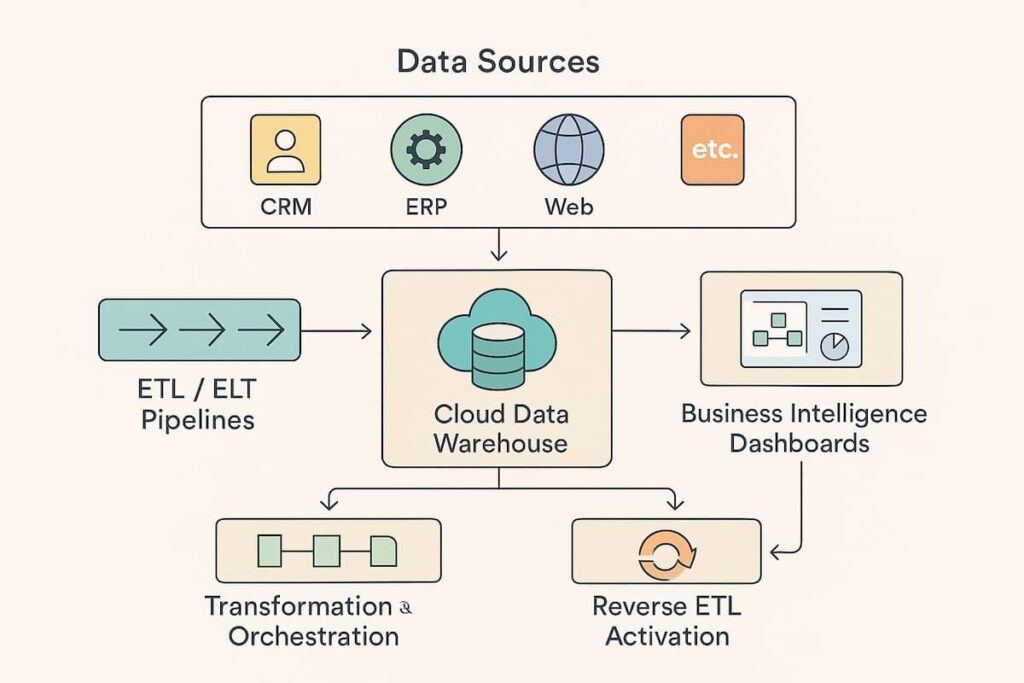
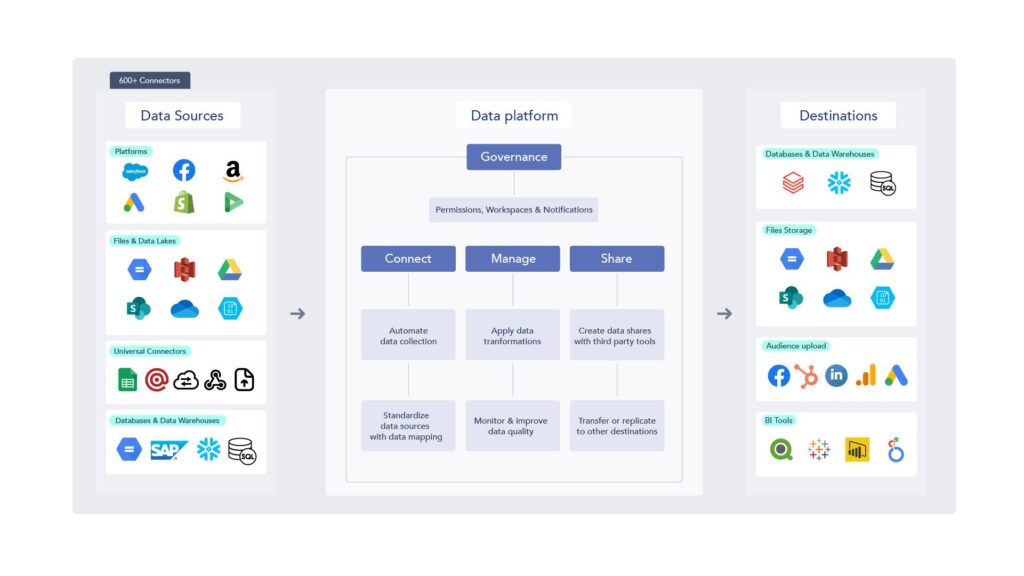
Actiknow’s connector offerings include data movement from multiple business platforms and custom-script approaches for sources such as Google Ads, Xero, Stripe, Zendesk, Salesforce, and others, with cloud destinations including BigQuery and Redshift. That is a useful example of the broader principle: the integration pattern should follow the source and destination requirements rather than a one-tool rule.
A Reliability Checklist Before You Approve Either Option
Before signing a managed-platform contract or approving custom development, require answers to these questions.
1. Data completeness
How do we know every expected record arrived?
How are deletes handled?
How are late updates handled?
How are historical backfills validated?
2. Change management
Who detects source schema changes?
What happens when a field changes type?
How are API deprecations monitored?
How are downstream consumers notified?
3. Operations
What is the retry strategy?
Can a failed run be replayed safely?
How are credentials rotated?
What is the recovery procedure after a partial load?
4. Observability
Can we see source and destination row counts?
Can we see freshness by source?
Are failures automatically alerted?
Can we distinguish API failure from transformation failure?
5. Cost
What drives marginal cost?
What happens if volume doubles?
What does a full re-sync cost?
What engineering effort remains after launch?
6. Ownership
Who is accountable for the pipeline?
Who supports it outside normal hours?
Where is the runbook?
Can another engineer take over without reverse engineering the system?
A Decision Framework for Executives
Choose the architecture in this order.
1. First, classify the source.
Is it a standard SaaS platform, database, file source, or proprietary API?
2. Second, assess managed coverage.
Does the connector meet the actual data requirement, not merely list the source logo?
3. Third, quantify the workload.
How many active rows, sources, connections, environments, and refreshes do you expect over three years?
4. Fourth, define the reliability requirement.
What freshness, completeness, recovery, and monitoring controls does the business need?
5. Fifth, price total ownership.
Include people, platform, infrastructure, support, and change management.
6. Sixth, assess strategic control.
Is this pipeline commodity plumbing, or is its extraction logic a meaningful part of your product or operating advantage?
7. Seventh, choose per source.
Do not force every integration into the same answer.
Common Mistakes
Comparing subscription cost with cloud infrastructure cost
This ignores engineering labor and maintenance.
Building because “it is only an API”
The API call is rarely the expensive part of a production pipeline.
Buying because “Fivetran handles everything”
A connector can manage ingestion while your team still owns data quality, downstream transformations, business definitions, and reporting SLAs.
Ignoring schema-change impact
Automatically adding a source column does not guarantee that downstream models remain correct.
Ignoring re-sync economics
Backfills and re-syncs can change workload, cost, and downstream processing. Model them before a production incident forces the decision.
Using one architecture for every source
Standard SaaS, databases, proprietary APIs, and file feeds have different operational characteristics.
Frequently Asked Questions
Is Fivetran cheaper than custom ETL?
Sometimes. Fivetran can be cheaper when managed connectors replace substantial engineering and maintenance work. Custom ETL can be cheaper for some stable, specialized, or high-volume workloads. Compare three-year total cost for your actual sources and volumes rather than subscription cost versus cloud compute.
Ongoing ownership. API changes, authentication, schema evolution, retries, backfills, monitoring, incidents, tests, and documentation continue after the initial connector works.
Usage growth and retained internal responsibility. A managed connector reduces extraction engineering, but your team still needs governance, monitoring, downstream data quality, transformation logic, and cost management.
Does Fivetran handle schema changes?
Fivetran documents automatic propagation of many source schema changes into connector and destination schemas. However, downstream models and business logic can still be affected, so schema-change monitoring remains necessary.
Can we build a custom connector inside Fivetran?
Yes. Fivetran provides a Connector SDK for custom Python connectors. The custom code runs within the Fivetran connector model, and usage is calculated using MAR according to Fivetran’s documentation.
When should we build a fully custom pipeline?
Consider it when the source is proprietary, managed coverage is materially incomplete, special extraction logic is required, strict operational controls demand it, or a realistic total-cost model favors ownership. The requirement should justify the ongoing engineering responsibility.
Should we use Fivetran for every source if we already have it?
Not automatically. Standardization has value, but each source should still be evaluated for coverage, cost, reliability, and control. A hybrid architecture can preserve platform consistency without forcing poor-fit sources into the same pattern.
How should a CFO evaluate the decision?
Ask for a three-year cost model containing platform fees, engineering labor, infrastructure, support, expected growth, backfills, and maintenance. Then pair that model with reliability and time-to-value requirements. The lowest visible monthly bill is not necessarily the lowest-cost operating model.
Call to Action
If you are deciding between managed connectors and custom pipelines, start with the source portfolio and operating requirements rather than a preferred tool. Actiknow can help assess the integration architecture, identify where managed connectors are appropriate, design custom ingestion where necessary, and connect the resulting data platform to reliable BI reporting. Talk to Actiknow about your data integration architecture.