

The lakehouse versus data warehouse debate is often framed as if every company must choose a side. For most mid-market organizations, that is the wrong starting point.
The better question is what data workloads you actually need to support over the next three to five years, and what is the simplest architecture your team can operate reliably.
A modern cloud data warehouse is still an excellent foundation for structured reporting, executive dashboards, finance analytics, sales reporting and operational BI. A lakehouse becomes more compelling when the organization also needs large-scale file data, semi-structured or unstructured data, data science, machine learning, streaming, open table formats, or several compute engines working against a common storage layer.
The technologies are also converging. Warehouse platforms increasingly support open formats and unstructured data, while lakehouse platforms increasingly provide SQL warehouses, semantic models and strong BI integration. Architecture should therefore be based on workload, governance and operating model rather than product labels.
Actiknow’s business intelligence services cover data-source integration, solution architecture, modeling, dashboards and ongoing refresh mechanisms. Those downstream requirements should shape the platform choice from the beginning.
The Short Answer
A data warehouse is usually the better starting point when most important data is structured, executive and operational BI are the primary workloads, SQL is the dominant analytical skill, the team wants a highly managed platform, and governance simplicity matters more than multi-engine flexibility.
A lakehouse becomes attractive when large volumes of files or semi-structured data matter, data science and machine learning are material workloads, open table formats or object-storage ownership are strategic requirements, streaming is important, or multiple analytical engines need shared datasets.
Many mid-market companies should use a pragmatic hybrid: a managed warehouse for governed BI, with object storage or lakehouse capabilities introduced only where a real workload requires them.
What Is a Data Warehouse?
A data warehouse is an analytical database designed to consolidate business data for querying, modeling and reporting. Typical sources include CRM, ERP, accounting systems, marketing platforms, product databases, spreadsheets, APIs and operational applications.
Data is ingested, cleaned and modeled into structures that make business analysis predictable. The warehouse becomes a governed foundation for executive dashboards, financial reporting, sales analytics, customer analytics, operations reporting and self-service BI.
Modern cloud warehouses such as Snowflake, BigQuery and Redshift remove many infrastructure concerns from the data team and provide mature SQL, security, workload management and BI connectivity.
What Is a Lakehouse?
A lakehouse combines characteristics of a data lake and a warehouse. Data commonly lives in cloud object storage or a unified data lake and is managed through table formats and metadata layers that add transactional consistency, schema management, snapshots, table history, partition evolution, SQL access and governance.
Lakehouse platforms are designed to let different workloads operate over the same broad data estate, including BI, SQL analytics, data engineering, machine learning, streaming, data science and unstructured-data processing.
The strategic attraction is workload breadth. The operational tradeoff is that breadth can introduce more architectural choices.
Do Not Confuse Storage With Business Architecture
A lakehouse does not automatically create better analytics. A warehouse does not automatically create a single source of truth. Both still require source ownership, reliable ingestion, data quality, business definitions, transformation, access control, testing, semantic modeling and monitoring.
If two departments disagree about what active customer means, moving the data from warehouse tables to Delta or Iceberg tables does not resolve the disagreement. Platform architecture and information governance are separate problems.
Start With the Workloads
List the workloads the platform must support. For each, record users, data types, data volume, freshness, query pattern, latency, concurrency, security, tools and business criticality.
If most of the value comes from structured SQL reporting, optimize for that reality. Do not design the entire platform around a hypothetical future machine-learning workload.
Structured BI Favors Simplicity
A typical mid-market BI estate may need to combine Salesforce, ERP, finance, Google Analytics, advertising platforms, support systems and operational databases. The output is often Power BI, Tableau, Looker Studio, Excel extracts and management reports.
A conventional cloud warehouse is extremely well suited to this pattern. Actiknow’s practical ETL vs ELT guide describes the same architectural principle: ingestion and transformation choices should follow the reliability, governance and reporting requirements of the business rather than a fashionable acronym.
For this type of company, the warehouse is not legacy. It is often the shortest path to a dependable analytical system.

When a Lakehouse Adds Real Value
A lakehouse earns its complexity when it solves workloads a warehouse-centric design handles awkwardly or expensively. Examples include large event streams, IoT data, application logs, images, documents, audio, video, large-scale data science, feature engineering, machine-learning training, massive raw history and open-table interoperability.
If these workloads are central to the product or business, a lakehouse can create a common foundation instead of maintaining separate analytical silos.
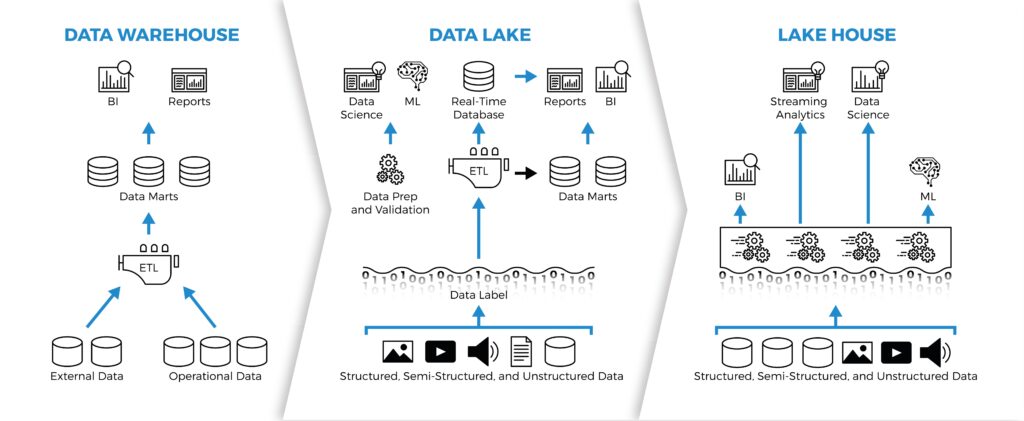
Unstructured Data Changes the Equation
Traditional BI is mostly about rows and columns. AI and machine-learning workloads increasingly need PDFs, support conversations, images, audio transcripts, documents, web content and logs.
A lake or lakehouse can be a natural home for these objects and their derived metadata. But ask whether your organization actually needs to analyze the underlying unstructured content. If the only requirement is to report counts, categories and metadata already stored in a business application, a warehouse may still be sufficient.
Do not build an unstructured-data platform to analyze structured metadata.
Data Science Can Justify a Lakehouse
Data scientists often need large raw datasets, Python, notebooks, distributed processing, feature engineering, model training and flexible file access. A lakehouse can reduce friction between data engineering and data science by keeping curated and raw data accessible through a common storage architecture.
However, a company with two analysts building forecasting models from clean warehouse tables may not need a full lakehouse. Evaluate actual workflow, not job titles.
Open Table Formats Matter Only If Openness Matters
Formats such as Apache Iceberg and Delta Lake can reduce coupling between data and one compute engine. That is strategically useful when several engines need the same data, storage ownership matters, portability matters or the company has a lake-first architecture.
It matters much less when one managed warehouse serves almost every workload. Open architecture has value, but it also creates more components to govern.
Actiknow’s comparison of Snowflake, BigQuery and Redshift makes a related point: cloud data-platform selection is an operating-model decision involving ecosystem, workload isolation, governance and cost, not simply a feature comparison.
Compare the Skills You Actually Have
A warehouse-oriented team may need SQL, data modeling, ELT tooling, BI development and basic cloud administration. A lakehouse estate may additionally require expertise in Spark, Python, distributed computing, object storage, open table formats, catalogs, file optimization, streaming and notebook environments.
Modern managed platforms reduce this burden, but they do not eliminate it. Architecture should fit the team that will operate it after the consultants leave. A technically elegant platform that nobody can troubleshoot is not a good platform.
Governance Gets Harder as Engines Multiply
A single warehouse can provide a relatively centralized control plane for users, roles, tables, views, audit, policies and workloads. A multi-engine lakehouse can require governance across object storage, catalog, compute engines, notebook environments, SQL endpoints, BI semantic models and service identities.
Ask where the authoritative access policy lives, whether users can bypass the catalog, whether row and column controls are consistent across engines, where audit is captured, who can write curated tables and who approves schema changes.
The flexibility of a lakehouse should not create uncontrolled access paths.
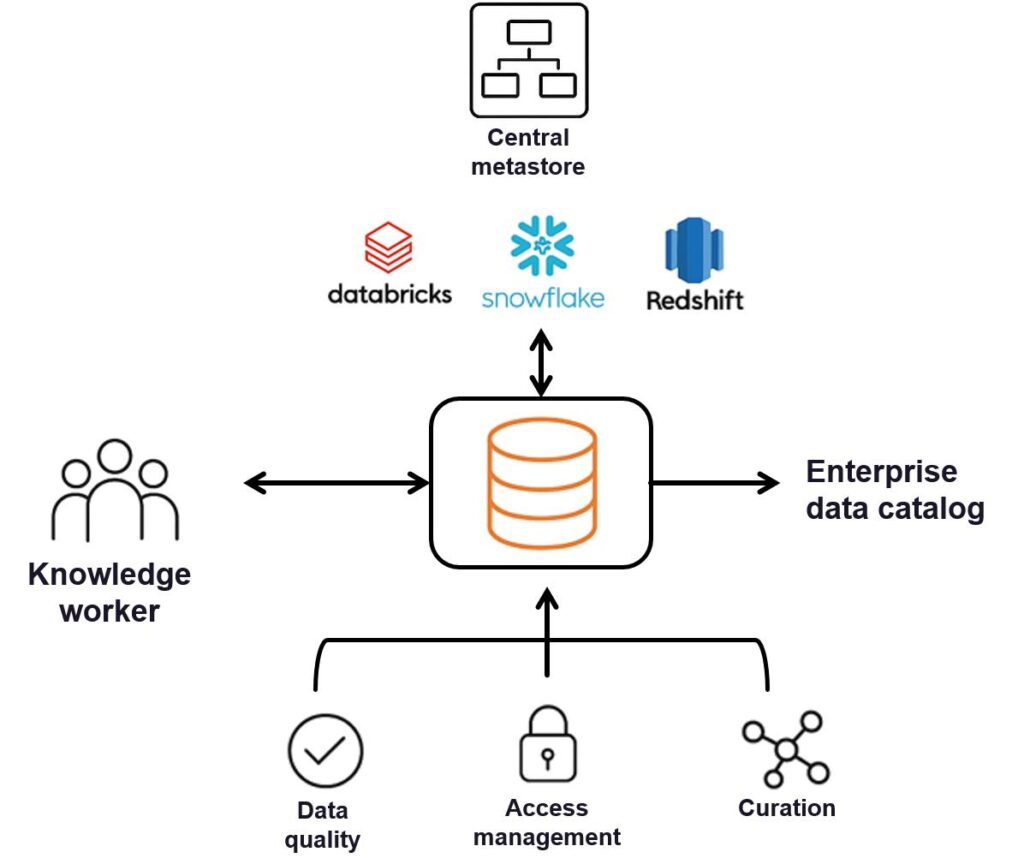
The Medallion Pattern Is Useful, Not Mandatory
Lakehouse architectures are often described as Bronze for raw/source-aligned data, Silver for cleaned/conformed data and Gold for business-ready data.
The conceptual separation is useful because it distinguishes source fidelity from reusable business data. But a mid-market company does not need three physical copies of every dataset just to comply with a diagram.
A small estate might use raw landing and curated marts. A complex domain might need all three layers. Design layers around replay, quality and reuse requirements. Do not create layers whose only purpose is architectural ceremony.
Warehouse Architectures Also Need Layers
A good warehouse commonly separates raw ingestion, staging, intermediate transformations, business marts and semantic models. The names differ, but the underlying principle is similar.
Reliable analytics benefits from separating source-aligned data from governed business logic. The lakehouse versus warehouse debate should not obscure that shared principle.
Performance Is Workload-Specific
Do not compare platforms using a generic which-is-faster question. Test representative executive dashboard queries, large aggregations, ad hoc analyst queries, transformations, concurrent BI users, data-science scans and streaming ingestion.
A warehouse may outperform for one workload while a lakehouse architecture is more efficient for another. The relevant metric is performance at the required service level and cost.
Freshness Is Also Workload-Specific
Some metrics need seconds. Others need minutes, hourly updates, daily updates or a controlled month-end close.
A lakehouse does not inherently make the business more real time. Freshness depends on the entire chain from source through ingestion, transformation, table availability, semantic model and dashboard.
Define the business SLA before designing the platform.
Cost Comparisons Need to Include People
Cloud bills are only part of total cost. Include storage, compute, data movement, BI capacity, orchestration, catalog and governance tooling, monitoring, engineering, DevOps, support, incident response and optimization.
A platform with cheaper storage can still cost more if it requires substantially more engineering effort. For a mid-market company, operational simplicity often has a high economic value.

Avoid Duplicating the Same Data Without a Reason
A common failure pattern is a raw lake, lakehouse, warehouse, departmental database and BI extract all containing overlapping versions of the same business data.
Every copy adds cost, freshness differences, security surface, reconciliation work and ownership ambiguity. Each layer should have a clear purpose.
If the warehouse already contains the governed sales facts needed by BI, do not create another gold sales table simply because a lakehouse project started.
A Hybrid Architecture Can Be Sensible
Hybrid does not have to mean complicated. One pattern is operational systems to ingestion to object storage for raw files and large event data to a curated analytical layer to governed semantic models to BI.
Another is to keep structured business systems in a cloud warehouse for BI while documents, logs and ML datasets use a lakehouse for data science. Integration occurs only where needed.
The architecture can evolve instead of being redesigned all at once.
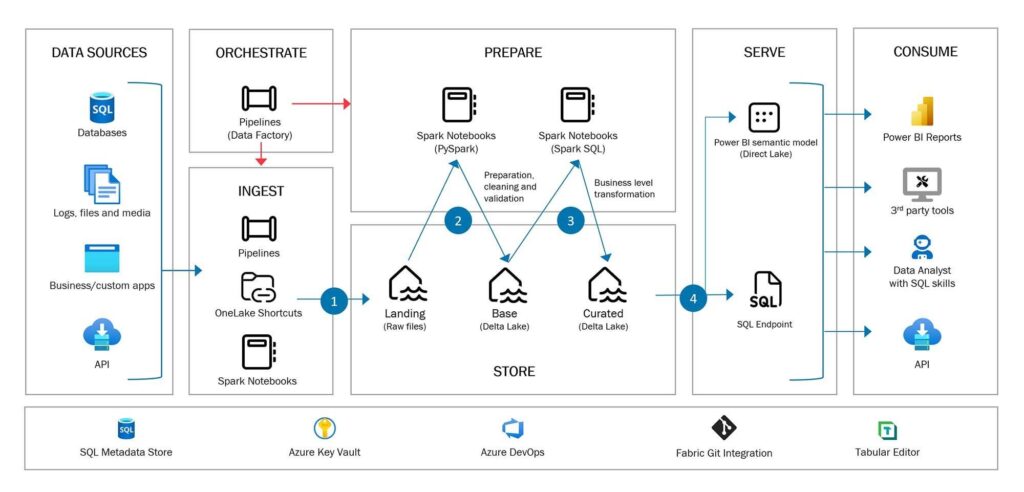
Microsoft Fabric Blurs the Boundary
Microsoft Fabric illustrates how the categories are converging. Fabric provides lakehouse and warehouse experiences over OneLake, with Power BI integrated into the platform. Direct Lake allows supported Power BI semantic models to access OneLake-backed data without the conventional full import cycle.
For a Microsoft-centric organization, this can make lakehouse capabilities accessible without assembling many independent products. But platform integration does not eliminate architecture decisions.
You still need to choose where transformations live, which data belongs in lakehouse versus warehouse structures, how security works, how capacity is sized and which models are authoritative.
Snowflake Also Blurs the Boundary
Snowflake increasingly supports workloads historically associated with lakehouse architectures, including managed and external Iceberg tables, unstructured data, Snowpark, streaming and ingestion options, and external-engine interoperability in supported Iceberg configurations.
This means an organization can add open-table or data-science capabilities without necessarily replacing its warehouse architecture.
BigQuery Has Similar Convergence
BigQuery combines serverless warehouse-style SQL with broader data-platform capabilities including external tables, BigLake, BigQuery ML, object tables, continuous queries and integration with Google Cloud AI and data services.
A company using BigQuery does not have to classify itself as warehouse or lakehouse before solving a business problem. Choose the capabilities required by the workload.
When to Start With a Warehouse
Start with a warehouse if your immediate priorities are consolidated management reporting, finance dashboards, sales analytics, marketing performance, customer reporting, operational KPIs and reliable self-service BI.
A sensible first architecture is sources to managed or custom ingestion to cloud warehouse to transformations and marts to semantic model to dashboards. It is easy to understand and relatively easy to govern. You can add lake capabilities later.
When to Start With a Lakehouse
Start with a lakehouse when the initial requirements already include several of these: massive raw datasets, streaming or event processing, data science at scale, machine learning, unstructured data, multiple processing engines, open table formats and object-storage ownership.
In that case, building a warehouse first and then immediately adding a lake may create unnecessary duplication. Design the broader data platform from the beginning.
When Not to Build Either Yet
Some companies are too early for either platform. If the organization has five core reports, a few stable data sources, low data volume, no dedicated data team and simple refresh requirements, a lighter architecture may be enough.
Examples include direct BI connections, managed reporting databases, well-controlled data extracts or a small analytical database. Architecture should be proportional to the problem.
Signs You Have Outgrown Direct Reporting
A centralized analytical platform becomes valuable when the same sources are extracted repeatedly, reports disagree, source APIs are overloaded, historical data is lost, transformations are duplicated, refreshes fail unpredictably, several teams need the same curated data or cross-system analysis is difficult.
At that point, centralization solves a real operational problem.
A Mid-Market Decision Scorecard
Use these dimensions to make tradeoffs visible. Structured BI favors a warehouse. Material unstructured data, extensive data science, or required multi-engine access strengthen the lakehouse case. Strong SQL skills and limited platform-engineering capacity strengthen the managed-warehouse case. Storage ownership and real-time event processing can strengthen the case for a broader lakehouse or open-table platform.
Do not add the scores mechanically. Use them to expose where complexity is actually justified.
A Practical Architecture Workshop
Before procurement, bring together the business sponsor, BI lead, data engineer, application or IT owner, security and finance or procurement.
Answer what decisions must improve, what data is needed, what workloads exist, what latency is required, what must be governed, what skills exist, what is likely to change in three years and what complexity the team can support.
Then shortlist platforms. This order prevents the product demo from defining the requirements.
Migration Does Not Need to Be Big Bang
If you already have a warehouse and want lakehouse capabilities, keep existing BI stable and introduce object storage or open tables for a specific workload. Connect only where needed, measure operational overhead and expand if value is proven.
If you have a lake and need stronger BI, create governed curated tables, define business marts, build semantic models and establish metric ownership without rewriting the raw platform.
Architecture can evolve incrementally.
Frequently Asked Questions
Is a lakehouse better than a data warehouse?
Not universally. A lakehouse offers broader workload and storage flexibility, while a managed data warehouse can be simpler for structured BI. The better architecture depends on actual workloads and operating capability.
Does a mid-sized company need a lakehouse?
Only if it has requirements that justify one, such as substantial unstructured data, data science, streaming, open-table interoperability or multi-engine processing. Many mid-sized companies can run excellent analytics on a cloud warehouse.
Can Power BI connect to a lakehouse?
Yes. Modern lakehouse platforms support SQL and BI access. Microsoft Fabric also provides Direct Lake for supported Power BI semantic models over OneLake data.
Can a data warehouse handle machine learning?
Yes. Modern warehouses increasingly include ML, Python and data-science capabilities or integrations. The question is whether those capabilities fit the scale and workflow of your data-science team.
Do we need both a data lake and a warehouse?
Not necessarily. Some organizations benefit from both, but maintaining overlapping platforms without distinct workloads creates unnecessary cost and reconciliation work.
Is Snowflake a warehouse or a lakehouse?
Snowflake originated as a cloud data warehouse but now supports broader data-platform and open-table capabilities. For architecture decisions, evaluate the specific workloads and storage models rather than relying on the label.
Is Microsoft Fabric a lakehouse?
Fabric supports both lakehouse and warehouse experiences over OneLake, along with integrated data engineering, data science and Power BI capabilities.
Should we choose the architecture before choosing the BI tool?
The decisions are related. BI concurrency, semantic modeling, refresh, security and embedding requirements can materially affect the data-platform design. Evaluate the end-to-end analytical workflow.
Conclusion
For most mid-market companies, the best data architecture is the simplest one that reliably supports the workloads the business genuinely needs.
If the primary goal is governed SQL analytics and executive BI, a modern cloud warehouse remains a strong default.
If the company has meaningful data-science, unstructured-data, streaming, open-table or multi-engine requirements, a lakehouse can provide a broader foundation.
And if different workloads genuinely need different architectures, use a controlled hybrid rather than forcing everything into one platform.
Start with business workloads. Then assess data types, skills, governance, performance and total operating cost. Only then choose the architecture.
If your organization is deciding whether to build a warehouse, lakehouse or pragmatic hybrid, Actiknow can help define the data architecture, integration approach and BI layer around the workloads you actually need. Talk to Actiknow about your analytics architecture.