
A modern data warehouse can become the most trusted place in the company to understand a customer. It may combine CRM activity, billing history, product usage, support interactions and marketing engagement. But if those insights stay inside dashboards, the people and systems that interact with customers may never use them.
Reverse ETL addresses that gap. It synchronizes selected, curated warehouse outputs back into operational systems such as CRM, support and marketing platforms. The idea is attractive: calculate once in the governed data platform, then activate the result where work happens.
The implementation is less simple. Once warehouse data writes back into operational tools, identity, ownership, latency, permissions and feedback loops become production concerns. A field that looks harmless in a dashboard can trigger a campaign or change a sales workflow.
The right question is not whether to buy a reverse ETL tool. It is which warehouse-derived decisions are valuable enough to operationalize, and whether the organization can control what happens after they leave the warehouse.
Actiknow’s business intelligence services include data integration from databases and APIs as well as automation and custom connectors. Those same disciplines are central to reliable reverse ETL.
The Short Answer
Reverse ETL is a strong fit when a trusted metric or segment already exists in the warehouse, operational users need it inside their normal tool, recalculating the logic elsewhere would create duplication, the destination has a stable identity key, and ownership of the outbound field is explicit.
It is a poor fit when the action must be synchronous with a transaction, the warehouse is not trusted for the underlying metric, records cannot be matched reliably, the write-back creates a circular update, or nobody owns what happens when the synchronization is wrong.
What Reverse ETL Actually Means
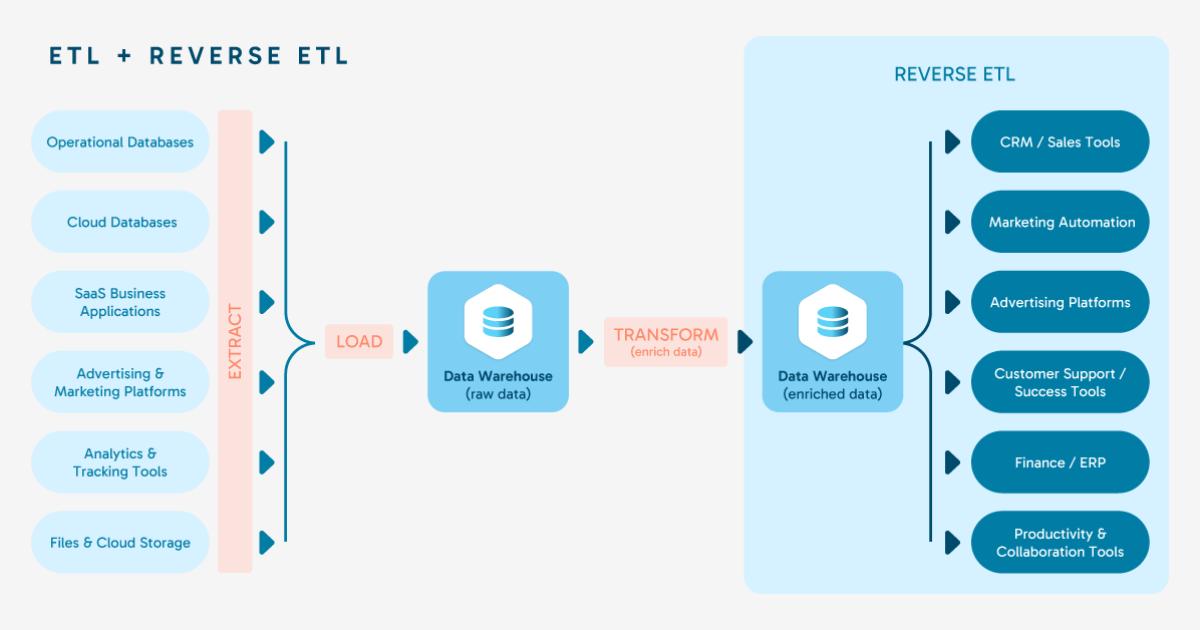
Traditional ETL or ELT moves data from operational systems into an analytical platform. Reverse ETL moves selected outputs in the other direction.
Salesforce, billing, product and support data may flow into a warehouse. Transformations create governed customer models. Reverse ETL can then push selected attributes such as customer health, product adoption or renewal risk into the CRM or another operational system.
Reverse ETL should not copy the warehouse back into operational applications. Destinations should receive a deliberately designed contract containing only the fields needed for action.
The Best Reverse ETL Use Cases
The strongest use cases share one characteristic: the warehouse knows something useful that the destination system cannot calculate reliably on its own.
1. Customer Health in CRM
A customer-health model may combine usage, billing, support tickets, renewal date and engagement. Writing a governed health band back to the account record can help sales and customer-success teams prioritize attention without requiring a separate dashboard for every account.

2. Product Usage for Sales and Customer Success
Product telemetry often lives outside the CRM. Useful activation fields include last active date, active users in the last 30 days, feature-adoption band, usage trend and license utilization.
Definitions must remain consistent. “Active user” should mean the same thing in the warehouse, CRM and executive reporting.
3. Marketing Audience Activation
A warehouse can create audiences that depend on several systems, such as high-value customers who have not purchased recently, trial users who completed a key product action, customers eligible for cross-sell, or customers approaching renewal.
Audience activation needs strong controls because an incorrect segment can create customer-facing mistakes at scale. Use exclusion rules, audience-size checks and controlled rollout.

4. Support Context
Support agents can benefit from a small amount of warehouse-derived context such as customer tier, recent product activity, current plan, account health or known incident cohort.
The goal is not to turn the support platform into a warehouse. It is to place decision-relevant context beside the support interaction.
5. Operational Alerts
Some warehouse-derived states should trigger workflows rather than simply update fields. Examples include a high-value customer becoming inactive or a renewal entering a risk state.
If an alert must happen within seconds of an event, the warehouse and reverse ETL path may not be the right real-time architecture.
6. Lead and Account Enrichment
The warehouse may have a more complete account view because it combines firmographic enrichment, billing, product and marketing history. Selected attributes can improve routing and prioritization.
Before writing them back, classify each field as authoritative, derived, advisory or temporary. An analytical classification should not accidentally become master data.
Reverse ETL vs CRM Integration
Not every CRM integration is reverse ETL.
A direct application-to-CRM integration is often better when an operational transaction should update CRM immediately. Reverse ETL is better when the value is calculated from analytical history or several systems.
Actiknow’s Salesforce integration services cover integrating Salesforce with other systems and applications. Reverse ETL should be evaluated alongside direct integration patterns rather than assumed to be the answer for every write-back.
Reverse ETL vs Workflow Automation
Event-driven automation tools are well suited to operational workflows such as “new CRM record, call another application, send notification.”
Reverse ETL is warehouse-centric: query governed warehouse data and synchronize selected results to a destination.
Use the warehouse when the logic depends on analytical history or cross-system data. Use event automation when the trigger and action are operational and immediate.
Reverse ETL vs Custom APIs
A custom service may be better when the action is synchronous, complex transaction semantics are required, the destination API has unusual behavior, or a user-facing application depends on the result.
Managed reverse ETL reduces commodity synchronization work. It does not replace application engineering.
Start With the Business Action
Do not begin with “what fields can we push into Salesforce?”
Begin with “what decision or workflow improves if this data is available there?”
Then define the consumer, destination, action, source model, fields, identity, latency, error tolerance and owner.
If the action is vague, the synchronization will become data clutter.
Define the Source Contract
The source should be a stable business-ready model, not a raw connector schema, analyst scratch table or volatile experimental query.
An activation model might contain account_id, health_band, health_updated_at, renewal_risk and last_product_activity_at.
It should have tests and a named owner.
Identity Resolution Is the Hard Part
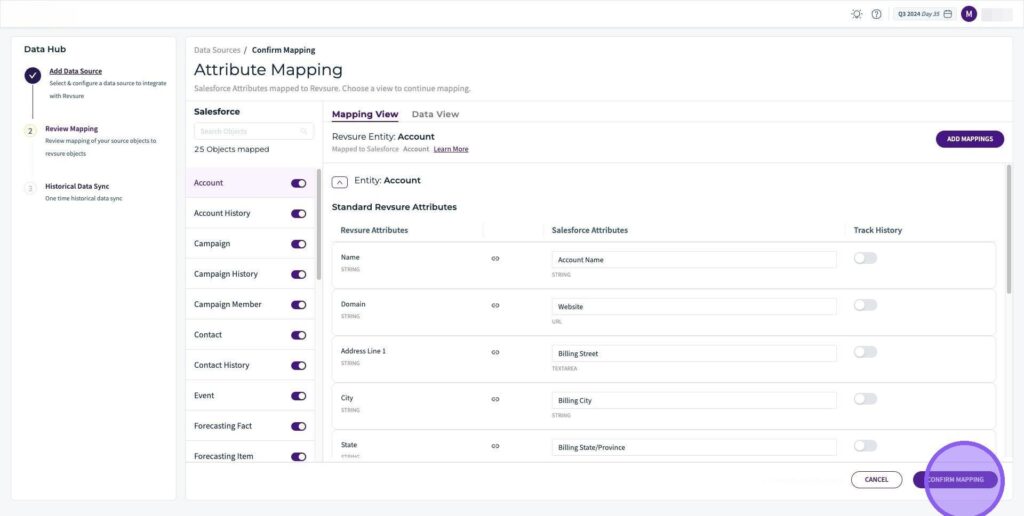
The warehouse may identify a company by an internal account ID while Salesforce uses a Salesforce Account ID and billing uses another customer ID.
Reverse ETL needs a reliable mapping. Do not match enterprise records by company name unless the business explicitly accepts the risk.
Preferred keys include destination-native IDs retained in the warehouse, stable internal IDs mapped to destination IDs, and verified external IDs.
Identity errors are more dangerous in reverse ETL than in dashboards because they can modify the wrong operational record.
Define the Write Behavior
For every destination field, decide whether the operation is insert, update, upsert, clear, ignore null, append, replace or create relationship.
Null semantics deserve special attention. NULL may mean “unknown” or it may mean “clear the current destination value.” Those are very different actions.
Destination Ownership
A CRM field cannot safely be owned simultaneously by sales users, CRM automation, reverse ETL and another integration.
Define the system of record for every writable field.
For example, the warehouse might own customer health while CRM owns account name and billing owns billing status.
Avoid Circular Data Flows
A dangerous pattern is CRM field to warehouse to transformation back to the same CRM field.
This can create loops, false change history, unnecessary API calls and confusing audit trails.
Separate source fields from derived activation fields and document lineage in both directions.
Latency Should Match the Decision
Reverse ETL does not automatically mean real time.
Customer tier may update daily. Renewal risk may need hourly refresh. Fraud authorization is usually too synchronous and operationally sensitive for a warehouse activation path.
Choose the architecture based on the business SLA.
Incremental Sync Is Usually Better
Do not rewrite every destination record on every run.
Identify changed rows using an update watermark, hash of activation fields, change table or CDC. This lowers API usage, reduces destination churn and improves auditability.
Design a replay path so state can be rebuilt when necessary.
Destination API Limits Matter
CRM and marketing APIs have rate, batch and concurrency limits.
Estimate records per synchronization, expected changed percentage, frequency and peak backfill volume.
A design that works for a thousand records can fail during a large resynchronization.
Backfills Need a Separate Plan
Initial activation often touches far more records than normal incremental runs.
Test in a sandbox, estimate API volume, define batch sizes, inspect destination automation, reconcile samples and roll out gradually.
A backfill can accidentally trigger thousands of downstream workflows if the destination treats every update as a business event.
Destination Automation Is Part of the Architecture
A field update may trigger CRM workflows, email, tasks, webhooks, scoring rules or customer notifications.
Reverse ETL testing must include these side effects. A technically correct synchronization can still create the wrong business outcome.
Security and Data Minimization
The warehouse may contain data that operational users should not see.
For every outbound field ask who can see it, whether it is required for the workflow, whether the destination has equivalent access controls, and whether it contains sensitive information.
Operational systems should receive the minimum data needed for the action.
Consent and Marketing Suppression
Warehouse audiences should not bypass consent, unsubscribe, suppression or channel-eligibility rules.
The final audience should incorporate those controls or the destination must enforce them reliably.
Observability
Monitor more than “sync succeeded.”
Track source rows eligible, changed rows, attempted rows, successes, failures, skips, destination rejects, API throttling, duration and freshness.
Also monitor the business contract. If an audience normally contains 4,000 accounts and suddenly contains 80,000, a technically successful job should probably be stopped.
Reconciliation
For critical fields, compare warehouse state with destination state.
Sample individual records as well as aggregate counts. Aggregate counts can hide identity mismatches.
Error Handling
Classify errors as transient, permanent or data-related.
Timeouts and rate limits can be retried. Invalid destination IDs, field validation failures and permission errors need resolution. Bad data should not be retried forever.
Dead-Letter Handling
Maintain a recoverable list of failed records containing the business key, destination key, error, attempt time, payload version and retry status.
Without this, failed activation records disappear inside logs.

Idempotency
A retry should not create duplicate business effects.
Updating the same CRM field to the same value is often naturally idempotent. Creating tasks, tickets or events may not be.
Use deterministic external IDs or deduplication keys for create operations.
Sandbox Testing
For CRM destinations, test field mapping, permissions, validation rules, record types and automation in a sandbox when available.
Remember that sandbox configuration may differ from production, so production rollout still needs guardrails.
Who Owns Reverse ETL?
Ownership is usually shared.
Data engineering owns the source model and pipeline. CRM or marketing operations owns destination configuration. The business owner owns the definition and intended action. Security or governance owns sensitive-data controls.
Every activation should have a named business owner and a decommission path.
Feedback Loops Can Be Useful
Reverse ETL can create a closed loop:
Operational data → warehouse → derived insight → operational action → new operational data → warehouse.
This is powerful because the organization can measure whether the action worked.
Design the loop explicitly so it remains measurable rather than becoming circular data movement.
Measure Activation Outcomes
Do not judge reverse ETL by rows synchronized.
Measure whether users use the field, workflows improve, audience performance changes, response time improves or manual work declines.
If an activated field is never used, retire it.
Avoid Turning CRM Into a Second Warehouse
Adding hundreds of analytical fields to CRM creates poor usability, confusing ownership, more API volume and a larger security surface.
Operational tools should contain the minimum context needed for action. Keep deep analysis in BI.
A Practical Architecture
A clean pattern is:
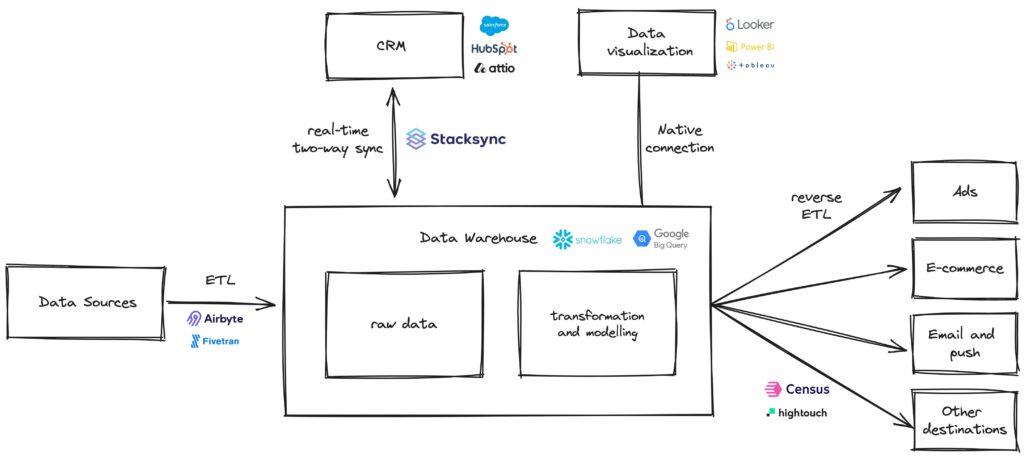
Operational systems → ingestion → warehouse raw layer → governed transformations → activation model → reverse ETL or integration service → CRM, support or marketing tool.
Destination changes can return through the normal ingestion path.
The activation model creates an explicit boundary between analytics and operations.
A Production Readiness Checklist
Before launch, confirm the business action, owner, governed source model, approved destination fields, stable identity mapping, write and null semantics, latency SLA, API capacity, data-access review, destination automation, backfill plan, incremental logic, retry and idempotency behavior, monitoring, reconciliation and rollback.
When Reverse ETL Is Worth the Investment
Reverse ETL is valuable when the warehouse has become the trusted place to calculate customer or business state and the result needs to influence frontline work.
The economic case is strongest when it replaces manual exports, repeated spreadsheet uploads, duplicate segmentation logic, custom point-to-point scripts or constant switching between BI and operational tools.
When Not to Build It
Keep the insight in BI when users only need analysis, no operational action follows, the data is too sensitive, the destination field would be ignored, the logic is experimental or the business cannot own the workflow.
Activation adds operational risk. Only activate what has a clear purpose.
Build vs Buy
A managed reverse ETL platform can reduce work around connectors, scheduling, incremental synchronization, destination APIs, retries and observability.
Custom engineering can be appropriate when destinations are proprietary, workflow behavior is unusual, strict control is required or activation is part of a larger custom application.
Evaluate total ownership, not only license price.
Frequently Asked Questions
What is reverse ETL?
Reverse ETL synchronizes curated data from a warehouse or analytical platform into operational systems such as CRM, support and marketing tools.
How is reverse ETL different from ETL?
ETL or ELT brings operational data into the analytical platform. Reverse ETL sends selected analytical outputs back to operational tools.
Is reverse ETL the same as an API integration?
No. Direct API integrations usually connect operational systems or application events directly. Reverse ETL is centered on warehouse-derived data and models.
What are common reverse ETL use cases?
Common use cases include customer health in CRM, product-usage enrichment, marketing audience activation, support context, lead or account scoring and warehouse-derived operational alerts.
Should reverse ETL be real time?
Only when the business decision requires it. Many CRM attributes can update hourly or daily. Truly synchronous decisions often belong in application or event-processing architecture.
What is the biggest reverse ETL risk?
Incorrect identity mapping and unclear field ownership are major risks because they can modify the wrong records or create conflicting updates.
Can reverse ETL replace dashboards?
No. Reverse ETL is for operational activation. Dashboards remain useful for exploration, monitoring and decision support that does not need to be written into another system.
Should Salesforce fields be populated from the warehouse?
Yes, when the field is a governed warehouse-derived value with a clear operational purpose, stable account or contact identity and explicit ownership. Master CRM fields should not be overwritten casually.
Conclusion
Reverse ETL is most useful when analytics has matured beyond reporting.
The warehouse knows something reliable. An operational team can act on it. The destination has a clear place for it. The business can govern the consequences.
Keep the architecture deliberately narrow: activate stable business-ready models, use reliable identity keys, define field ownership, control latency and side effects, and monitor the business outcome rather than only the synchronization job.
If your organization is deciding whether customer, sales or product insights should remain in BI or be activated in operational systems, Actiknow can help design the data integration, Salesforce and automation boundaries around that workflow. Discuss your data activation and integration requirements with Actiknow.