
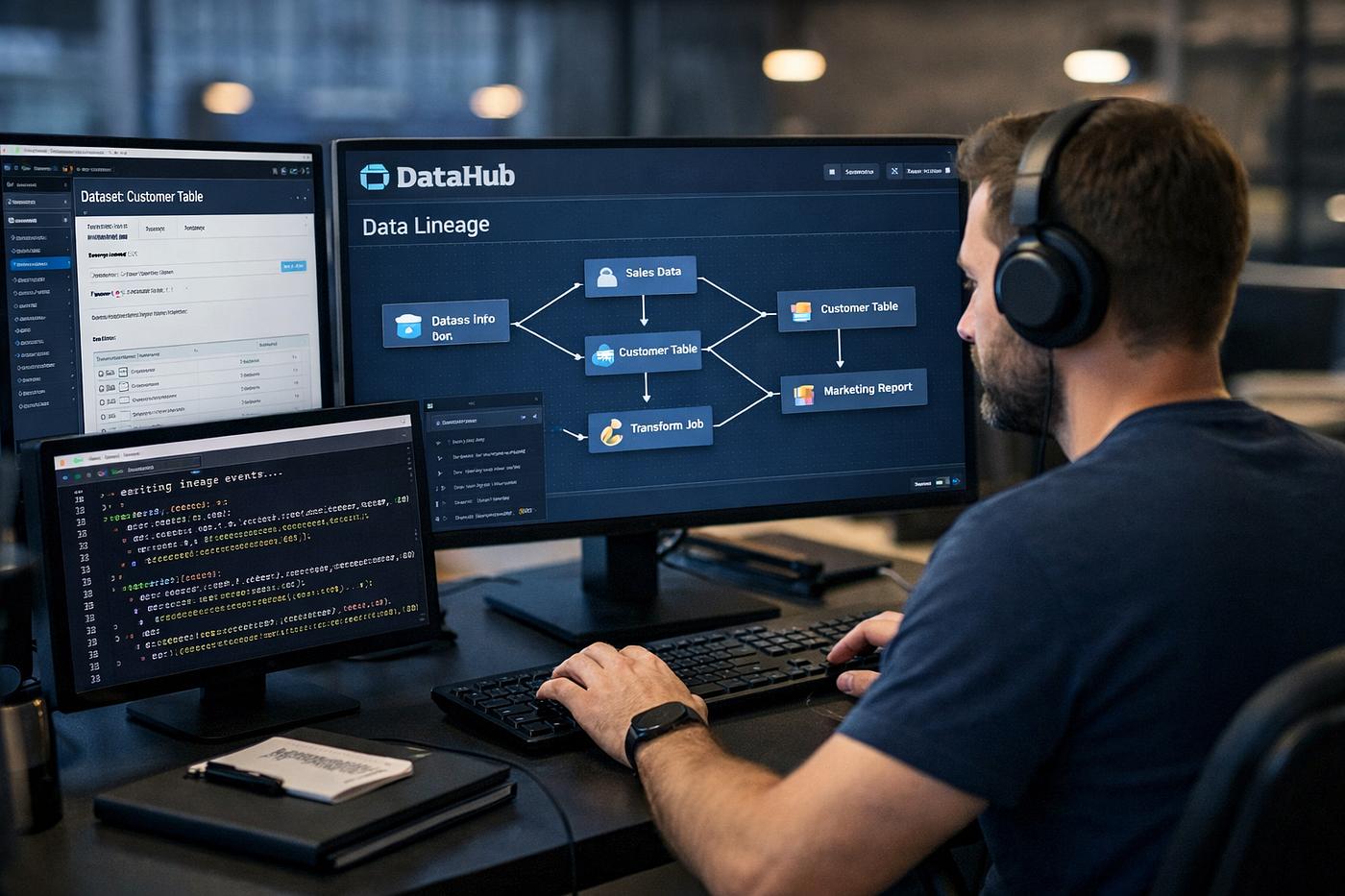
A dashboard often breaks several systems away from the change that caused it. An application developer renames a field, a CRM administrator changes an allowed status, an API returns a new data type, or a product event changes meaning. The source application may continue working perfectly while the warehouse model, semantic model or dashboard fails.
Data contracts make these dependencies explicit. A data contract defines what a producer promises to provide to consumers, what the fields mean, what quality and freshness can be expected, who owns the interface, and how changes will be introduced.
The contract is not a substitute for robust pipelines, testing or monitoring. It is the agreement that lets those controls operate against something intentional.
For organizations building BI across databases, APIs and SaaS systems, this matters because analytics is downstream of systems owned by many teams. Actiknow’s Business Intelligence services describe BI as an end-to-end architecture spanning source integration, data manipulation, modeling, visualization and refresh. A contract helps define the boundaries between those stages.
The Short Answer
Data contracts are useful when several teams publish data consumed by analytics, source schemas change frequently, BI failures are discovered after deployment, the same source feeds multiple products, or important metrics depend on poorly documented fields.
A useful contract should cover the data interface, business meaning, schema, keys, required fields, allowed values, freshness, quality expectations, data classification, ownership, change policy, deprecation and versioning.
The objective is not paperwork. It is to turn an accidental dependency into a managed interface.
What Is a Data Contract?
A data contract is an agreement between the producer of data and its consumers. The producer might be an application team, CRM team, finance system, vendor API or another data platform. Consumers might include data engineering, Power BI, Tableau, machine learning or another application.
The contract describes the interface consumers are allowed to depend on. Think of it as the data equivalent of an API contract. Analytics architectures should not rely on querying arbitrary internal structures and hoping they never change.
Schema Is Only the Beginning
A weak contract says customer_id is a string, status is a string and updated_at is a timestamp.
A useful contract also explains that customer_id is the stable account identifier, status represents the current commercial lifecycle state, updated_at is the source modification timestamp in UTC, customer_id cannot be null, and status belongs to an approved set of values.
Without semantics, technically valid data can still produce incorrect analytics.
Why BI Breaks After Source Changes
BI dependencies are long:
CRM field → connector → raw table → staging model → customer dimension → sales mart → semantic model → executive dashboard.
A source owner may see only the first object. The BI team sees the chain. If dependency ownership is informal, a reasonable local change can create a serious downstream incident.
Data contracts make critical dependencies visible before the change.
Schema Contracts
The schema section should define field name, data type, nullability, key behavior, description and format. For important fields, document expected uniqueness, precision, timezone, units and default behavior.
For example, order_id may be defined as a required, immutable string that is unique within the source. order_total may be a required decimal whose currency is identified by currency_code. created_at may be a required UTC timestamp.
The contract should be machine-readable where practical so these promises can become automated checks.
Semantic Contracts
Schema compatibility does not guarantee semantic compatibility.
Suppose status remains a string. Yesterday, Won means completed sale. Tomorrow, Won means verbally accepted. No schema check fails, but revenue reporting may become wrong.
For business-critical fields, define business meaning, lifecycle behavior, effective timing, exclusions and relationships to other fields. Semantic changes should be treated as contract changes.
Keys Are Part of the Contract
Many pipeline failures come from misunderstood identity. Document the primary business key, whether it can change or be reused, composite-key logic, parent-child relationships and deduplication expectations.
A statement such as “contact_id is stable and never reused” is much stronger than “contact_id STRING.”
Freshness Contracts
A source can be structurally correct and operationally late. Define freshness expectations such as events available within 15 minutes, a CRM snapshot completed by a stated time, or a finance extract delivered by the next business day.
Then monitor against the contract. Freshness should reflect business need rather than an unrealistic real-time promise.
Completeness Contracts
Define what complete means. Examples include all completed orders are included, cancelled orders remain available with their status, deleted CRM records have a deletion indicator, or a daily file contains one row per active subscription.
These rules directly affect reconciliation.
Allowed Values and Nullability
Enumerations should be contracted when they affect logic. If membership_status supports Active, Pending, Expired and Cancelled, a new Suspended value should trigger an explicit decision about reporting behavior.
A database may allow null without analytics being able to tolerate it. Rules can also be conditional: order_date must exist for completed orders, while cancel_reason may be null unless status is Cancelled.
Ownership
Every contracted dataset should identify a producer owner, technical owner, business owner where relevant, consumer contacts and an escalation path.
The producer owns the interface it publishes. The consumer owns how it uses that interface. Shared definitions require shared governance.
Change Classification
Not every change needs the same process. Adding an optional column may be non-breaking. Adding an enumeration value or changing freshness may require review. Renaming a field, changing a key or changing a business definition is typically breaking.
The contract should define the process for each category.
Versioning and Deprecation
For material breaking changes, version the interface or contract and give consumers a migration window. A mature deprecation process announces the change, identifies affected consumers, publishes the replacement, runs both versions in parallel where practical, validates migration and then retires the old version.
This is ordinary software interface management applied to data.
Contract Tests
Turn promises into tests. Schema tests verify columns, types, required fields and keys. Quality tests validate values, ranges and relationships. Operational tests monitor freshness and arrival. Semantic tests reconcile known business totals and rules.
A contract that cannot be monitored is mostly documentation.

Where Should Tests Run?
Useful checks exist at several boundaries. Producer-side checks can prevent invalid releases. Ingestion checks detect unexpected source changes. Transformation tests validate conformed rules. Mart tests reconcile KPI outputs. BI monitoring validates refresh and semantic-model integrity.
Do not rely on one test suite at the end.
Producer-Side Validation Is Powerful
The cheapest failure is one prevented before release. If an application delivery process can detect that a proposed database migration removes a contracted field, teams can coordinate before deployment rather than discovering the problem in an overnight warehouse run.
Organizations that cannot implement producer-side enforcement immediately can start with change notification and downstream tests.
Data Contracts and APIs
APIs already use mature contract concepts such as schemas, versioning, deprecation and backward compatibility.
Analytics teams can borrow these practices. If your BI architecture integrates databases and APIs, as described in Actiknow’s BI implementation approach, treat both as governed interfaces rather than undocumented extraction targets.
Data Contracts and Database CDC
Change data capture creates tight coupling to source tables. Changes to column types, keys, names or other table structures can affect replication and downstream models.
A contract should define which tables and columns are published for analytical consumption. Where practical, applications can expose stable data products instead of making every internal table a permanent public interface.
Data Contracts and SaaS Sources
You cannot negotiate a contract with every SaaS vendor, but you can create an internal contract at the ingestion boundary.
Your data team may consume a changing CRM interface while publishing a stable conformed customer model to downstream marts. The team is then both a consumer of the SaaS source and a producer of the internal data product.
Data Contracts and ETL/ELT
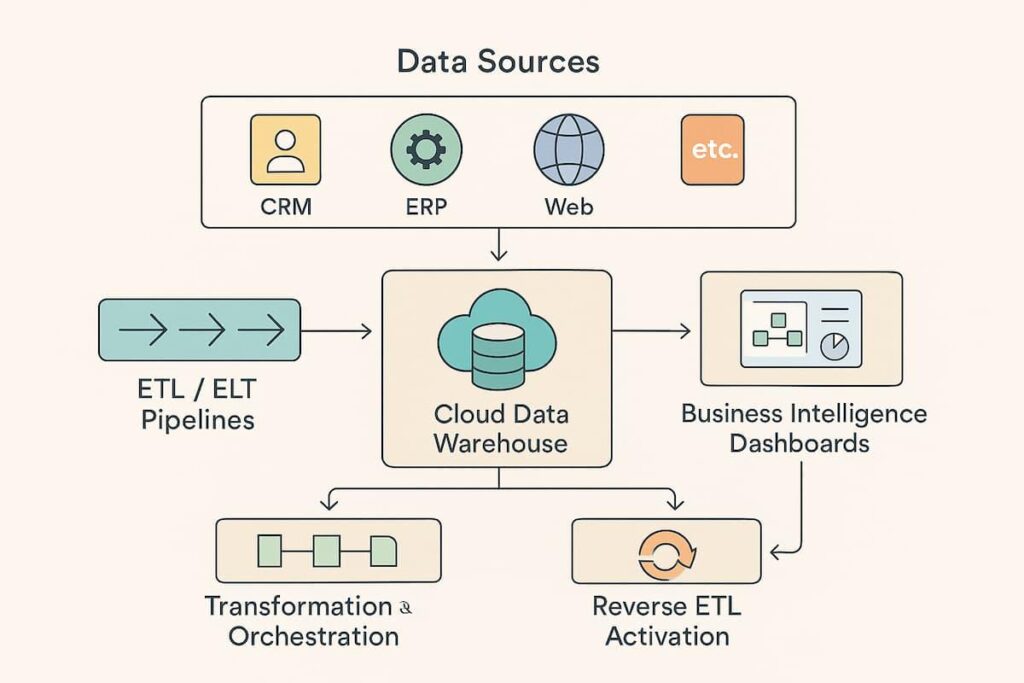
In an ELT architecture, raw data often lands before business transformation. That does not eliminate contracts. The source-to-raw contract protects ingestion, while the conformed-to-mart contract protects downstream analytics.
Actiknow’s ETL vs ELT guide explains why transformation location depends on architecture. Contracts complement either approach because they define the interface independently of where transformation executes.
Data Contracts and BI Semantic Models
The semantic model is also a data product. Its consumers depend on measure names, definitions, dimensions, relationships, hierarchies and refresh.
If a measure called Revenue changes from booked revenue to recognized revenue, that is a semantic breaking change even if no SQL schema changed. Apply contract thinking to certified semantic models too.

Do Not Contract Every Column
Over-contracting creates bureaucracy. A source table may contain 200 columns while only 25 belong to the supported analytical interface.
Contract the fields consumers genuinely depend on and mark everything else as non-contractual. This gives producers room to evolve internal implementation.
Tier Contracts by Criticality
Finance, executive KPIs and regulated reporting may need strict contracts, named owners and high observability. Departmental analytics may need moderate controls. Exploratory data may be best effort.
Governance effort should follow business impact.
The Contract Should Not Freeze the Source
Producers need to evolve software. A bad contract makes every change difficult. A good contract defines what is stable, what can change freely, what requires notice and what requires migration.
This protects consumers without turning analytics into a veto point for application development.
Consumer Responsibilities
Consumers should use supported fields, avoid undocumented internal columns, respond to deprecation notices, maintain ownership metadata and test migrations.
If a BI developer depends on an explicitly non-contractual field, that dependency carries a known risk.
Contract Registry and Contracts as Code
As contracts grow, maintain a searchable registry with dataset, owner, version, consumers, schema, SLA, classification and change history.
Where practical, store machine-readable contracts in version control. This supports review, history and automated validation. YAML or JSON can work, but the operating agreement matters more than the file format.
Example Contract
- Dataset: customer_account
- Owner: CRM Platform Tea
- Consumers: Revenue Analytics and Customer Success Analytics
- Business key: account_id
- Freshness: changes available within 60 minutes
- Required fields: account_id, account_status, created_at
- Allowed account_status values: Prospect, Active, Churned
- Quality: account_id non-null and unique; created_at non-null
- Change policy: breaking changes require an agreed notice period and parallel version where practical
- Data classification: sensitive contact fields are excluded from the general analytics interface
This is understandable to engineering and business teams.
Data Contracts and Data Protection
Contracts should identify sensitive fields and permitted downstream uses. Actiknow’s data security guidance for connectors describes encrypted connections and minimum necessary source permissions. A data contract can extend that discipline into the analytical interface by specifying which sensitive fields are permitted downstream and how they should be handled.
Monitoring Contract Violations
Create alerts for schema drift, missing fields, new enumeration values, freshness breaches, volume anomalies, null spikes, duplicate keys and failed reconciliation.
Alert the owner who can act. A hundred warnings nobody owns are not governance.

What Happens When a Contract Breaks?
A useful response process is straightforward: detect the violation, identify the producer and affected consumers, protect downstream reporting where necessary, communicate impact, restore compatibility or migrate, reconcile affected data, backfill and document the root cause.
The goal is faster recovery and prevention, not blame.
Soft Failure vs Hard Failure
Some violations should stop processing. A missing primary key can make downstream results unsafe. Other anomalies may warrant a warning, such as a moderate drop in daily volume.
Classify checks as error, warning or informational. Hard-stopping every anomaly can make the platform less reliable, while silently accepting every anomaly is worse.
Schema Drift Is Not Always Bad
A new optional field may be harmless and safe for automated schema evolution. The contract tells the platform whether a change is allowed, requires review or is breaking.
This is better than treating all drift as either catastrophic or automatically safe.
Contracts and Data Products
A data product should have a purpose, owner, interface, quality expectations, documentation, service expectations and known consumers. A contract formalizes the interface.
You do not need a large data-mesh program to benefit from this. A small data team can use a contract between the product database and executive BI.
Start With the Pipelines That Hurt Most
Do not contract the entire enterprise at once. Choose the most critical dashboard, most unstable source, most expensive recurring incident or most reused domain. Create one contract, automate a few high-value tests, define change notification, learn and expand.
A 30-Day Adoption Plan
- Week 1: select one critical dataset, identify producer and consumers, and document dependencies.
- Week 2: agree schema, semantics, keys, freshness, sensitive fields and owners.
- Week 3: add automated schema, quality and freshness checks and define change/deprecation rules.
- Week 4: simulate a breaking change, test the incident path and refine the contract template.
The first contract should prove operational value.
Common Failure: Documentation With No Enforcement
A page says status has four values. The source adds a fifth and nobody notices. That is documentation, not an effective contract. At minimum, test the most important promises.
Common Failure: Data Team Writes the Contract Alone
The data team cannot unilaterally define what an application field means. The producer understands source behavior, business owners understand semantics, and consumers understand reporting dependencies. Create the contract together.
Common Failure: Everything Is Critical
If every field requires extensive approval, teams will bypass the process. Protect the interfaces that matter and leave internal implementation flexible.
Common Failure: No Consumer Inventory
A producer cannot safely deprecate an interface if nobody knows who uses it. Maintain lineage or consumer registration. At minimum, know which critical marts and dashboards depend on the dataset.
Common Failure: Contracts Replace Reconciliation
A source can satisfy every schema rule and still produce the wrong business total. Continue reconciling orders, revenue, customers, membership or other important measures. Contracts reduce classes of failure; they do not prove business correctness.
How Data Contracts Change Team Behavior
Without contracts, a producer changes something, a pipeline breaks, BI investigates and teams discover the dependency during an incident.
With contracts, a producer proposes a change, compatibility is checked, consumers are identified, migration is planned, versions can coexist where needed, and the old interface retires deliberately.
That is a software-engineering improvement applied to analytics operations.
A Practical Contract Checklist
For a critical analytics dataset, confirm that purpose, producer owner, consumer owner, business key, required fields, types, semantics, allowed values, freshness, delete behavior, data classification, quality checks, change categories, notice expectations, versioning, consumers and escalation are documented.
If half of these are unknown, the dataset is being consumed largely on trust.
Frequently Asked Questions
What is a data contract in analytics?
A data contract is an explicit agreement between a data producer and consumers covering the supported interface, including schema, semantics, quality, freshness, ownership and change behavior.
Are data contracts the same as schemas?
No. Schema is one component. A useful contract also covers meaning, keys, quality, freshness, ownership, data classification and change policy.
Do data contracts prevent all pipeline failures?
No. Infrastructure failures, API outages, logic errors and quality issues can still occur. Contracts reduce failures caused by unmanaged interface changes and make expectations testable.
Who owns a data contract?
The producer should own the interface it publishes, while business owners and consumers participate in agreeing important semantics and service expectations.
Should data contracts be stored in code?
Machine-readable contracts in version control are useful because they support review, history and automated tests. The operating agreement matters more than the specific format.
Do we need a data mesh to use data contracts?
No. Data contracts are useful in centralized warehouses, lakehouses and conventional BI teams.
Can we create contracts for SaaS data?
Yes. You may not control the vendor interface, but your data team can create a stable internal contract at the raw or conformed boundary for downstream consumers.
Should every dataset have a data contract?
Not necessarily. Prioritize business-critical, widely reused or frequently changing interfaces. Lightweight governance is appropriate for exploratory data.
How do data contracts help Power BI or Tableau?
They stabilize the upstream fields and meanings that semantic models depend on, reduce surprise schema changes and create explicit processes for changes to business definitions.
Conclusion
Data contracts will not stop source systems from changing, and they should not. They stop important analytical dependencies from changing accidentally.
A good contract tells producers what consumers rely on, tells consumers what is actually supported, and gives both sides a controlled way to evolve.
Start with the interfaces behind your most important BI. Define schema, meaning, ownership, freshness and change. Then automate the promises that matter most.
If source-system changes are repeatedly breaking your pipelines, warehouse models or dashboards, Actiknow can help assess the integration and BI architecture and define stable consumption boundaries around it. Discuss your BI and data integration architecture with Actiknow.