

An executive and data engineering guide to cross-platform impact analysis, trustworthy metrics, and practical lineage governance
The executive problem: the warehouse is only part of the story
A revenue dashboard changes unexpectedly. The Snowflake transformation ran successfully, its target table exists, and the SQL is unchanged. But the upstream CRM connector changed a field mapping, or an external orchestration job stopped updating a source. The warehouse can show what happened inside its own boundaries without necessarily showing the complete route from the operational system to the executive metric.
That gap matters in three situations: when a source schema changes, when a metric is challenged, and when a data incident needs an owner. Teams waste time reconstructing dependencies from orchestration code, connector configurations, transformation manifests, and BI models. A useful lineage graph should answer which source produced a value, which transformations changed it, which downstream assets depend on it, and who must respond when it breaks.
Snowflake external lineage addresses part of that gap. It extends Snowflake’s native lineage with relationships reported by external tools using OpenLineage events. The feature became generally available on September 3, 2026. It is a metadata capability, not a guarantee that every application, dashboard, or business rule is automatically discovered. The quality of the graph depends on what participating tools actually emit and how those objects are identified.
For organizations evaluating a broader data platform, the starting point should be the business questions the graph must answer, not the number of nodes it can display. Actiknow’s business intelligence services describe an end-to-end approach spanning source integration, modeling, dashboards, and refresh management. Lineage governance should follow those same boundaries.
What Snowflake external lineage actually does
Snowflake already tracks supported dependencies among Snowflake objects. External lineage adds metadata about sources and destinations beyond Snowflake, such as files, databases, and datasets handled by orchestration or transformation tools. Participating systems send OpenLineage-compatible COMPLETE events to Snowflake’s external lineage REST endpoint. Snowflake incorporates accepted relationships into its lineage graph, where external objects are marked as external nodes.
According to Snowflake’s external lineage documentation, supported scenarios include edges from an external source into a Snowflake table, edges from a Snowflake table to an external destination, and even edges between two external objects. A columnLineage facet can describe how individual output columns derive from input columns. Snowflake’s Snowsight interface can display these relationships, and lineage can also be queried through supported SQL and REST interfaces.
The important distinction is between observed or declared dependency metadata and validated business truth. A lineage edge says that a job reported a relationship. It does not prove that the records arrived on time, the transformation applied the correct definition, the destination was refreshed, or the final KPI reconciles with an authoritative system.
Four layers of lineage
- Source lineage: which operational database, API, file, or SaaS export supplied the data. Capture the source system, dataset identity, ingestion owner, and any known extraction or CDC mechanism.
- Processing lineage: which orchestrated job, transformation, or SQL model produced the next dataset. Capture job identity, inputs, outputs, environment, and where useful, a run identifier.
- Warehouse lineage: how Snowflake tables, views, and columns relate through supported native operations. Preserve object identity and privileges as environments and schemas evolve.
- Consumption lineage: which semantic models, reports, extracts, or outbound services consume the curated data. This last layer is frequently incomplete unless BI or downstream applications emit or supply their own metadata.
A graph that ends at a warehouse mart may still be valuable, but it cannot by itself tell the CFO which dashboard tiles are affected. Make that boundary explicit rather than implying end-to-end coverage.

Why executives should care: three decisions made easier
1. Impact analysis before changing a source
Suppose a sales system is retiring a legacy account identifier. Before approving the change, the data team needs to find every ingestion process, transformation, mart, and consumer that depends on that identifier. A credible lineage graph can narrow the investigation, show likely affected assets, and help plan regression tests. The change owner still needs to verify that the graph covers relevant pipelines and that uninstrumented manual exports are not missing.

2. Faster incident triage
When an upstream dataset is stale, lineage helps identify downstream assets that might also be stale. Incident responders can prioritize a financial close report over a low-use exploratory dashboard. But lineage alone is not monitoring. Pair dependency metadata with freshness, row-volume, data-quality, and BI-refresh signals. Actiknow’s guide to data pipeline observability explains why successful jobs do not necessarily produce trustworthy data.
3. More defensible metric governance
An executive metric should have a documented definition, owner, calculation grain, refresh commitment, and traceable source path. Lineage helps locate the data path behind a reported number. It cannot decide whether gross bookings should include cancellations or whether active customers are measured at month end. Those decisions belong in a governed semantic model and business approval process.
A realistic architecture: CRM to warehouse to executive report
Consider an illustrative, not client-specific, environment. A CRM exports opportunities to an ingestion service. An orchestration workflow loads source-aligned data into Snowflake. dbt models standardize currencies and sales stages, then produce a pipeline mart. A BI tool reads the mart to display qualified pipeline by region.
The desired dependency chain is CRM opportunities → ingestion job → Snowflake raw opportunities → Snowflake standardized opportunity model → Snowflake pipeline mart → BI semantic model → executive pipeline report.
Native Snowflake lineage may cover transformations inside the warehouse. An OpenLineage-enabled ingestion or orchestration component can report edges connecting an external CRM extract to Snowflake. A BI integration, metadata export, or separately maintained catalog mapping may be needed for the final report connection. Do not assume the BI tool publishes OpenLineage events simply because it connects to Snowflake.
For this architecture, define a small contract for every important edge: stable source and target identifiers; environment; job or transformation name; owning team; the mechanism that emits lineage; expected freshness; and a validation method. Store the owner and criticality in an operational catalog even if the lineage platform itself does not model every business attribute.

Naming and identity are not housekeeping
A dataset called public.orders in two PostgreSQL environments is not the same asset. Use distinct, consistent namespaces that identify the platform and environment. Keep Snowflake database, schema, and object names consistent with the objects that actually exist. Standardize casing and rename procedures. If two producers use different identifiers for the same object, a graph may show disconnected nodes; if they reuse the same identifier for different assets, it may show false connections.
Treat environment separation as a governance rule. Development lineage must not be interpreted as production impact. For a pilot, maintain a mapping inventory and test whether each emitted node resolves to the expected real object.
Implementation: from OpenLineage event to usable graph
Step 1. Confirm edition, scope, and privileges
Snowflake external lineage requires Enterprise Edition or higher. An identity that ingests events needs the account-level INGEST LINEAGE privilege and must be able to resolve every referenced Snowflake object. A reader retrieving lineage needs VIEW LINEAGE, with additional object visibility where applicable. Removing lineage requires DELETE LINEAGE. Use dedicated service identities and narrowly scoped roles rather than broad administrator access.
Step 2. Select a supported event producer
Snowflake documents configurations for dbt and Apache Airflow integrations that emit OpenLineage events. Other tools may work if they emit compatible events, but validate their behavior against Snowflake’s requirements. Check whether the producer reports dataset names and columns accurately, handles failures, and preserves a stable job namespace. Avoid assuming that a generic OpenLineage integration is plug-and-play with every target.
Step 3. Send only the event type Snowflake accepts
The documented ingestion endpoint is POST /api/v2/lineage/external-lineage on the account’s Snowflake host. Payloads must conform to the supported OpenLineage specification and use eventType COMPLETE. START or FAIL events are rejected with HTTP 400; that rejection can be expected when a producer emits the full lifecycle. Configure or filter transport behavior accordingly and alert specifically on rejected COMPLETE events.
An illustrative event identifies the completed job, timestamp, and inputs and outputs: eventType = COMPLETE; job.namespace = finance-prod; job.name = build-pipeline-mart; inputs = snowflake://ORG-ACCOUNT / RAW.CRM.OPPORTUNITIES; outputs = snowflake://ORG-ACCOUNT / MART.SALES.PIPELINE. This is a conceptual field mapping, not a ready-to-send JSON payload. Use the current Snowflake examples and OpenLineage schema to construct the actual request, and do not embed credentials in source control.
Step 4. Add column-level lineage only where it adds value
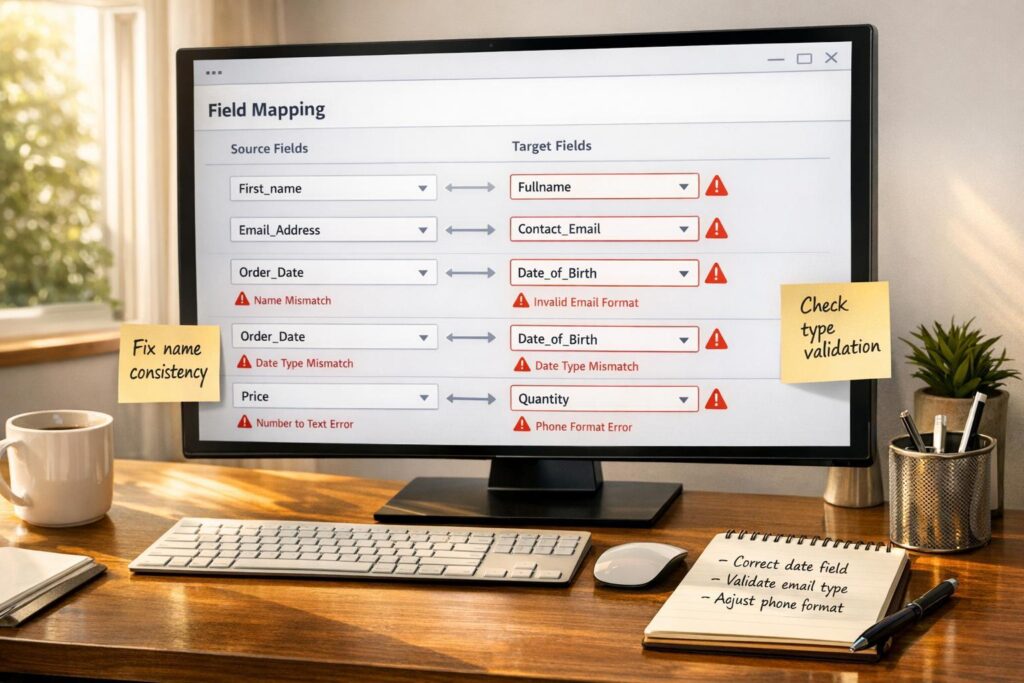
The columnLineage facet maps output fields to their input fields. Start with high-risk measures such as net revenue, customer identifiers, entitlement status, and regulated attributes. Snowflake processes column mappings on a best-effort basis: a mapping that cannot be resolved may be skipped even while object-level lineage is accepted. Validate representative columns manually rather than treating event acceptance as column-lineage completeness.
Step 5. Inspect the graph and test queries
Open the relevant object’s lineage in Snowsight and confirm expected external nodes. Use GET_LINEAGE or the documented REST retrieval endpoint where suitable. The REST retrieval endpoint returns immediate edges from the anchor; following a longer external chain requires successive requests. A production impact-analysis service should handle traversal, deduplication, missing nodes, cycles, and permissions deliberately.
Step 6. Establish a maintenance process
Version the event producer’s configuration, document namespace conventions, monitor rejected events, and reconcile known critical dependencies. When an upstream system is renamed or a Snowflake object is dropped and recreated, test whether the lineage still connects. Treat lineage metadata as an operational asset with an owner, not as a one-time diagram.
Design the pilot around a real executive question
A useful pilot is not ‘connect all the tools.’ It is ‘when the source of qualified pipeline changes, can we identify the production reports and owners affected within a defined response window?’ Select one high-value data product with a small, representative chain across at least one external tool, Snowflake transformations, and a named BI consumer.
Document the expected graph before instrumentation. For each expected edge, record source, destination, emitting component, verification evidence, and owner. Build a coverage matrix: expected edges; observed edges; verified edges; uninstrumented edges; stale edges; and ambiguous identities. The difference between expected and observed coverage is as important as the number of nodes displayed.
Then run four controlled tests. Rename or change a nonproduction source field and check the impact path. Simulate an ingestion failure and see whether the incident playbook identifies the affected report. Add a new transformation and confirm that the edge appears. Recreate a test object and check whether lineage continuity survives. None of these tests should be performed on production data without an approved change plan.
What external lineage will not solve
It will not automatically discover every SaaS and BI dependency
OpenLineage is a standard for reporting metadata, not a universal crawler. A SaaS export, spreadsheet handoff, reverse ETL workflow, or report may remain invisible if no system emits or imports its relationships. Maintain a declared coverage boundary and use complementary cataloging or manual mappings where justified.
It will not replace quality controls
A correct edge can connect two incorrect datasets. Reconcile source counts, financial totals, key uniqueness, expected null rates, and refresh timestamps separately. For dashboards, verify that semantic definitions and report filters match approved business logic. Actiknow’s BI dashboard development page describes the downstream reporting work that still requires design, testing, and governance.
It will not provide unlimited history or graph capacity
Snowflake documents a one-year retention period for external lineage events, a limit of 15,000 edges produced by one event, and a maximum of 20,000 external lineage edges per account. A single event with many inputs and outputs can multiply into a large number of edges. These are material design constraints for enterprise estates: prioritize meaningful datasets, avoid indiscriminate column explosion, and establish cleanup and capacity monitoring. Verify current limits before scaling.
It will not guarantee continuity through object replacement
Dropping and recreating Snowflake objects can break external lineage edges depending on edge direction and object identity. A successful deployment may therefore change the graph even when the business-facing name is unchanged. Include lineage regression checks in release processes for important marts.
It is not a security policy
Lineage visibility and data access are different concerns. The privilege to ingest metadata does not authorize unrestricted reads of underlying tables, and metadata itself can reveal sensitive system names and dependencies. Restrict who can publish, view, or delete lineage, and audit privileged changes.
Governance model: who owns the graph?
Business data owner: approves metric definitions, criticality, and the consequences of a broken data product. Data engineering owner: manages event emitters, dataset identifiers, pipeline changes, and graph completeness. Platform or security owner: controls Snowflake edition, service identities, account privileges, retention, and access reviews. BI owner: maintains report and semantic-model dependencies that are not automatically captured. Incident lead: uses the graph alongside monitoring evidence to determine impact and communications.
For each critical data product, publish one accountable business owner and one technical owner. Avoid the common anti-pattern in which a governance team owns the lineage tool but no delivery team owns the accuracy of its edges.

How to measure success without vanity metrics
Measure critical-path coverage: verified expected dependency edges divided by all expected edges for the selected data products. Report unknown edges separately; do not quietly remove them from the denominator.
Measure change-analysis completeness: for sampled source changes, the proportion of known affected downstream assets and owners identified before deployment. Review false positives and false negatives, not just raw graph size.
Measure incident usefulness: time to identify the likely upstream fault and affected business consumers, with a record of whether lineage actually helped. Do not claim improvement without a baseline.
Measure metadata health: percentage of expected COMPLETE events received, rejected-event count, unresolved dataset identifiers, stale edges, and coverage after deployments. Add the cost and operational burden of emitting and maintaining the metadata.
Finally, measure governance adoption: proportion of critical reports with a documented owner, approved definition, and tested upstream dependency chain. A technically rich graph with no business ownership is a discovery tool, not a governed reporting system.
A practical 30-day rollout
Week 1: select and map
Choose one executive data product, define its trusted business metric, inventory source systems and consumers, and map expected dependencies. Confirm Snowflake edition, permissions, producer compatibility, and which links are currently invisible. Agree on two or three acceptance questions that the graph must answer.
Week 2: instrument and normalize
Configure one OpenLineage-capable producer, use a dedicated service identity, establish namespace rules, and send representative COMPLETE events. Inspect the graph in Snowsight. Resolve duplicate nodes and test a small number of critical column mappings.
Week 3: validate business impact
Compare the graph with transformation manifests, orchestration definitions, and the BI team’s dependency list. Run controlled source-change and failure exercises. Document missing coverage and decide whether to add another emitter, import catalog metadata, or maintain a manual dependency record.
Week 4: operationalize
Publish a coverage scorecard, assign owners, create event-ingestion monitoring, and add a lineage regression check to the deployment checklist. Establish a quarterly review for stale or missing edges and a process to retire obsolete lineage. Expand to the next data product only when the pilot answers its acceptance questions reliably.
Executive acceptance checklist
Before treating external lineage as production-ready, ask:
- Can we trace the selected metric to its authoritative source?
- Can we identify its direct and indirect consumers?
- Are external objects clearly distinguished from Snowflake objects?
- Are all production identifiers unambiguous?
- Can an authorized responder retrieve the required edges?
- Have we tested missing events, object recreation, and incomplete column mappings?
- Does the incident runbook identify the right owners?
- Are retention and edge limits monitored?
- Is the graph’s coverage boundary visible to users?
A ‘no’ answer is not necessarily a reason to reject the feature. It is a reason to record the gap and avoid using the graph as the sole evidence for a high-stakes decision.
Frequently asked questions
Is Snowflake external lineage generally available?
Yes. Snowflake announced general availability on September 3, 2026. Confirm edition and current account availability against the official release notes.
Does it require a separate enterprise catalog?
Not for the supported Snowflake lineage graph itself. A broader catalog may still be useful for ownership, definitions, stewardship workflows, and assets that do not emit lineage events.
What is the difference between native and external lineage?
Native lineage captures supported relationships inside Snowflake. External lineage incorporates metadata emitted by other tools about datasets and flows outside that boundary.
Can it track lineage between two non-Snowflake systems?
Yes. Snowflake documents external-to-external edges, provided compatible COMPLETE events are sent and accepted.
Does external lineage show individual columns?
It can, using the columnLineage facet. Column mappings are best-effort and must be validated for critical fields.
Will it automatically show Power BI or Tableau dashboards?
Not automatically. You need a compatible emitter, metadata integration, or a separately governed mapping for those consumer dependencies.
Can Airflow or dbt provide the metadata?
Snowflake documents OpenLineage integrations for both. Validate tool versions, transport configuration, event compatibility, and actual graph coverage in your environment.
Can we use lineage to prove that a KPI is correct?
No. Lineage explains reported dependencies. Correctness also requires approved definitions, data-quality checks, reconciliation, and report-level testing.
What happens when a table is recreated?
Some external lineage edges may break. Test continuity as part of the deployment and object-lifecycle process.
What are the key scaling limits?
Snowflake currently documents one-year external-event retention, a 15,000-edge-per-event limit, and a 20,000-external-edge account limit. Check current documentation before designing a large rollout.
Conclusion: trace the decisions, not just the tables
Snowflake external lineage makes a previously fragmented part of the data estate more visible. Its value is not the visual complexity of the graph. It is the ability to answer concrete questions about source changes, incident impact, and the provenance of executive metrics with less manual investigation.
Start with one important data product. Instrument the missing boundary, validate identities and edges, connect the graph to quality and ownership, and be explicit about what remains outside coverage. That is how lineage becomes a practical control rather than a decorative architecture diagram.
If your organization is assessing cross-platform data dependencies or the reliability of executive reporting, discuss your BI architecture with Actiknow. The initial conversation can focus on a specific metric, its source-to-report path, and the gaps that matter most to your team.
Technical references
Snowflake’s September 3, 2026 general-availability announcement documents the feature’s release stage and supported use cases.
The Snowflake external lineage implementation guide covers privileges, payload requirements, supported event types, retrieval, deletion, and current limitations.