
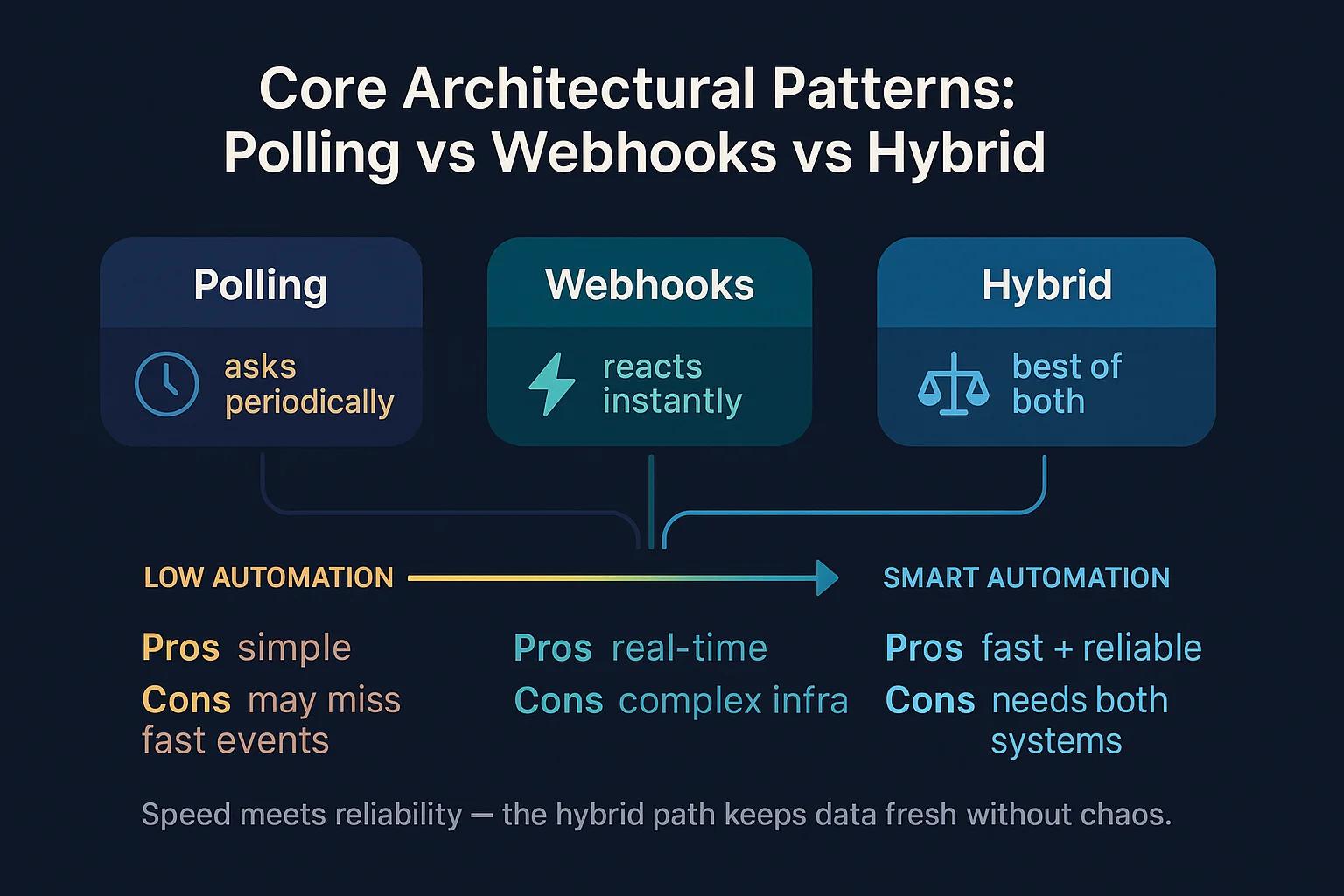
A SaaS integration needs to know when something changed.
There are two common patterns.
Polling asks the source repeatedly:
Anything new?
A webhook lets the source tell you:
Something changed.
Webhooks sound more efficient.
Polling sounds simpler.
Both can be correct.
The choice depends on event frequency, latency, source capability, reliability and how much operational complexity the team can support.
How Polling Works
A polling integration calls the source on a schedule.
Examples:
- Every minute.
- Every 15 minutes.
- Hourly.
- Nightly.
The request typically asks for records updated since a stored checkpoint.
Polling gives the consumer control over when data is retrieved.
It does not require a publicly reachable webhook endpoint.
How Webhooks Work
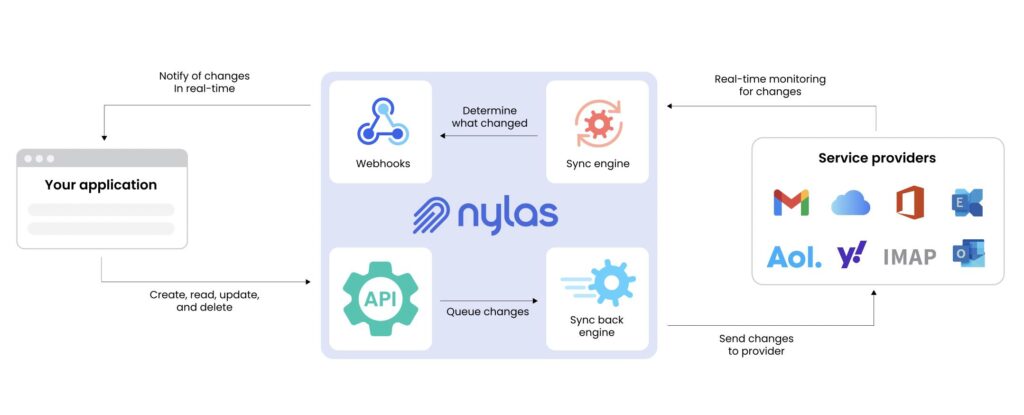
With webhooks, the source sends an HTTP request to your endpoint when an event occurs.
Examples:
- Customer created.
- Invoice paid.
- Order updated.
- Subscription cancelled.
The integration receives the event and processes it.
This can reduce latency and unnecessary requests.
Actiknow’s custom solutions work includes API integrations, automation and event-driven workflows. The right trigger model should be selected based on business timing and recovery requirements, not simply developer preference.
Start With the Latency Requirement
Ask how quickly the destination must react.
If the business needs:
1. Seconds
Webhook or streaming patterns may fit.
2. Minutes
Webhook or frequent polling can work.
3. Hours
Polling may be simpler.
4. Daily
Scheduled batch is often enough.
Do not add webhook infrastructure for a workflow where a one-hour delay has no business impact.
Consider Event Frequency
Suppose a source changes twice per day.
Polling every minute generates 1,440 checks to discover two events.
A webhook is more efficient.
Now suppose the source changes continuously at massive scale.
A webhook per event may create high request volume.
Batch polling or streaming may be more efficient.
Event frequency matters.
Rate Limits Can Favor Webhooks
Polling consumes API requests even when nothing changed.
If the SaaS vendor has strict rate limits, frequent polling can waste quota.
Webhooks can reduce that load.
However, webhooks often still require API calls to retrieve full record details.
Calculate the combined request volume.
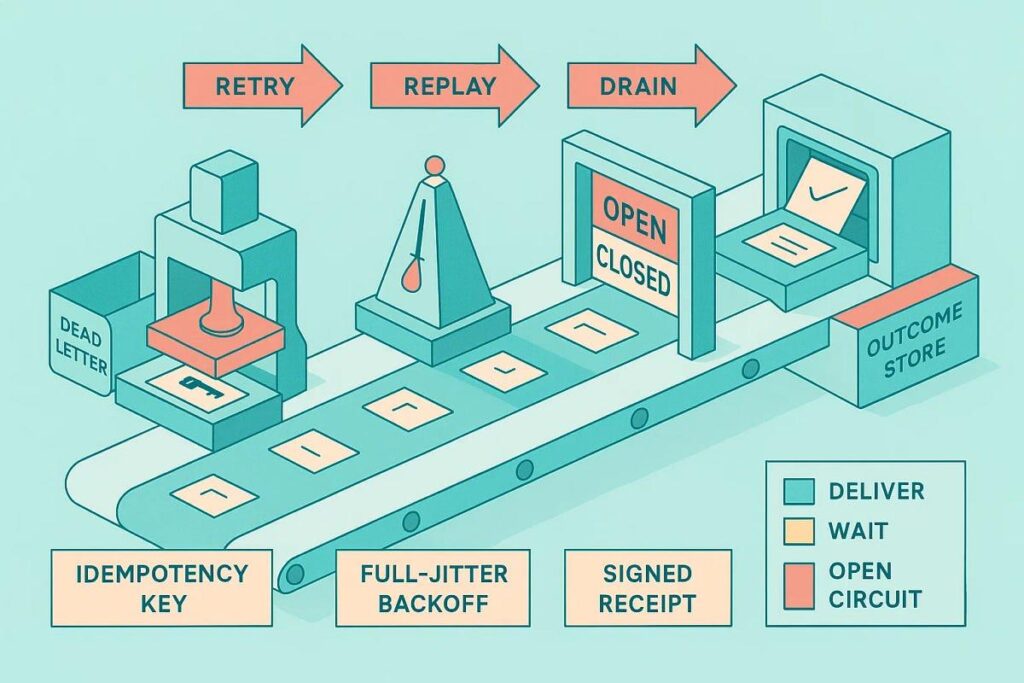
Webhooks Are Usually At-Least-Once in Practice
Design as if the same event can arrive multiple times.
Providers retry when:
- Your endpoint times out.
- Your endpoint returns an error.
- Acknowledgement is lost.
- Network failures occur.
Deduplicate using stable event IDs.
Make downstream processing idempotent.
Polling Can Also Duplicate Data
Polling overlapping windows is often a good reliability strategy.
For example:
Every 15 minutes, query records updated in the last 30 minutes.
This intentionally rereads records.
Upsert by stable key.
The overlap protects against late indexing or boundary issues.
Polling should also be idempotent.
Webhooks Can Arrive Out of Order
An “updated” event may arrive before an earlier “created” event.
Or two updates may be delivered in reverse order.
Use:
- Source version.
- Sequence.
- Updated timestamp.
- Current-state API lookup.
Do not assume arrival order equals business order.
Polling Often Retrieves Current State
A polling request usually asks:
What records are currently changed since X?
This can reduce event-order complexity.
You get the current source state rather than every intermediate event.
That is useful when only the latest state matters.
Webhooks Are Better When Every Event Matters
Some workflows need each event.
Examples:
- Payment attempt.
- Audit event.
- Message delivery.
- Inventory movement.
If intermediate events matter, webhook/event feeds can preserve the sequence more naturally than polling a current-state endpoint.
But only if the provider’s event model guarantees the required history.
Missed Webhooks Need Recovery
What happens if your webhook endpoint is unavailable for two hours?
Good providers retry.
Some offer replay.
But the integration should still have a recovery plan.
Options:
- Provider event replay.
- Query API by updated timestamp.
- Periodic reconciliation.
- Manual replay.
- Raw event log.
Never assume webhook delivery is perfect.
Polling Has a Natural Recovery Path
If polling uses a durable checkpoint and safe overlap, recovery can be straightforward.
After downtime:
- Resume from last successful checkpoint.
- Re-read overlap.
- Deduplicate.
This simplicity is one reason polling remains useful.
Webhook Endpoints Need Security
Verify the sender.
Use provider-supported mechanisms such as:
- HMAC/signature.
- Shared secret.
- mTLS.
- Verification token.
- IP restrictions where appropriate.
Do not accept arbitrary internet requests as trusted events.
Polling Needs Credential Security
Polling integrations need API credentials or OAuth tokens.
Manage:
- Encryption.
- Rotation.
- Refresh.
- Scopes.
- Revocation.
- Least privilege.
Both patterns have security requirements; they are simply different.
Webhook Processing Should Be Asynchronous
A webhook endpoint should generally:
- Authenticate.
- Validate.
- Persist.
- Acknowledge quickly.
- Then process asynchronously.
This avoids provider retries caused by long-running business logic.
It also allows queue-based scaling.
Queues Add Architecture
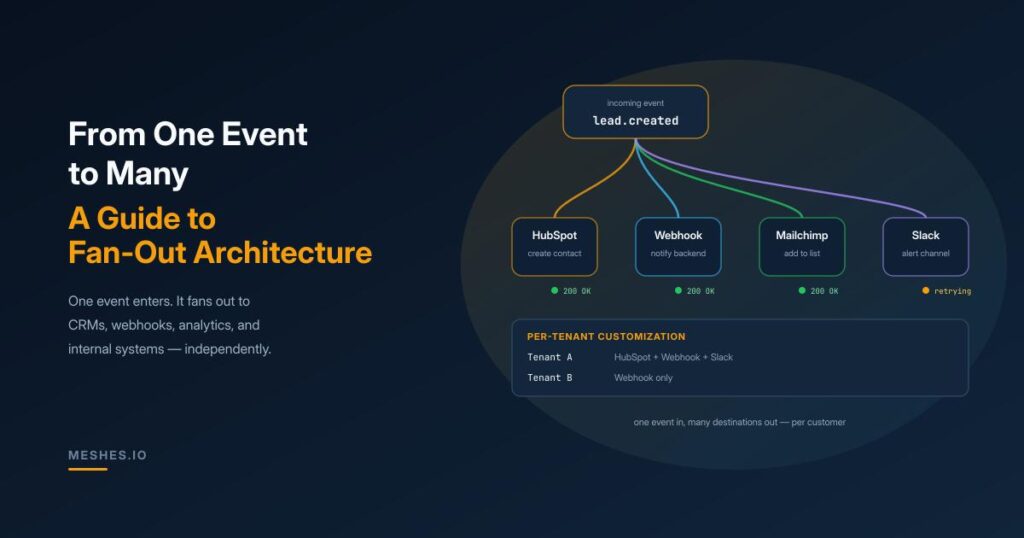
Webhook reliability often introduces:
- Endpoint.
- Queue.
- Worker.
- Dead-letter queue.
- Deduplication store.
- Replay tooling.
- Monitoring.
For a low-value hourly workflow, this may be unnecessary.
Polling can be a simpler operational choice.
Polling Needs Scheduler and Checkpointing
Polling also has architecture:
- Scheduler.
- Credential management.
- Checkpoint.
- Pagination.
- Overlap logic.
- Rate-limit handling.
- Retries.
- Monitoring.
It is not complexity-free.
Compare actual implementation, not caricatures.
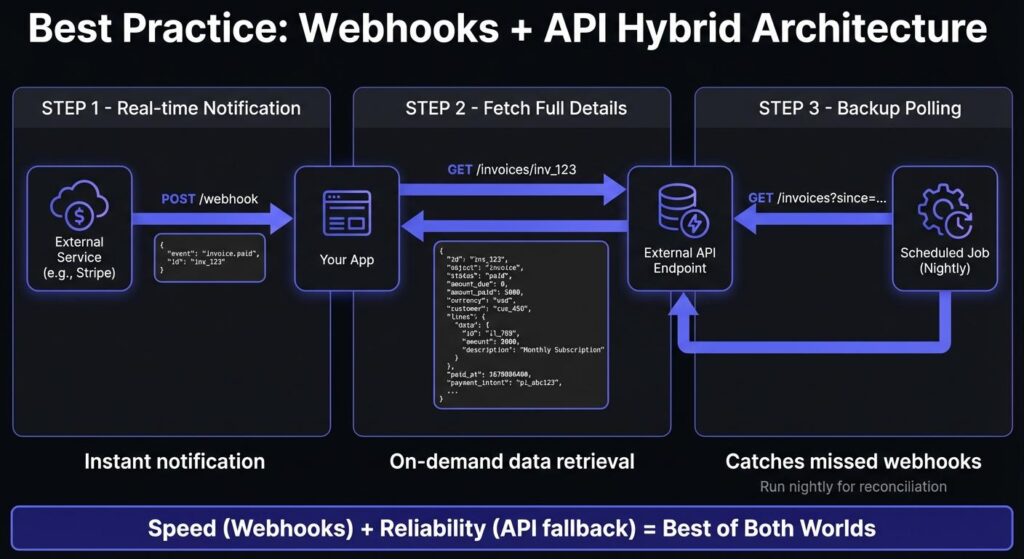
Hybrid Is Often Best
A strong pattern is:
- Webhook for fast notification.
- API fetch for authoritative current state.
- Periodic polling/reconciliation for completeness.
This combines low latency with recovery.
For example:
- Webhook says invoice updated.
- Worker fetches invoice by ID.
- Nightly job checks all invoices updated in the last 48 hours.
- Upsert is idempotent.
If one webhook is missed, reconciliation catches it.
Use Webhooks for Sparse, Time-Sensitive Events
Strong candidates:
- Payment completed.
- Support ticket created.
- Subscription cancelled.
- Approval submitted.
- Order shipped.
Events are meaningful and the business wants prompt reaction.
Use Polling for Predictable Batch Needs
Strong candidates:
- Nightly reporting.
- Hourly CRM sync.
- Daily accounting export.
- Periodic reference-data refresh.
- Sources without webhooks.
Polling can be easier to observe and replay.
Use Polling When the Webhook Is Incomplete
Some providers send webhooks only for certain objects or changes.
If the business needs complete data, polling may still be required.
Read the event coverage documentation.
Do not assume “webhooks supported” means every relevant field change generates an event.
Use Webhooks When API Quota Is Tight
If frequent polling would consume most available quota, webhooks can preserve requests for actual work.
But remember that fetching full event details may still consume API quota.
Model end-to-end volume.
Polling Interval Is a Business Decision
Do not default to every five minutes.
Choose interval based on:
- Required freshness.
- Rate limits.
- Data volume.
- Source load.
- Cost.
- Operational importance.
A daily finance feed and an order-routing workflow should not share the same polling cadence.
Use Adaptive Polling Carefully
Some systems poll more frequently during active periods and less frequently when idle.
This can reduce requests.
But adaptive logic adds complexity.
Use it only when the savings matter.
Monitor Webhook Health
Track:
- Events received.
- Authentication failures.
- Duplicate rate.
- Processing latency.
- Queue depth.
- Failed events.
- Dead letters.
- Oldest unprocessed event.
- Provider delivery failures where visible.
A webhook endpoint returning 200 is not enough.
Monitor Polling Health
Track:
- Last successful poll.
- Checkpoint.
- Records returned.
- Pagination count.
- API latency.
- 429s.
- Retries.
- Freshness.
- Records processed.
A poll job can succeed while returning zero records incorrectly.
Use volume and freshness controls.
Reconciliation Is the Common Safety Net
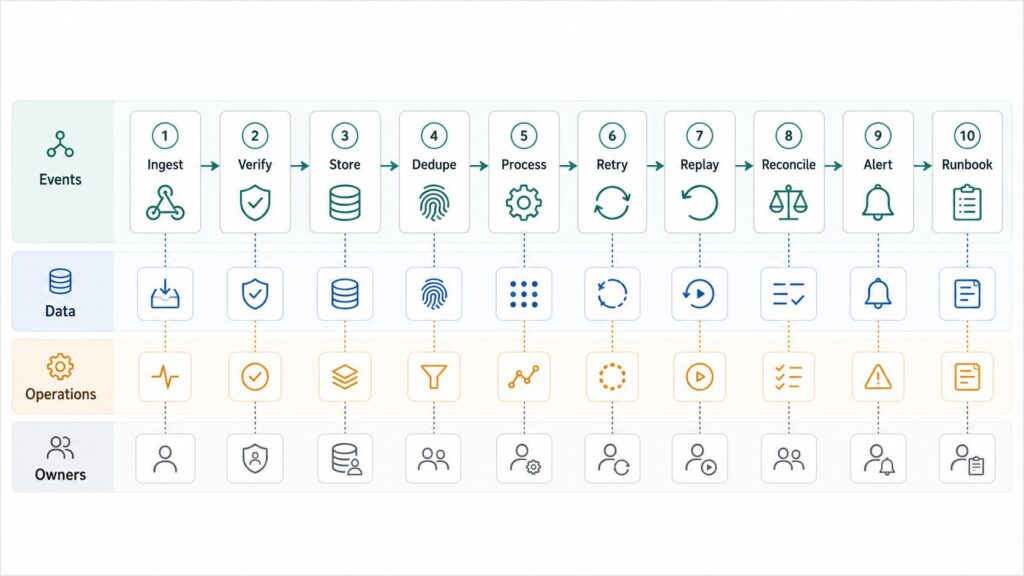
Regardless of trigger model, business-critical integrations should periodically compare source and destination.
Examples:
- Count of invoices updated yesterday.
- Distinct order IDs.
- Payment totals.
- Active subscriptions.
This catches missed events, pagination defects and source anomalies.
Choose Based on Failure Recovery
Ask:
If the integration is down for six hours, how do we recover?
Webhook answer must be clear.
Polling answer must be clear.
The easier recovery model may be more important than the normal happy-path latency.
A Decision Framework
1. Choose webhooks when:
- Low latency matters.
- Events are sparse or meaningful.
- Provider webhook coverage is good.
- Replay or reconciliation exists.
- Your team can operate event infrastructure.
2. Choose polling when:
- Minutes/hours of latency are acceptable.
- The source supports reliable incremental queries.
- Recovery simplicity matters.
- Webhook support is weak.
- Batch processing is efficient.
3. Choose hybrid when:
- Low latency matters and completeness matters.
- The provider offers both webhooks and query APIs.
- A reconciliation path is required.
Production Checklist
1. For webhooks:
- Sender authentication exists.
- Endpoint acknowledges quickly.
- Events are persisted before processing.
- Duplicate events are safe.
- Out-of-order events are handled.
- Replay exists.
- Queue/dead-letter monitoring exists.
- Reconciliation exists.
2. For polling:
- Incremental filter is understood.
- Time boundaries are tested.
- Checkpoint is durable.
- Pagination is tested.
- Overlap is safe.
- Rate limits are respected.
- Zero-volume anomalies are monitored.
- Reconciliation exists.
Frequently Asked Questions
Are webhooks better than polling?
Not always. Webhooks are strong for low-latency event notification. Polling can be simpler and easier to recover for batch-oriented workflows.
Are webhooks guaranteed to arrive once?
Do not design that assumption. Handle duplicate delivery and have a recovery or reconciliation path for missed events.
How often should an API be polled?
Based on business freshness, rate limits, volume and source constraints. There is no universal interval.
Can webhooks and polling be used together?
Yes. This is often the strongest design: webhook for speed and periodic polling for completeness.
Why would I poll if webhooks are available?
Webhook coverage may be incomplete, replay may be limited, or the workflow may not need low latency. Polling can provide a simple recovery mechanism.
Do webhooks eliminate API calls?
Not necessarily. Many webhook events contain only identifiers, requiring the consumer to call the API for current record details.
Which is easier to operate?
It depends on scale and team capabilities. Polling often has simpler infrastructure; webhook systems can be more efficient but need event-processing controls.
Conclusion
Webhook vs polling is not a contest between modern and old architecture.
It is a choice between event notification and scheduled discovery.
Use webhooks when reaction time matters and the provider supports reliable event delivery.
Use polling when batch freshness is sufficient or recovery simplicity is more valuable.
Use both when you need speed and completeness.
Whichever model you choose, design idempotency, replay, monitoring and reconciliation from the beginning.
If you are designing a SaaS integration or automation workflow, Actiknow can help choose and implement the right event, polling and recovery architecture. Discuss your integration requirements with Actiknow.